
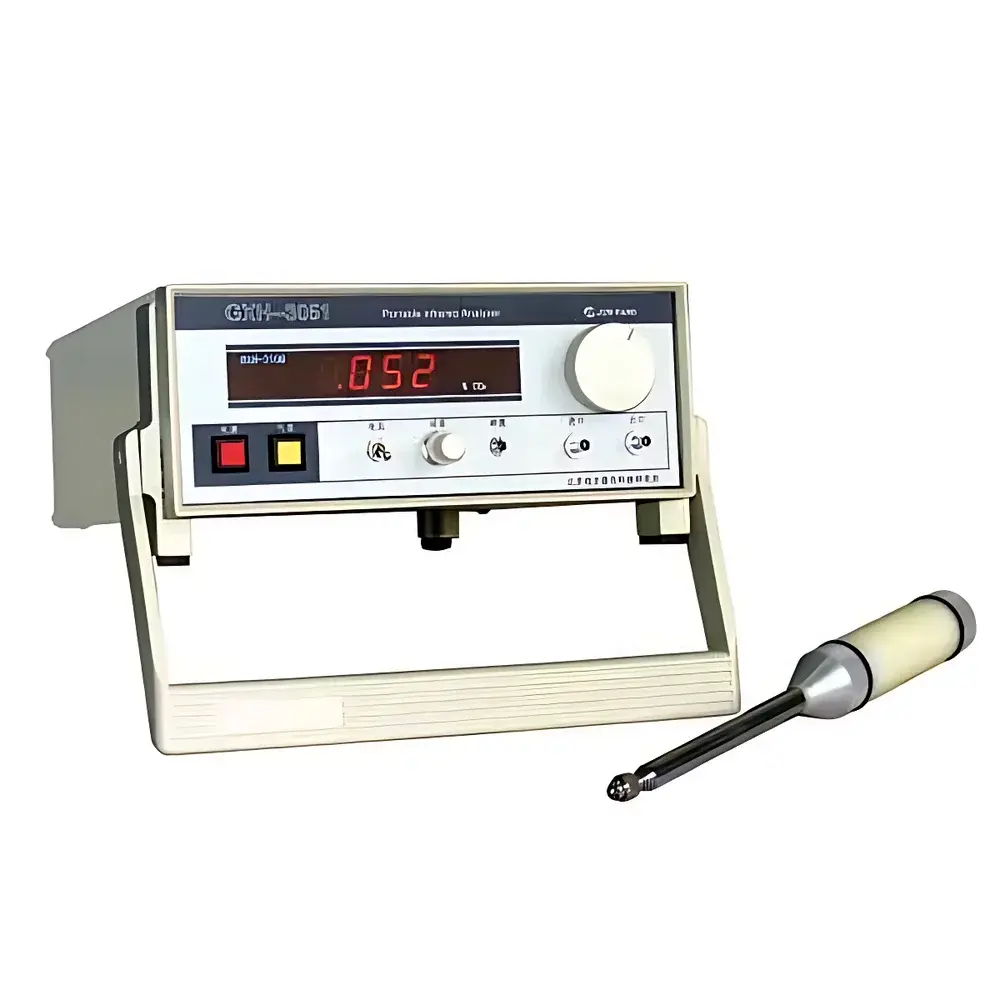
JFQ-3150L Portable Multicomponent Infrared Gas Analyzer
| Brand | Junfang Lihua |
|---|---|
| Origin | Beijing, China |
| Model | JFQ-3150L |
| Principle | Non-Dispersive Infrared (NDIR) Absorption |
| Type | Portable |
| Response Time | ≤30 s |
| Repeatability | ≤±1% FS |
| Zero Drift | ≤±2% FS / 4 h |
| Span Drift | ≤±2% FS / 4 h |
| Linearity | ≤±2% FS |
| Warm-up Time | 15 min |
| Measurable Gases | CO₂, CO, CH₄, SO₂, NO, NO₂, H₂S |
| Measurement Ranges | CO₂ & CO — 0–50 ppm to 0–100% (configurable per application) |
| Compliance | Designed for field-deployable environmental and occupational hygiene monitoring per ISO 12039, ISO 21258, and EPA Method TO-11A guidelines |
Overview
The JFQ-3150L Portable Multicomponent Infrared Gas Analyzer is an engineered field instrument designed for real-time, on-site quantification of multiple trace and major gas species using non-dispersive infrared (NDIR) absorption spectroscopy. Each target gas—CO₂, CO, CH₄, SO₂, NO, NO₂, and H₂S—exhibits unique vibrational absorption bands in the mid-infrared region (typically 2–14 µm), enabling selective detection without chemical interference. The analyzer integrates dual-beam optical path architecture with temperature-stabilized infrared sources and thermopile detectors, minimizing thermal drift and ensuring stable baseline performance during extended portable operation. Unlike electrochemical or catalytic bead sensors, NDIR-based measurement provides inherent immunity to sensor poisoning, humidity cross-sensitivity, and long-term calibration decay—critical attributes for regulatory-grade ambient air quality surveys, indoor air quality (IAQ) audits, and occupational exposure assessments.
Key Features
- Multi-gas capability with simultaneous or sequential measurement of up to seven analytes via dedicated optical filter wheels and wavelength-specific detector channels
- Portable form factor (≤2.8 kg) with integrated rechargeable Li-ion battery supporting ≥6 hours of continuous operation under typical sampling conditions
- Dual-range detection architecture: high-sensitivity mode (0–50 ppm) for trace-level compliance verification and full-scale mode (0–100%) for combustion exhaust or biogas analysis
- Optical path purge system with desiccant cartridge to mitigate water vapor condensation and maintain signal integrity in high-humidity environments (RH ≤95%, non-condensing)
- Onboard data logging with timestamped records stored on microSD card (up to 32 GB), supporting CSV export for post-processing in Excel or statistical software
- Backlit monochrome LCD display with intuitive menu navigation, real-time concentration bar graphs, and alarm status indicators for configurable threshold violations
Sample Compatibility & Compliance
The JFQ-3150L accepts gaseous samples via built-in axial-flow sampling pump (flow rate: 0.3–0.6 L/min) with adjustable suction pressure and optional particulate filter (5 µm) and chemical scrubber modules for H₂O and acidic gas removal. It complies with international method frameworks applicable to portable gas analyzers, including ISO 12039 (CO₂ in flue gas), ISO 21258 (CO in ambient air), and EPA Method TO-11A (aldehydes and organic vapors—adapted for IR-active gases). While not certified for Class I Div 1 hazardous locations, its ingress protection rating meets IP54 for dust and splash resistance. Calibration traceability follows NIST-traceable standards; factory calibration certificates include uncertainty budgets per ISO/IEC 17025 requirements. Instrument design supports GLP-aligned audit trails when used with external PC-based configuration software.
Software & Data Management
The analyzer interfaces with Windows-based configuration and reporting software via USB-C or Bluetooth 5.0. The software enables full parameter configuration—including zero/span calibration sequences, alarm setpoints, averaging intervals (1–60 s), and gas-specific interference compensation coefficients. All calibration events are logged with operator ID, date/time stamp, standard gas lot number, and pre-/post-calibration verification results. Exported datasets include raw detector voltage, temperature-compensated absorbance, and final concentration values in ppm or %vol, all compliant with ASTM D6216-20 metadata conventions. Audit log files support 21 CFR Part 11–compliant electronic signatures when deployed in regulated QA/QC environments.
Applications
- Indoor Air Quality (IAQ) assessment in commercial buildings, healthcare facilities, transportation cabins (aircraft, rail, marine), and public assembly spaces per ASHRAE Standard 62.1
- Field validation of fixed continuous emission monitoring systems (CEMS) in municipal waste incinerators, biomass boilers, and cement kilns
- Epidemiological exposure studies conducted by public health agencies measuring CO and CO₂ as proxies for ventilation adequacy and combustion source proximity
- Biogas composition analysis at anaerobic digesters and landfill gas collection points, with CH₄/CO₂ ratio trending for process optimization
- Emergency response screening for toxic gas leaks (e.g., SO₂ from industrial accidents, H₂S from sewage infrastructure) with rapid deployment and visual/audible alarms
FAQ
What calibration standards are required for routine maintenance?
NIST-traceable certified gas mixtures in aluminum cylinders (e.g., 100 ppm CO in N₂, 5% CO₂ in air) are recommended for span calibration; zero air (hydrocarbon-free, <0.1 ppm total VOC) is required for zero adjustment.
Can the instrument measure gases outside the listed seven components?
No—the optical filter set and detector sensitivity are factory-configured for the specified analytes; hardware modification is not supported.
Is the device suitable for outdoor use in sub-zero temperatures?
Operating temperature range is 0–40 °C; extended cold-weather operation requires external thermal insulation and pre-warming to avoid condensation-induced optical attenuation.
How is measurement uncertainty quantified for regulatory reporting?
Total expanded uncertainty (k=2) is calculated per GUM (JCGM 100:2008) incorporating repeatability, linearity, drift, and calibration standard uncertainty—typical combined uncertainty is ±3.2% FS for CO₂ at 1000 ppm.
Does the analyzer support Modbus RTU or other industrial protocols?
No native industrial protocol support; data output is limited to USB CDC ACM virtual COM port and Bluetooth SPP for host-system integration.
Related Products







