
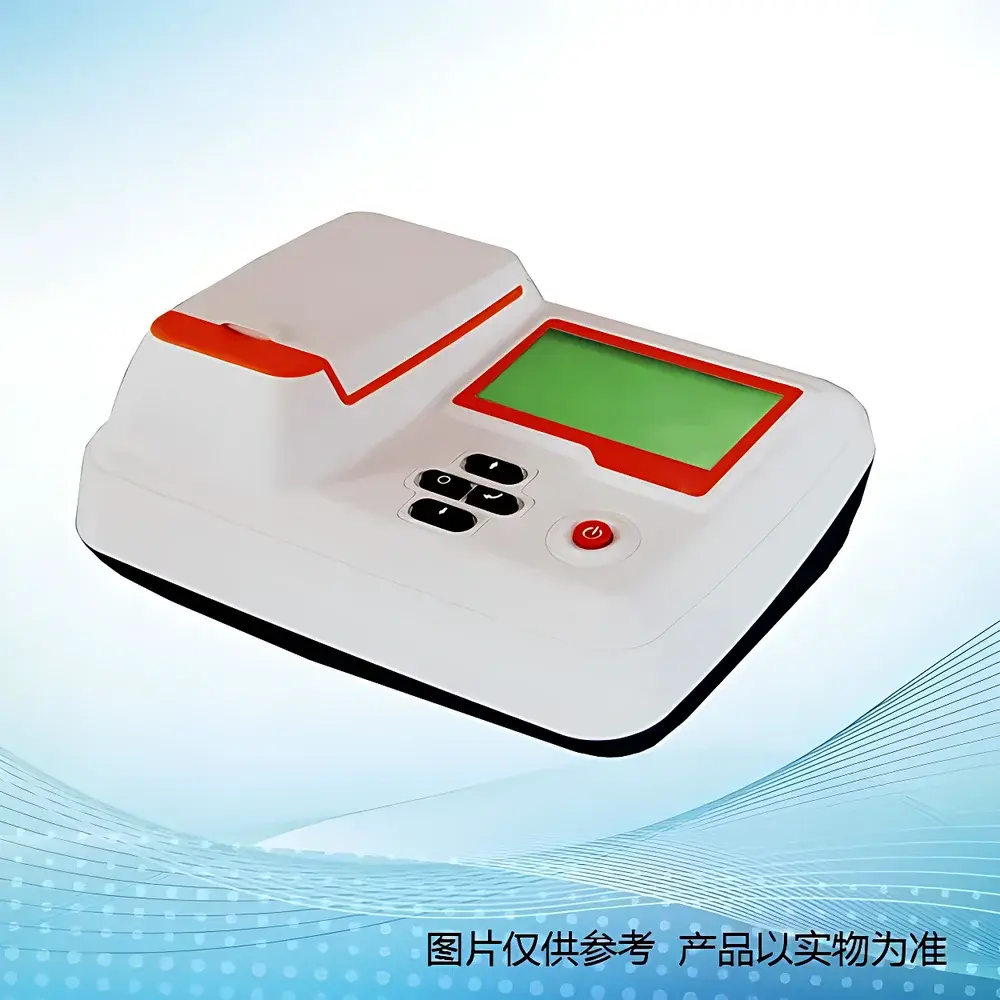
Jiada Xiaotian’e GDYJ-201MA Multi-Parameter Formaldehyde Analyzer
| Brand | Jiada Xiaotian’e |
|---|---|
| Origin | Jilin, China |
| Manufacturer Type | Direct Manufacturer |
| Country of Origin | China |
| Model | GDYJ-201MA |
| Detection Principle | Colorimetric Method (Acetylacetone-Based Chromogenic Reaction) |
| Measurement Range | Textiles: 0.00–500.00 mg/kg |
| Engineered Wood & Furniture | 0.00–5.00 mg/L |
| Adhesives | 0.00–0.50 g/kg |
| Coatings & Paints | 0.00–1.25 g/kg |
| Ambient Air | 0.00–1.00 mg/m³ |
| Detection Limit | Textiles: 5.00 mg/kg |
| Engineered Wood & Furniture | 0.05 mg/L |
| Adhesives | 5.0 × 10⁻³ g/kg |
| Coatings & Paints | 1.25 × 10⁻² g/kg |
| Air | 0.01 mg/m³ |
| Response Time | ≤15 min |
| Accuracy | ±5% of Full Scale |
| Display | Backlit LCD with Chinese UI |
| Control System | Embedded Microcontroller |
| Sample Prep | Integrated Pre-treatment Module + Single-Use Reagent Cartridges |
| Output | Direct Concentration Readout (mg/kg, mg/L, g/kg, or mg/m³) |
Overview
The Jiada Xiaotian’e GDYJ-201MA Multi-Parameter Formaldehyde Analyzer is a field-deployable, microprocessor-controlled quantitative analyzer engineered for rapid, on-site formaldehyde assessment across heterogeneous sample matrices. It operates on the internationally recognized acetylacetone colorimetric principle (Hantzsch reaction), in which formaldehyde reacts with acetylacetone and ammonium acetate under controlled heating to form a stable yellow chromophore measurable at 412 nm. This method is standardized in multiple national protocols—including GB/T 2912.1–2009 (textiles), GB 18580–2017 (engineered wood), GB/T 23993–2009 (adhesives), and GB/T 18204.2–2014 (indoor air)—ensuring regulatory alignment for compliance-driven environments such as QA/QC labs, third-party inspection agencies, and environmental health & safety (EHS) teams conducting indoor air quality (IAQ) audits.
Key Features
- Multi-matrix quantification capability—simultaneously calibrated for textiles, engineered wood panels, adhesives, architectural coatings, and ambient air—eliminating need for instrument switching or method revalidation.
- Dedicated pre-treatment module integrated into the instrument chassis, enabling standardized extraction (e.g., aqueous leaching per GB/T 2912.1, desorption from air sampling cartridges per GB/T 18204.2) without external glassware or timing dependency.
- Single-use, factory-preloaded reagent cartridges minimize cross-contamination risk, reduce analyst training burden, and ensure batch-to-batch consistency—critical for GLP-aligned workflows.
- Backlit monochrome LCD with native Chinese interface supports intuitive menu navigation, real-time calibration verification, and direct concentration readout in matrix-specific units (mg/kg, mg/L, g/kg, mg/m³).
- Embedded microcontroller enables automatic zero-point correction, temperature-compensated photometric measurement, and linear regression-based quantification using pre-stored calibration curves traceable to NIM (National Institute of Metrology, China) reference standards.
- Compact, battery-operated design (optional AC adapter) facilitates deployment in confined spaces (e.g., behind wall cavities, inside HVAC ducts, or on construction sites) where fixed laboratory instrumentation is impractical.
Sample Compatibility & Compliance
The GDYJ-201MA accommodates solid, liquid, and gaseous samples through standardized, matrix-specific preparation protocols. For textiles, it supports extraction via boiling water immersion; for engineered wood and particleboard, it implements perforator or desiccator methods per GB 18580; for adhesives and coatings, it employs solvent dilution followed by derivatization; for air, it interfaces with standard 10-L impinger or passive diffusion samplers. All operational procedures comply with Chinese National Standards (GB series) governing formaldehyde release limits in consumer products and indoor environments. While not certified to ISO/IEC 17025 for accredited testing, its methodology is fully compatible with internal audit requirements under ISO 14001 (Environmental Management Systems) and OHSAS 18001 (Occupational Health & Safety). Data output meets minimum documentation criteria for GMP-adjacent manufacturing audits where formaldehyde is a critical control point (e.g., pharmaceutical cleanroom validation, medical device sterilization monitoring).
Software & Data Management
The GDYJ-201MA stores up to 500 test records internally—including sample ID, date/time stamp, matrix type, measured concentration, operator code, and pass/fail status relative to configurable threshold limits. Data export is supported via USB interface to CSV files for integration into LIMS or Excel-based trending analysis. Though lacking network connectivity or remote firmware updates, its audit trail functionality satisfies basic data integrity requirements under GLP Annex 11 and FDA 21 CFR Part 11 when used in conjunction with procedural controls (e.g., dual-operator verification, printed report sign-off). Calibration history—including date, standard concentration, and deviation %—is retained and printable, supporting annual metrological review cycles.
Applications
- Pre-delivery screening of laminate flooring, MDF, and plywood for compliance with China’s Class E1/E0 formaldehyde emission thresholds.
- Routine QA checks of textile batches (e.g., curtains, upholstery fabrics) prior to export under REACH Annex XVII restrictions.
- On-site verification of adhesive formulations during R&D or production line adjustments.
- Post-renovation IAQ assessments in residential apartments, kindergartens, and elderly care facilities per GB/T 18883–2002.
- Field validation of activated carbon filter efficiency in HVAC systems by comparing upstream/downstream air concentrations.
- Regulatory inspections by provincial market supervision bureaus verifying labeling accuracy of “low-formaldehyde” building materials.
FAQ
Is the GDYJ-201MA suitable for regulatory reporting to Chinese authorities?
Yes—it implements GB-standardized methods and delivers results directly traceable to national reference materials; however, formal accreditation requires independent lab validation per CNAS-CL01.
Can the instrument be recalibrated using non-original reagents?
No—calibration curves are optimized for proprietary reagent lot-specific absorbance profiles; third-party reagents invalidate measurement uncertainty budgets.
What is the shelf life of the single-use reagent cartridges?
18 months from manufacture date when stored at 2–8 °C in sealed aluminum pouches; exposure to humidity >60% RH degrades chromogen stability.
Does the device support external gas sampling pumps?
It accepts standard 10-L impinger solutions collected via any certified low-flow pump (e.g., SKC 224-PCXR8); no built-in pump is included.
How frequently must the optical path be cleaned?
Every 50 measurements or after high-particulate samples; cleaning protocol uses lint-free swabs and isopropyl alcohol—no disassembly required.
Related Products







