
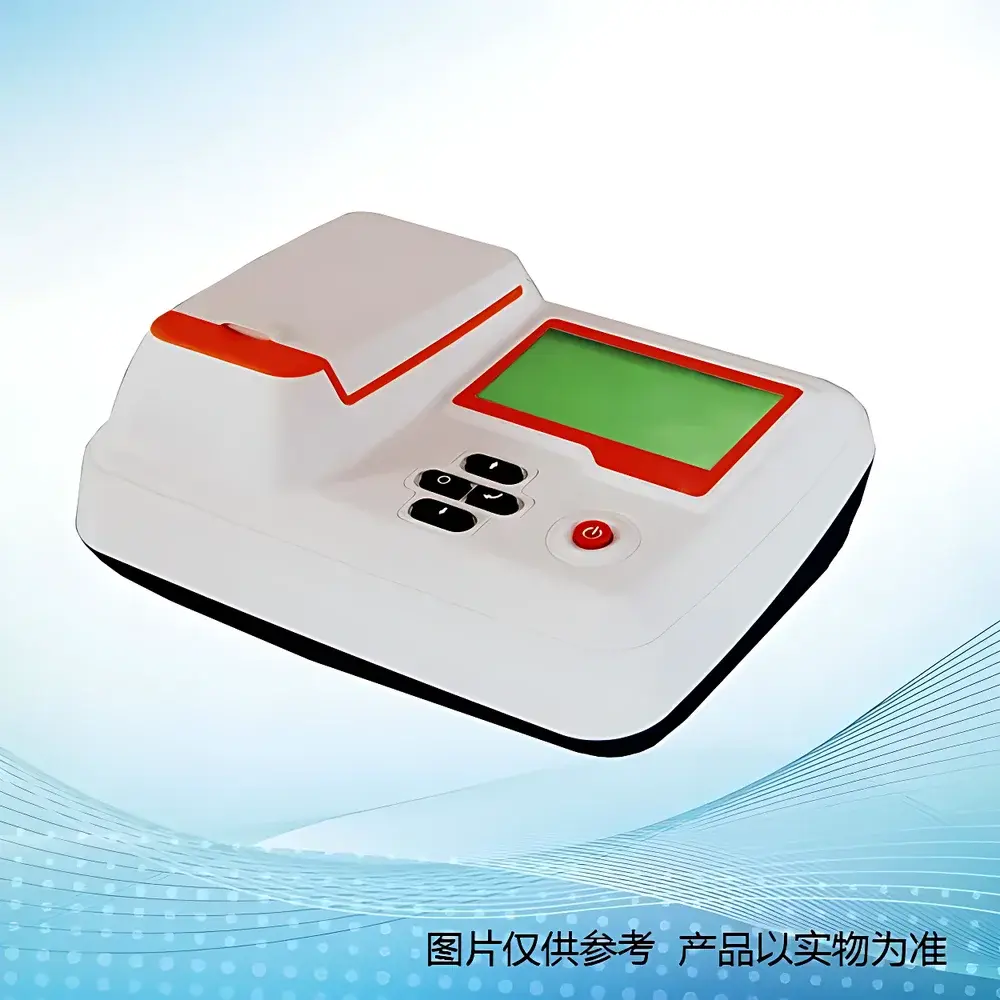
Jiada Xiaotian’e GDYJ-201MC Formaldehyde Analyzer for Fire Door Materials
| Brand | Jiada Xiaotian'e |
|---|---|
| Origin | Jilin, China |
| Manufacturer Type | Direct Manufacturer |
| Origin Category | Domestic (China) |
| Model | GDYJ-201MC |
| Principle | Colorimetric Method |
| Measurement Ranges | Adhesives: 0.00–1.25 g/kg |
| Furniture & Engineered Wood | 0.0–5.0 mg/L (Desiccator Method) |
| Detection Limits | Adhesives: 0.01 g/kg |
| Furniture & Engineered Wood | 0.1 mg/L (Desiccator), 0.1 mg/100g (Perforator), 0.05 mg/m³ (Climate Chamber) |
| Accuracy | ±5% |
| Light Source | High-Brightness LED |
| Wavelength | 412 nm |
| Power Supply | AC 220 V ±22 V, 50 Hz ±1 Hz |
| Rechargeable Battery | 7.4 V, 900 mAh |
| Dimensions | 310 × 225 × 125 mm |
| Weight | 1.7 kg |
Overview
The Jiada Xiaotian’e GDYJ-201MC Formaldehyde Analyzer is a portable, field-deployable colorimetric instrument engineered for rapid, on-site quantification of formaldehyde emissions from fire-rated door materials—including core adhesives, engineered wood substrates, and surface laminates. It operates on the principle of chromogenic reaction between formaldehyde and acetylacetone under acidic conditions, generating a stable yellow-colored complex measurable at 412 nm via high-precision LED-based photometry. Designed specifically to support compliance verification with GB 18580–2017 (Formaldehyde Emission Limits in Wood-Based Panels), GB 12955–2008 (Fire Doors), and related Chinese construction material safety standards, the GDYJ-201MC delivers trace-level detection without requiring laboratory-grade infrastructure. Its compact architecture enables routine screening in production lines, third-party inspection labs, and post-installation site audits—bridging the gap between regulatory sampling protocols and real-time decision-making.
Key Features
- Optimized optical path with high-stability 412 nm LED light source ensures consistent photometric response across environmental temperature fluctuations (10–35 °C operational range)
- Dual-power operation: mains-powered mode for continuous benchtop use; integrated 7.4 V / 900 mAh rechargeable lithium-ion battery supports ≥6 hours of uninterrupted field measurements
- Pre-calibrated assay kits compatible with three standardized Chinese test methods: desiccator (GB/T 17657–2013), perforator extraction (GB/T 17657–2013 Annex D), and climate chamber (GB/T 17657–2013 Annex B)
- Ergonomic handheld design (310 × 225 × 125 mm; 1.7 kg) with anti-slip rubberized casing and IP54-rated enclosure for dust and splash resistance
- On-device calibration verification using certified reference standards traceable to NIM (National Institute of Metrology, China)
- Non-destructive sample interface: accommodates liquid extracts, chamber air condensates, and adhesive paste suspensions without dilution or filtration steps
Sample Compatibility & Compliance
The GDYJ-201MC is validated for direct analysis of formaldehyde-containing matrices derived from fire door manufacturing: phenol-formaldehyde (PF) and melamine-urea-formaldehyde (MUF) adhesives, medium-density fiberboard (MDF), particleboard, plywood cores, and intumescent sealant extracts. It fully aligns with national mandatory testing workflows defined in GB 18580–2017 (E1/E0 classification thresholds), GB 12955–2008 Annex A (fire door material emission limits), and JC/T 2565.1–2020 (fire-resistance test specimen conditioning). While not certified for ISO 12460 or EN 717 series protocols without method adaptation, its measurement uncertainty (±5%) meets GLP-aligned internal quality control requirements for in-house QC labs operating under CNAS accreditation frameworks.
Software & Data Management
The analyzer features embedded firmware with non-volatile memory storing up to 500 test records, each timestamped and tagged with operator ID, sample ID, method type, and raw absorbance values. Data export is supported via USB-C interface to Windows-compatible desktop software (GDYJ-PC Suite v2.1), which generates audit-ready PDF reports compliant with GB/T 27025–2019 documentation requirements. The software enforces electronic signature fields, version-controlled calibration logs, and automatic flagging of out-of-range results—facilitating alignment with basic 21 CFR Part 11 principles for electronic records in regulated environments. No cloud connectivity or remote telemetry is implemented, preserving data sovereignty per Chinese cybersecurity regulations.
Applications
- Quality assurance during fire door assembly: real-time monitoring of adhesive cure efficiency and residual formaldehyde content prior to final pressing
- Batch release testing of MDF/particleboard substrates supplied to fire door OEMs
- Third-party conformity assessment for CCC (China Compulsory Certification) applications under category 0302 (Fire Protection Products)
- Post-installation indoor air quality (IAQ) surveys in public buildings where fire doors constitute >15% of total interior surface area
- Technical due diligence in supplier qualification audits, particularly for export-oriented manufacturers targeting ASEAN or GCC markets with harmonized formaldehyde limits
FAQ
What formaldehyde test methods does the GDYJ-201MC support natively?
It supports three Chinese standard methods: desiccator (GB/T 17657–2013 Section 4.58), perforator extraction (GB/T 17657–2013 Annex D), and climate chamber (GB/T 17657–2013 Annex B). Method selection is configured via device menu.
Is external calibration required before each use?
No. Factory calibration is retained for ≥12 months under normal storage conditions. Users perform daily blank verification using reagent-grade water; full recalibration is recommended every 90 days or after 200 assays.
Can this instrument measure airborne formaldehyde directly?
Not as a standalone gas monitor. It analyzes liquid-phase extracts or condensates collected from climate chambers or impingers—consistent with GB 18204.2–2014 indoor air sampling protocols.
Does the GDYJ-201MC comply with ISO/IEC 17025 requirements?
While the instrument itself is not accredited, its measurement process—including traceable calibration, documented uncertainty budget (k=2), and controlled environmental operating conditions—can be incorporated into an ISO/IEC 17025-compliant testing system when deployed within an accredited laboratory’s scope.
What consumables are required for routine operation?
GDYJ-certified acetylacetone reagent kits (cat. no. GDYJ-RK-FA-01), pH 3.5 buffer tablets, and matched quartz cuvettes (10 mm pathlength). Each kit supports 100 determinations per method.







