
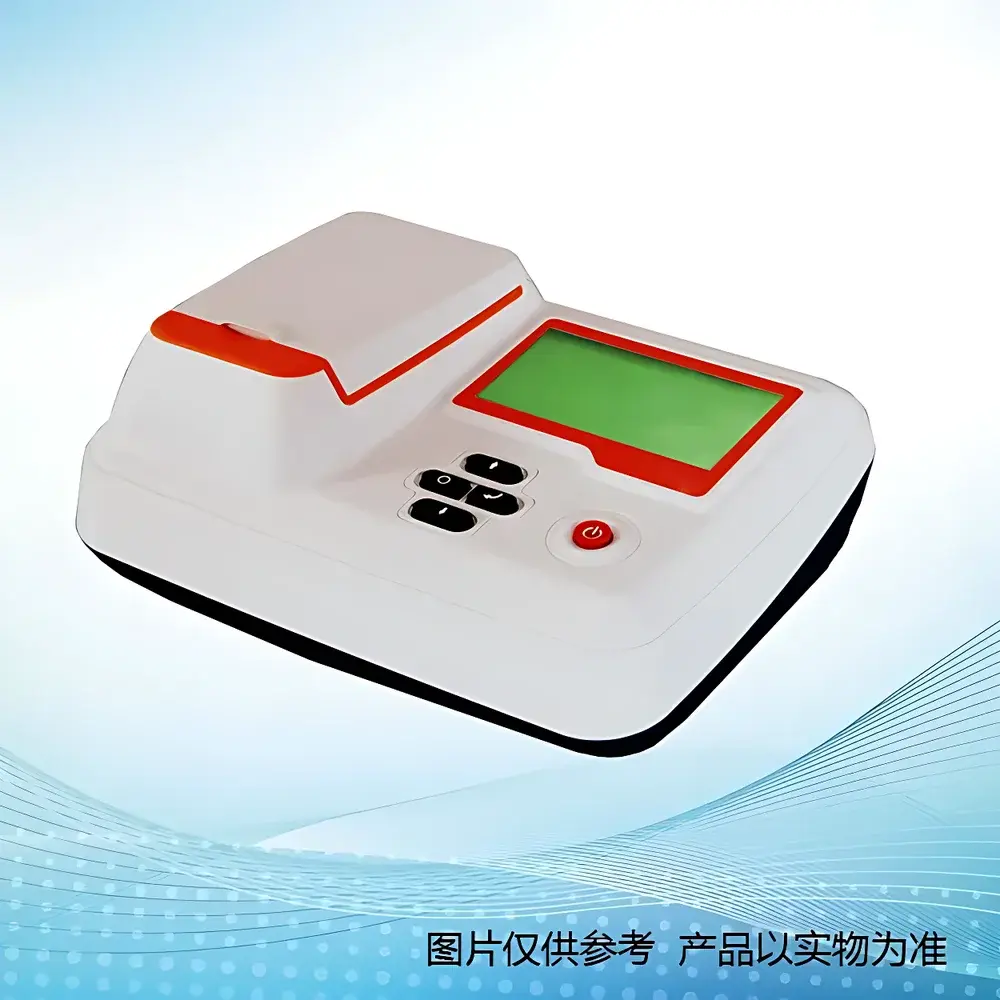
Jiada Xiaotian’e GDYJ-201SY Textile Formaldehyde Analyzer
| Brand | Jiada Xiaotian'e |
|---|---|
| Origin | Jilin, China |
| Manufacturer Type | Direct Manufacturer |
| Country of Origin | China |
| Model | GDYJ-201SY |
| Detection Limit | 5.00 mg/kg |
| Measurement Range | 0.00–500.00 mg/kg |
| Accuracy | ±5% |
| Compliance | GB/T 2912.1–1998, GB 18401–2001 |
| Analysis Time | ≤15 min per sample |
| Display | Backlit LCD with Chinese interface |
| Control System | Embedded microcontroller |
| Data Functions | Measurement logging, statistical processing, configuration, help, and RS232 communication |
| Sample Prep | Dedicated extraction apparatus + single-use reagent kits |
| Quantitative Output | mg/kg (formaldehyde content in fabric) |
Overview
The Jiada Xiaotian’e GDYJ-201SY Textile Formaldehyde Analyzer is a dedicated benchtop instrument engineered for the quantitative determination of free and hydrolyzable formaldehyde in textile materials—primarily fabrics, garments, linings, and nonwovens—according to established Chinese national standards. It operates on the principle of chromogenic spectrophotometric detection following acetylacetone derivatization: formaldehyde reacts with acetylacetone under acidic heating conditions to form a yellow-colored 3,5-diacetyl-1,4-dihydrolutidine (DDL) complex, which is measured at 412 nm. This method is fully aligned with GB/T 2912.1–1998 (equivalent in scope to ISO 14184–1:2011) and supports compliance verification against the formaldehyde limits specified in GB 18401–2001 (National Basic Safety Technical Specifications for Textile Products). Designed for routine quality control laboratories in textile mills, third-party testing facilities, and import/export compliance units, the GDYJ-201SY delivers standardized, reproducible results without requiring HPLC or GC-MS infrastructure.
Key Features
- Standards-compliant methodology: Fully implements GB/T 2912.1–1998 and GB 18401–2001 protocols—including prescribed extraction temperature (40 °C), time (60 min), and solvent volume (100 mL aqueous buffer)
- Rapid turnaround: Complete quantitative analysis—from sample loading to final concentration readout—in ≤15 minutes per test, enabled by optimized thermal reaction kinetics and integrated photometric measurement
- Dedicated hardware ecosystem: Includes proprietary sample extraction unit with precise temperature-controlled water bath and calibrated glassware, plus factory-prepared, lot-traceable single-use reagent kits to eliminate inter-batch variability
- Embedded intelligent control: Microcontroller-based system with real-time status monitoring, automatic zero calibration, and built-in diagnostic routines for optical path integrity and reagent stability
- Human-centered interface: High-contrast monochrome LCD display with full Chinese menu navigation, intuitive soft-key operation, and context-sensitive on-screen help prompts
- Traceable data handling: Supports timestamped result storage (up to 500 records), basic statistical functions (mean, SD, CV%), and bidirectional RS232 communication for external data export or LIMS integration
Sample Compatibility & Compliance
The GDYJ-201SY accommodates a broad spectrum of textile substrates—including cotton, polyester, wool, nylon, blends, and coated fabrics—provided they conform to the dimensional and mass requirements defined in GB/T 2912.1 (e.g., 1.0 g ±0.1 g cut specimen, 20 mm × 20 mm square). It is validated for use with both solid-phase extraction (SPE) and direct aqueous extraction workflows. While designed for Chinese regulatory frameworks, its analytical output is technically comparable to ISO 14184–1:2011 and AATCC Test Method 112 (Sealed Jar); however, formal cross-standard equivalency claims require laboratory-specific method validation per ISO/IEC 17025:2017. The instrument itself does not bear CE, UKCA, or FDA registration; users deploying it for EU or US market compliance must perform additional verification per REACH Annex XVII or CPSIA requirements.
Software & Data Management
The GDYJ-201SY operates without external PC software—its firmware handles all measurement logic, calibration management, and data retention locally. Calibration is performed using certified formaldehyde standard solutions (e.g., 10, 50, 100 mg/kg traceable to NIM reference materials). Each test record stores sample ID, date/time, absorbance value, calculated concentration (mg/kg), and operator code (if entered). Data export via RS232 enables transfer to spreadsheet or LIMS platforms; no proprietary drivers or cloud services are required. Audit trail functionality is limited to chronological log entries—full 21 CFR Part 11 compliance (electronic signatures, change controls, immutable logs) necessitates supplementary documentation practices or integration with validated external systems.
Applications
- Pre-shipment QC screening of apparel, home textiles, and infant wear prior to domestic distribution or export
- Verification of formaldehyde removal efficacy after wet-processing steps (e.g., resin curing, dye fixation, anti-wrinkle finishing)
- Supplier qualification and incoming material inspection in vertically integrated textile supply chains
- Supporting technical documentation for GB 18401 Class A/B/C labeling (e.g., ≤20 mg/kg for婴幼儿 textiles, ≤75 mg/kg for direct-skin contact)
- Method transfer and training in regional textile testing centers where access to advanced chromatographic instrumentation is constrained
FAQ
Does the GDYJ-201SY comply with ISO 14184–1:2011?
It implements an equivalent chemical principle and comparable extraction parameters, but formal ISO 14184–1 compliance requires independent method validation per ISO/IEC 17025.
Can it measure formaldehyde in leather or footwear materials?
No—the instrument and its reagent kits are validated exclusively for woven/knitted fabrics and nonwovens per GB/T 2912.1; leather requires ISO 17226–1 or EN 14232 protocols.
What is the shelf life of the single-use reagent kits?
Unopened kits retain stability for 12 months when stored at 2–8 °C; post-opening, reagents must be used within 2 hours.
Is external calibration verification required?
Yes—users must verify photometric accuracy annually using NIST-traceable neutral density filters and confirm concentration linearity with fresh formaldehyde standards before each testing batch.
Does the system support GLP or GMP documentation?
It provides basic data logging but lacks electronic signature, audit trail depth, or user-role permissions required for full GLP/GMP environments.






