
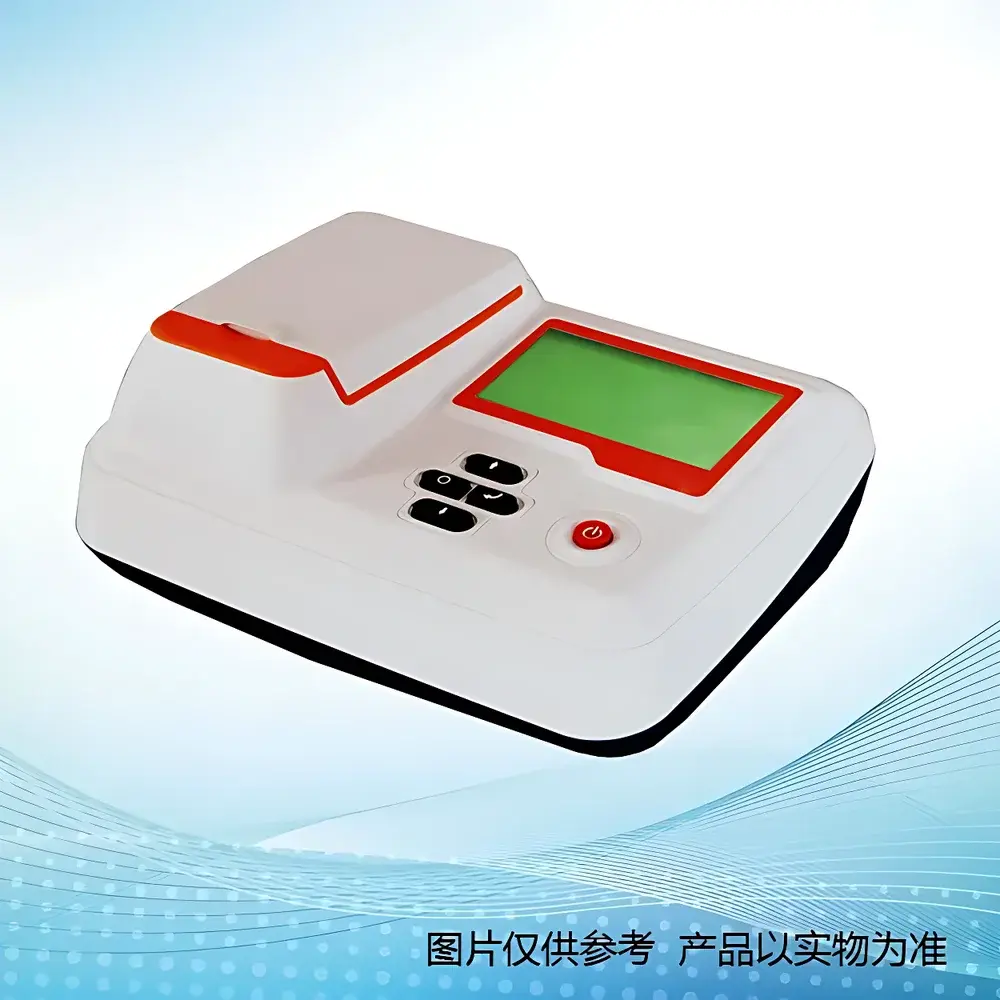
Jiada Xiaotian’e GDYQ-1000S Rapid Amino Acid Nitrogen Analyzer for Soy Sauce
| Brand | Jiada Xiaotian'e |
|---|---|
| Origin | Jilin, China |
| Manufacturer Type | Direct Manufacturer |
| Region of Origin | Domestic (PRC) |
| Model | GDYQ-1000S |
| Function Type | Single-Analyte Dedicated Instrument |
| Sample Specificity | Soy Sauce Only |
| Detection Time | 30 minutes |
| Detection Range | 0.0–2.0 g/100 mL |
| Detection Limit | 0.1 g/100 mL |
| Accuracy | ±2% |
| Display | Backlit LCD with Chinese UI |
| Control System | Embedded MCU with Data Logging, Parameter Configuration, Statistical Processing, and RS232 Communication |
| Sample Prep | Integrated Dedicated Pretreatment Module + Single-Use Reagent Cartridge Kit |
Overview
The Jiada Xiaotian’e GDYQ-1000S Rapid Amino Acid Nitrogen Analyzer is a dedicated benchtop instrument engineered for the quantitative determination of amino acid nitrogen (AAN) in soy sauce—a critical quality parameter directly correlated with fermentation maturity, umami intensity, and overall product authenticity. It implements a standardized colorimetric methodology derived from the modified national standard GB/T 5009.39–2003, which relies on the reaction of amino groups with formaldehyde under controlled pH conditions, followed by titration with standardized sodium hydroxide solution. The system integrates optical density measurement, microprocessor-driven endpoint detection, and automated calculation to deliver traceable, repeatable results within 30 minutes per sample—significantly accelerating routine QC workflows in soy sauce production facilities, third-party food testing laboratories, and regulatory inspection units.
Key Features
- Compliance-driven assay protocol aligned with GB/T 5009.39–2003, ensuring methodological equivalence to reference laboratory procedures
- Dedicated hardware architecture optimized exclusively for soy sauce matrix—minimizing interferences from pigments, organic acids, and residual reducing sugars
- Integrated sample pretreatment module including filtration, dilution, and pH adjustment stages—eliminating manual pipetting errors and operator variability
- Single-use reagent cartridges pre-loaded with calibrated formaldehyde solution, NaOH titrant, and indicator—ensuring batch-to-batch consistency and eliminating reagent stability concerns
- Embedded 32-bit MCU with real-time clock, non-volatile memory (≥1000 result storage), and RS232 serial interface for LIMS integration or external data export
- Backlit monochrome LCD display with intuitive Chinese-language menu navigation, contextual help prompts, and on-screen statistical summary (mean, SD, CV%)
Sample Compatibility & Compliance
The GDYQ-1000S is validated solely for liquid soy sauce samples meeting standard industrial specifications (e.g., light/dark soy sauce, brewed vs. blended types). It is not intended for use with fermented pastes, fish sauces, or other high-salt, high-viscosity condiments without prior method verification. While GB/T 5009.39–2003 remains the primary regulatory anchor in China, the instrument’s measurement principle is technically compatible with ISO 8586:2014 (sensory analysis—general guidelines for selection, training and monitoring of assessors) for method correlation studies, and its data logging architecture supports basic GLP documentation requirements—including user ID entry, date/time stamping, and result archiving. For export-oriented facilities, the system may serve as a rapid screening tool preceding confirmatory HPLC or ion chromatography analysis per AOAC Official Method 982.30 or ISO 13903:2005.
Software & Data Management
The onboard firmware provides local data management without requiring external PC software: users can review historical measurements, apply pass/fail thresholds based on internal specification limits (e.g., ≥0.6 g/100 mL for Grade A light soy sauce), generate batch reports, and export comma-separated values (CSV) via RS232 to spreadsheet applications. Audit trail functionality includes timestamped records of calibration events, reagent lot tracking (via cartridge barcode scan), and operator-initiated result overrides—with all entries immutable once saved. No cloud connectivity or remote access capabilities are implemented, preserving data sovereignty in regulated environments.
Applications
- Routine in-process quality control during soy sauce fermentation and aging stages
- Final product release testing against national labeling requirements (e.g., mandatory AAN declaration on packaging)
- Raw material verification of koji-inoculated wheat/soy substrates prior to brining
- Supplier qualification audits where rapid turnaround is prioritized over full-spec characterization
- Educational use in food science laboratories for teaching classical titrimetric principles and food authenticity assessment
FAQ
What regulatory standards does the GDYQ-1000S comply with?
It implements the methodology specified in GB/T 5009.39–2003, China’s national standard for amino acid nitrogen determination in soy sauce.
Can this instrument analyze other fermented condiments, such as fish sauce or oyster sauce?
No—it is analytically validated only for soy sauce matrices; cross-matrix use requires full method validation per ISO/IEC 17025:2017 Annex B.
Is reagent lot traceability supported?
Yes—each single-use cartridge carries a unique lot number scanned at initialization; the system logs it alongside each measurement.
Does the device meet FDA 21 CFR Part 11 requirements?
It does not provide electronic signature capability or role-based access control; however, its audit-ready data structure satisfies foundational ALCOA+ principles for paper-based or hybrid QC environments.
What maintenance is required beyond routine cleaning?
Annual verification using certified reference materials (CRM) traceable to NIM (National Institute of Metrology, China) is recommended; no field calibration tools are shipped with the unit.






