
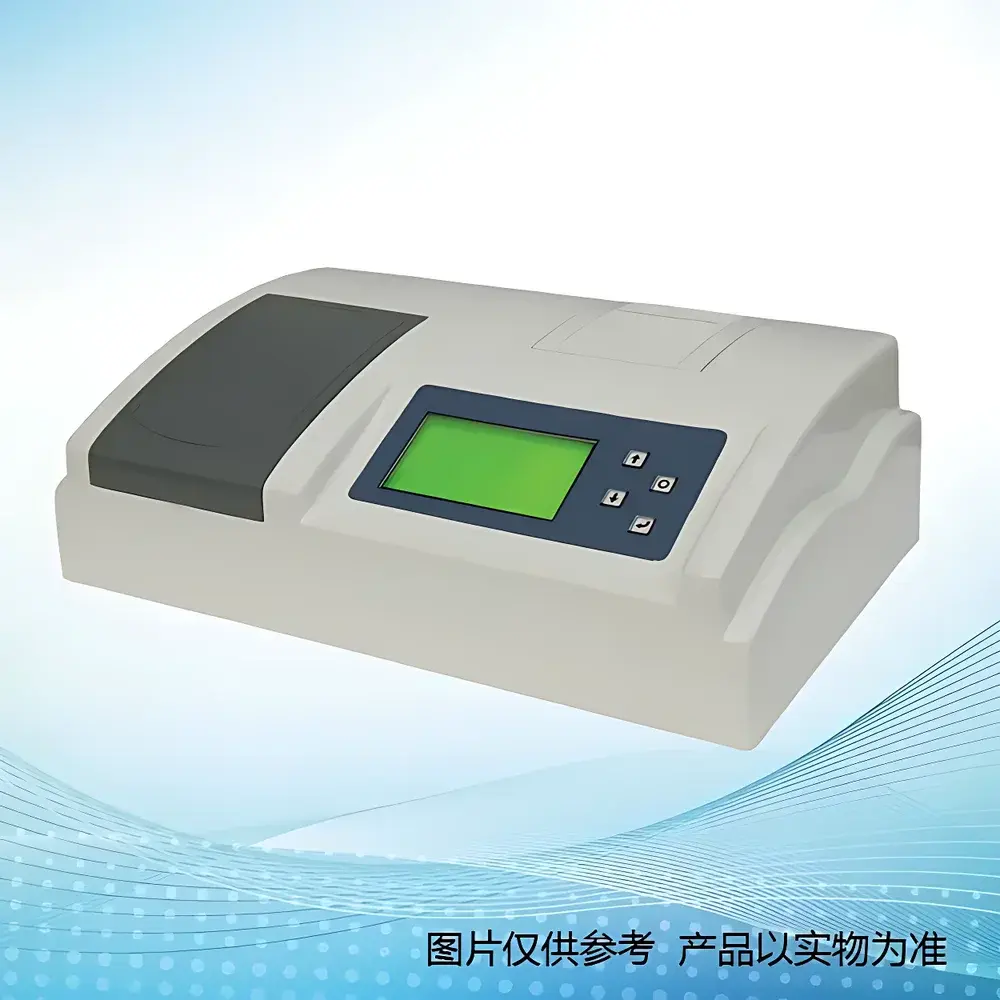
Jiada Xiaotian’e GDYQ-100M Multi-Parameter Food Safety Rapid Analyzer
| Brand | Jiada Xiaotian'e |
|---|---|
| Origin | Jilin, China |
| Manufacturer Type | Direct Manufacturer |
| Regional Classification | Domestic (China) |
| Model | GDYQ-100M (50 Parameters) |
| Price Range | USD 7,000 – 14,000 |
| Function Type | Multi-Analyte (Simultaneous Quantitative Screening) |
| Sample Applicability | Universal for Solid, Semi-Solid & Liquid Food Matrices |
| Optical Wavelength Range | 400 nm – 630 nm |
| Typical Analysis Time per Parameter | 3–10 minutes |
Overview
The Jiada Xiaotian’e GDYQ-100M Multi-Parameter Food Safety Rapid Analyzer is a benchtop spectrophotometric screening platform engineered for on-site or laboratory-based quantitative and semi-quantitative analysis of up to 50 regulated food safety analytes. It operates on the principle of visible-light absorbance spectroscopy (400–630 nm), leveraging standardized colorimetric and enzymatic-colorimetric reaction chemistries aligned with national food safety standards—including GB 5009 series, GB/T 5009.x, and corresponding SN/T methods. Unlike single-analyte immunoassay or chromatographic systems, the GDYQ-100M employs a modular reagent cartridge architecture combined with micro-volume cuvette-based measurement, enabling rapid method switching without hardware modification. Its design prioritizes operational robustness in non-climate-controlled environments (e.g., market inspection stations, cold-chain logistics hubs, and rural food processing facilities), while maintaining analytical reproducibility suitable for preliminary compliance verification under ISO/IEC 17025-aligned workflows.
Key Features
- Modular parameter selection: Users configure up to 50 pre-validated assays from a unified firmware menu—no software reinstallation or calibration recalibration required when switching between analytes such as formaldehyde, sulfite, nitrite, melamine, pesticide residues (organophosphorus class), peroxide value, acid value, iodine content, histamine, and synthetic colorants (e.g., Allura Red AC, Brilliant Blue FCF).
- Dedicated sample preparation module: Integrated centrifuge-free homogenization, filtration, and extraction accessories ensure consistent matrix disruption across heterogeneous samples (e.g., minced meat, crushed grains, viscous honey, turbid beverages), minimizing inter-operator variability.
- Single-chip microcontroller architecture: Embedded real-time OS supports full audit trail logging (time-stamped measurement records, user ID, method version), USB host/device connectivity for data export, and local firmware updates via encrypted SD card.
- Pre-calibrated optical path: Fixed-wavelength LED array with temperature-compensated photodiode detection eliminates need for routine wavelength validation; optical stability verified per ISO 10993-12 guidelines for medical device-grade optical subsystems.
- Disposable assay kits: Each test uses factory-preloaded, lyophilized reagent strips or vials with lot-specific calibration curves embedded in QR-coded packaging—ensuring traceability and eliminating manual reagent preparation errors.
Sample Compatibility & Compliance
The GDYQ-100M accepts raw, processed, and fortified food matrices including dairy products, edible oils, condiments (soy sauce, vinegar), cereals, fruits/vegetables, meat and seafood, honey, beverages, and spices. Sample throughput is optimized for regulatory field screening: typical workflow includes homogenization (≤2 min), extraction/filtration (≤3 min), reaction incubation (1–5 min), and measurement (≤30 sec). All validated methods comply with Chinese National Standards (GB) and align with internationally referenced principles in AOAC Official Methods of Analysis® Chapter 4 (Spectrophotometry) and ISO 22000:2018 Clause 8.4.2 (Verification of Control Measures). While not certified for GLP/GMP production release testing, its performance documentation satisfies pre-market surveillance requirements under China’s SAMR Food Safety Supervision Framework and supports due diligence reporting for HACCP plan verification.
Software & Data Management
The instrument’s embedded software (v3.2+) provides dual-mode operation: standalone mode for field use and networked mode via RS-232 or USB-to-Ethernet bridge. Data files are exported in CSV and XML formats compliant with LIMS import protocols (e.g., Thermo Fisher SampleManager, LabVantage). Audit trails record all critical events—including parameter selection, calibration date, operator login, measurement timestamp, and result flagging (e.g., “Out-of-Range”, “Re-test Recommended”). Software supports statistical summary generation (mean, SD, CV%) across batch runs and exports PDF-formatted reports with embedded digital signatures compatible with FDA 21 CFR Part 11 Annex 11–aligned electronic record retention policies.
Applications
- Routine surveillance at food markets and border inspection posts for adulterants (e.g., borax in rice noodles, Sudan dyes in chili powder, hydrogen peroxide in tofu)
- Quality assurance in small-to-midsize food processors lacking access to HPLC or GC-MS infrastructure
- Educational laboratories demonstrating AOAC-endorsed rapid screening principles
- Third-party certification bodies conducting preliminary audits prior to full-method validation
- Emergency response units assessing contamination events (e.g., nitrate spikes in drinking water sources, formaldehyde leaching from food-contact materials)
FAQ
Does the GDYQ-100M meet international regulatory acceptance criteria for export documentation?
It fulfills technical prerequisites for initial screening under EU Regulation (EC) No 882/2004 and US FDA Import Alert 99-05, but final compliance certification requires method validation per destination-country requirements (e.g., AOAC PTM, SANTE/11813/2017).
Can the instrument be integrated into an existing enterprise LIMS?
Yes—via standard CSV/XML export or optional OPC UA gateway (firmware v3.3+); API documentation available under NDA.
Is reagent shelf life tracked automatically?
Each disposable kit’s QR code contains expiration date and lot-specific calibration coefficients; the system blocks assay initiation if expired.
What maintenance is required beyond routine cleaning?
Annual optical path verification using NIST-traceable neutral density filters is recommended; no user-serviceable optics or moving parts exist.
Are method validation reports available for individual analytes?
Comprehensive validation summaries (precision, LOD/LOQ, recovery, matrix interference) for all 50 parameters are provided in English upon purchase, aligned with ICH Q2(R2) principles.






