
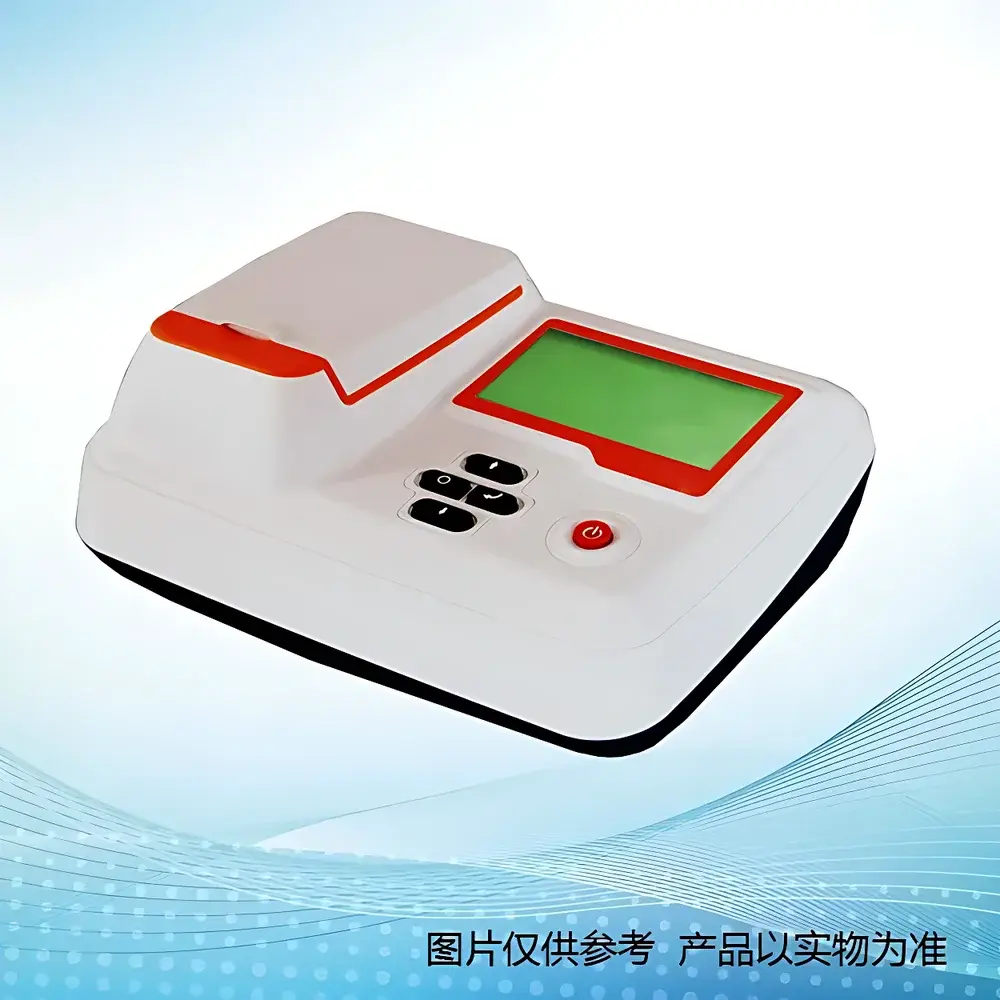
Jiada Xiaotian’e GDYQ-103SC Food Safety Rapid Borax Analyzer
| Brand | Jiada Xiaotian'e |
|---|---|
| Origin | Jilin, China |
| Manufacturer Type | Direct Manufacturer |
| Origin Category | Domestic (China) |
| Model | GDYQ-103SC |
| Function Type | Single-Analyte Detection |
| Sample Versatility | Multi-Matrix (Solid & Liquid) |
| Optical Wavelength | 538 nm |
| Detection Limit | 10.0 mg/kg (solid), 1.00 mg/L (liquid) |
| Quantification Range | 0.0–600.0 mg/kg (solid), 0.0–60.0 mg/L (liquid) |
| Accuracy | ±5% |
| Power Supply | AC 220 V ±22 V, 50 Hz ±1 Hz |
| Dimensions | 310 × 225 × 125 mm |
| Weight | <1.7 kg |
Overview
The Jiada Xiaotian’e GDYQ-103SC Food Safety Rapid Borax Analyzer is a dedicated photometric detection system engineered for field-deployable and laboratory-based quantitative analysis of borax (sodium tetraborate) in food and environmental matrices. It operates on the principle of visible-light colorimetric assay: borax reacts with curcumin under acidic conditions to form a stable pink-red chromophore, the absorbance of which is measured at 538 nm using a high-brightness LED light source and integrated solid-state photodetector. This method is aligned with established rapid screening protocols referenced in GB/T 5009.28–2016 (Chinese National Standard for borax detection in food) and provides trace-level sensitivity suitable for regulatory pre-screening and quality control workflows where turnaround time and operational simplicity are critical.
Key Features
- Optimized optical path design featuring a narrow-band 538 nm LED light source and temperature-stabilized photodiode detector, ensuring consistent photometric performance across ambient operating conditions (10–35 °C).
- Dual-mode power operation: mains-powered for benchtop use or battery-powered (7.4 V, 900 mAh Li-ion) for mobile deployment—enabling >6 hours of continuous measurement without recharging.
- Integrated calibration and blank compensation routines embedded in firmware, minimizing operator-induced variability and supporting GLP-aligned documentation practices.
- Compact ergonomic housing (310 × 225 × 125 mm, <1.7 kg) designed for portability without compromising mechanical stability during sample handling and cuvette insertion.
- Pre-programmed analytical curves for both solid (mg/kg) and liquid (mg/L) sample formats, eliminating manual slope-intercept calculations and reducing interpretation error.
Sample Compatibility & Compliance
The GDYQ-103SC is validated for direct analysis of homogenized meat products (e.g., dumpling fillings, processed sausages), wheat-based doughs and noodles, and aqueous samples including drinking water and processing rinse water. Sample preparation follows standardized acid hydrolysis and curcumin derivatization steps, compatible with ISO/IEC 17025-compliant laboratory SOPs. While not certified for regulatory submission under FDA 21 CFR Part 11, the instrument supports audit-ready data export (CSV format) and maintains full measurement traceability—including date/time stamp, operator ID (if configured), and raw absorbance values—facilitating internal QA/QC review and alignment with HACCP prerequisite programs.
Software & Data Management
The included desktop software enables instrument control, calibration curve management, batch result compilation, and statistical summary generation (mean, SD, CV%). Data files retain metadata such as instrument serial number, test date, reagent lot number (manually entered), and user-defined sample IDs. Export functions support CSV and PDF report generation with embedded calibration history—compatible with LIMS integration via standardized file ingestion protocols. No cloud connectivity or remote access functionality is implemented; all data reside locally unless explicitly exported by the user, preserving data sovereignty per institutional IT policies.
Applications
- Routine surveillance testing in food manufacturing QC labs for borax adulteration in starch-rich products.
- On-site verification at slaughterhouses and noodle production facilities to enforce local food safety ordinances.
- Environmental health department monitoring of borax contamination in municipal water distribution systems.
- Educational use in food science curricula for teaching colorimetric assay fundamentals and method validation principles.
- Third-party contract laboratories performing preliminary screening prior to confirmatory analysis by ICP-MS or HPLC-ICP-MS.
FAQ
What sample preparation steps are required before analysis?
Homogenized solid samples undergo acid digestion followed by centrifugation and filtration; liquid samples require pH adjustment and direct derivatization. Full procedural details are provided in the English-language user manual.
Is reagent stability monitored or tracked by the instrument?
No. Reagent shelf life (≤12 months unopened, ≤30 days after reconstitution) must be managed manually per lot-specific CoA; the software does not log or alert on expiration dates.
Can the GDYQ-103SC be used for other analytes besides borax?
No. The optical filter, reaction chemistry, and calibration algorithms are fixed for borax-specific detection at 538 nm; it is not a multi-analyte platform.
Does the system meet international regulatory requirements for official testing?
It serves as a rapid screening tool compliant with Chinese national standards (GB/T). For legally defensible results in international trade or enforcement contexts, confirmatory testing using ISO 17025-accredited methods is required.
How often must the instrument be recalibrated?
Factory calibration is stable for 12 months under normal use. Users should perform daily blank verification and full calibration every 7 days or after any maintenance event, following the protocol in Section 4.2 of the technical manual.
Related Products






