
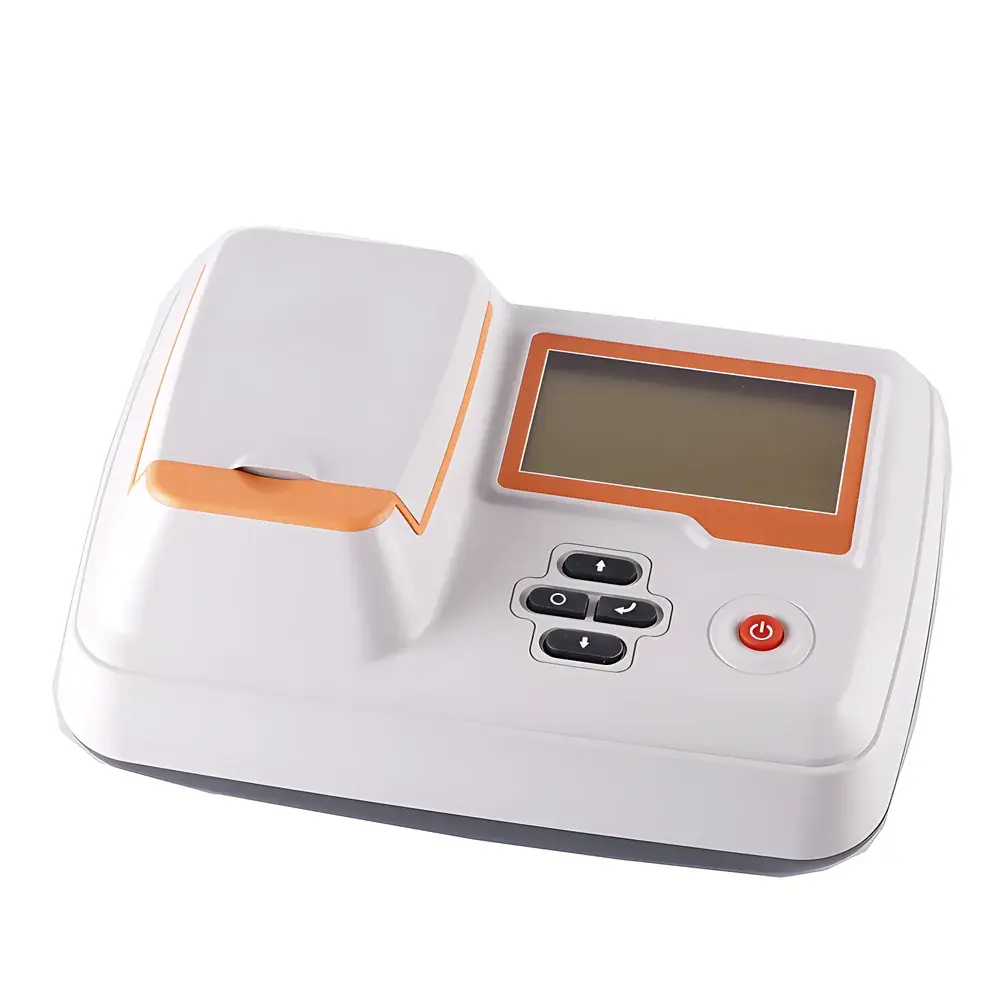
Jiada Xiaotian’e GDYQ-110S2 Methanol & Ethanol Rapid Quantitative Analyzer
| Brand | Jiada Xiaotian'e |
|---|---|
| Origin | Jilin, China |
| Manufacturer Type | Direct Manufacturer |
| Product Origin | Domestic (China) |
| Model | GDYQ-110S2 |
| Function Type | Multi-analyte (Methanol + Ethanol) |
| Sample Format | Single-sample dedicated format |
| Wavelengths | 412 nm, 595 nm |
Overview
The Jiada Xiaotian’e GDYQ-110S2 Methanol & Ethanol Rapid Quantitative Analyzer is a portable, optical absorption-based instrument engineered for on-site quantitative determination of methanol and ethanol concentrations in alcoholic beverages. It operates on the principle of colorimetric analysis, where analyte-specific chemical reactions generate chromophores whose absorbance intensities at defined wavelengths—412 nm (optimized for methanol-derived reaction products) and 595 nm (optimized for ethanol-derived reaction products)—are linearly correlated with concentration under controlled reaction kinetics. Designed for compliance with GB/T 5009.48–2003 (Methods for Determination of Methanol in Alcoholic Beverages) and GB 5009.225–2016 (Determination of Ethanol in Food), the system delivers field-deployable performance without requiring laboratory-grade infrastructure. Its compact architecture integrates an LED light source, precision optical path, photodiode detector, and embedded microprocessor for real-time signal processing—enabling direct quantification from raw absorbance data via pre-calibrated calibration curves stored in firmware.
Key Features
- Simultaneous dual-wavelength detection (412 nm and 595 nm) with independent optical channels to minimize spectral interference between methanol and ethanol assay chemistries.
- Integrated reagent kit compatibility: pre-formulated, lyophilized reagents packaged in sealed vials for stable shelf life (>18 months at 4–25 °C) and minimized operator error during field use.
- On-device calibration management: supports up to five user-defined calibration sets per analyte, each traceable to NIST-traceable reference standards; calibration history stored with timestamp and operator ID.
- Ruggedized housing rated IP54 for dust and splash resistance, suitable for ambient conditions ranging from 10–35 °C and 30–85% RH.
- Battery-powered operation (rechargeable Li-ion, ≥8 hours continuous use) with USB-C interface for firmware updates and data export.
- Auto-zero function with dark-current compensation to correct for LED drift and detector thermal noise across extended measurement sessions.
Sample Compatibility & Compliance
The GDYQ-110S2 accepts clarified liquid samples of distilled spirits, fermented wines, and blended alcoholic beverages with alcohol content ≤65% v/v. Sample preparation requires minimal pretreatment—typically centrifugation or filtration (0.45 µm PVDF membrane) to remove particulates that may scatter incident light. The instrument conforms to national food safety regulatory frameworks in China, including mandatory requirements under the Food Safety Law of the People’s Republic of China (2021 Amendment) and technical specifications outlined in SN/T 2776–2011 (Inspection Procedures for Methanol and Ethanol in Alcoholic Drinks). While not certified to ISO/IEC 17025, its measurement uncertainty profile has been validated against reference methods per CNAS-CL01:2018 guidelines for field-deployable rapid screening tools used in official food safety surveillance programs.
Software & Data Management
Data acquisition and reporting are managed through the embedded GDYQ Control Suite v2.3 firmware. Each measurement record includes sample ID, test date/time, operator code, wavelength channel used, raw absorbance value, calculated concentration (mg/L for methanol; % v/v for ethanol), confidence flag (based on signal-to-noise ratio >15), and calibration set version. Export is supported via CSV over USB or Bluetooth 5.0 to paired Android/iOS devices running the official GDYQ FieldSync mobile application. All exported files include digital signatures compliant with GB/T 33749–2017 (Guidelines for Electronic Records in Food Safety Monitoring), enabling audit-ready documentation for GLP-aligned workflows. No cloud storage is performed by default; data residency remains local unless explicitly configured by the end-user.
Applications
- Routine screening of bulk alcohol shipments at port-of-entry inspection stations to verify compliance with maximum residue limits (MRLs) for methanol (≤0.6 g/L in spirits per GB 2757–2012).
- On-farm distillery QC checks during spirit maturation and blending to prevent accidental over-concentration of fusel oils containing methanol precursors.
- Mobile food safety patrols conducting unannounced market surveillance of informal-sector liquor vendors.
- Training laboratories in vocational colleges delivering hands-on instruction in food adulteration detection protocols aligned with national occupational standards (e.g., Food Inspector Level III certification).
- Supporting emergency response teams during outbreaks linked to illicit alcohol consumption, enabling triage-level quantification within 12 minutes per sample.
FAQ
What is the typical measurement time per sample?
Approximately 10–12 minutes, including reagent addition, incubation (7 min at 37 °C), and optical readout.
Does the instrument require external calibration standards for daily use?
No—factory-installed calibration curves are sufficient for routine operation; however, verification with a mid-range control standard is recommended before each testing session.
Can the GDYQ-110S2 quantify other alcohols such as propanol or butanol?
No—it is specifically optimized for methanol and ethanol using reaction chemistries and wavelength selection defined in Chinese national standards; cross-reactivity with higher alcohols is not characterized or supported.
Is the device suitable for testing non-alcoholic beverages or fruit juices?
Not intended for such matrices; high sugar, acid, or pigment content may interfere with color development and optical path integrity.
How is measurement traceability maintained across different instruments?
Each unit ships with a Certificate of Conformance referencing batch-specific calibration validation data; inter-unit reproducibility (CV ≤4.2% at 100 mg/L methanol, n=15) is verified during final QA prior to shipment.




