
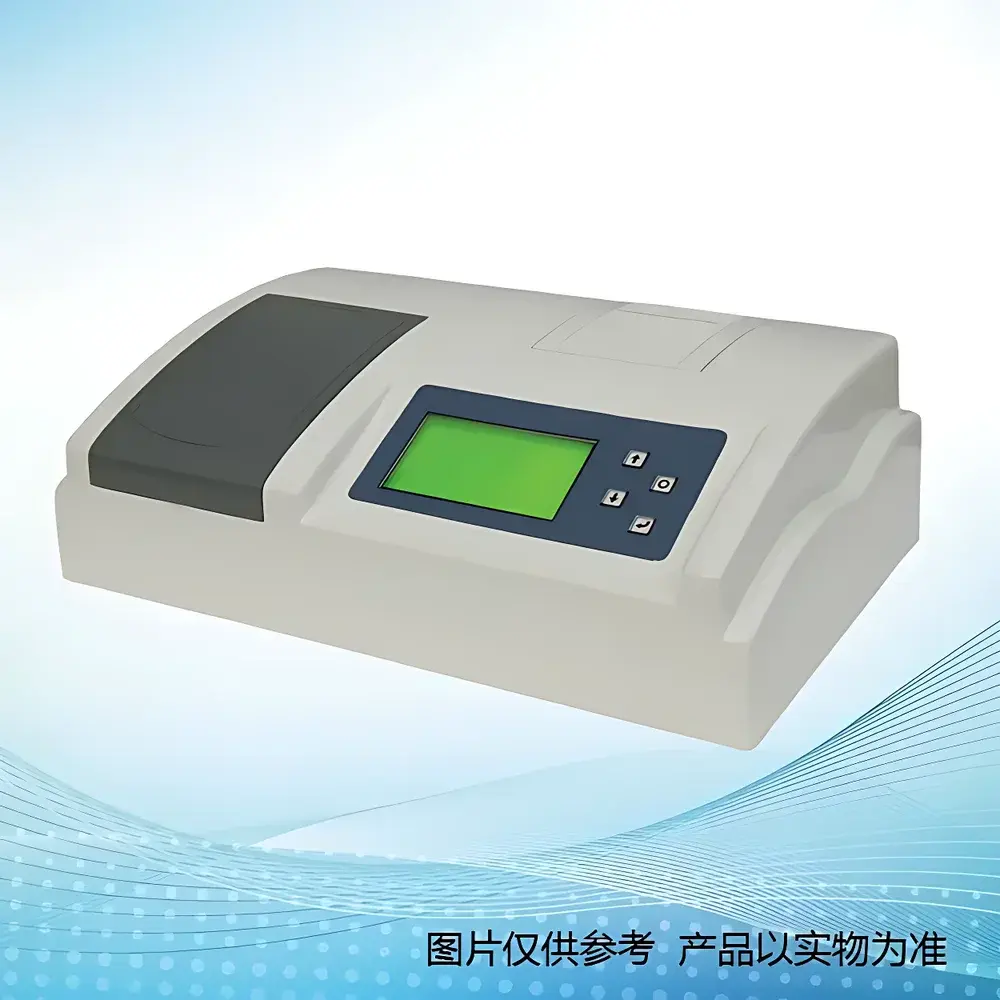
Jiada Xiaotian’e GDYQ-110SE2 Rapid Pathogenic Meat & Spoilage Detection Analyzer
| Brand | Jiada Xiaotian'e |
|---|---|
| Origin | Jilin, China |
| Manufacturer Type | Direct Manufacturer |
| Country of Origin | China |
| Model | GDYQ-110SE2 |
| Function Type | Multi-analyte (POD, TVB-N, pH) |
| Sample Compatibility | Universal for raw meat, poultry, and aquatic products |
| Detection Limits | POD Absorbance ≥0.010 A |
| pH Resolution | 0.1 unit |
| Measurement Ranges | POD: 0.000–2.000 A |
| TVB-N | 0.0–150.0 mg/100g |
| pH | 0.2–14.0 |
| Accuracy | ±10% of full scale (per GB/T 5009.44-2003 validation protocol) |
| Interface | RS-232 & USB 2.0 |
| Data Handling | On-device storage, print output, PC synchronization |
Overview
The Jiada Xiaotian’e GDYQ-110SE2 Rapid Pathogenic Meat & Spoilage Detection Analyzer is a field-deployable, multi-parameter optical analyzer engineered for quantitative assessment of meat quality deterioration and potential pathogenic contamination indicators. It operates on the principle of spectrophotometric quantification of enzymatic and chemical markers—specifically peroxidase (POD) activity, total volatile basic nitrogen (TVB-N), and pH—each serving as validated surrogate endpoints for microbial spoilage and tissue degradation in fresh and chilled meat matrices. The instrument implements analytical protocols aligned with GB/T 5009.44–2003 (National Standard of the People’s Republic of China for Determination of Volatile Basic Nitrogen in Meat and Poultry), ensuring methodological traceability to national food safety reference frameworks. Designed for use in regulatory inspection sites, slaughterhouse QC labs, cold-chain distribution hubs, and mobile food safety units, the GDYQ-110SE2 delivers objective, repeatable results without reliance on microbiological culture or time-intensive HPLC methods.
Key Features
- Triple-parameter detection architecture: simultaneous or sequential measurement of POD absorbance (470 nm), TVB-N via Nesslerization-based colorimetry, and pH using integrated solid-state electrode sensing.
- Microcontroller-driven operation with embedded firmware compliant with GLP data integrity requirements—including timestamped measurement logs, user ID tagging, and non-volatile memory retention for ≥10,000 test records.
- Optimized reagent consumption: pre-packaged, lyophilized assay kits minimize reagent volume (≤100 µL per test) and eliminate liquid handling errors; all kits are lot-numbered and stability-verified per ISO 8655 calibration guidelines.
- Human-centered interface: 4.3-inch TFT LCD with Chinese-language menu navigation, tactile keypad, and context-sensitive help prompts—designed for operators with minimal technical training.
- Dual connectivity architecture: RS-232 serial port supports legacy LIMS integration; USB 2.0 host mode enables direct connection to Windows-based PCs for data export in CSV/Excel format and remote firmware updates.
- Portable form factor: dimensions 285 × 210 × 120 mm; weight <2.1 kg; powered by AC adapter or optional rechargeable Li-ion battery (≥6 hours continuous operation).
Sample Compatibility & Compliance
The GDYQ-110SE2 accepts homogenized aqueous extracts prepared from pork, beef, mutton, chicken, duck, and freshwater/marine fish samples—requiring only 2–5 g of representative tissue per analysis. Sample preparation follows standardized homogenization (1:10 w/v in phosphate buffer, pH 7.0) and centrifugation (3,000 × g, 10 min), consistent with AOAC Official Method 985.15 for TVB-N and ISO 13730:2014 for meat pH. All measurement algorithms and calibration curves are validated against certified reference materials (CRMs) traceable to NIM (National Institute of Metrology, China). While not FDA 21 CFR Part 11-certified out-of-box, the system supports audit-ready data export and manual record-keeping suitable for GMP-aligned facilities conducting internal verification per ISO/IEC 17025:2017 clause 7.7.
Software & Data Management
On-device firmware provides real-time statistical processing—including mean, SD, CV%, and pass/fail flagging against preset thresholds (e.g., TVB-N >25 mg/100g for fresh pork per EU Commission Regulation (EC) No 2073/2005). Data export via USB generates timestamped .csv files containing sample ID, operator code, measurement values, instrument serial number, and environmental temperature/humidity (logged via onboard sensors). Optional PC software (GDYQ-DataLink v3.2) enables batch reporting, trend charting over time, and generation of PDF certificates compliant with CNAS-CL01:2018 documentation requirements. All data transfers are unencrypted but support SHA-256 hash verification for integrity auditing.
Applications
- Routine screening of carcass meat at abattoirs prior to chilling and packaging.
- Field verification of cold-chain integrity during transport and wholesale distribution.
- Surveillance testing by municipal food safety bureaus during market inspections.
- QC release testing in processed meat manufacturing facilities (sausages, cured hams, minced blends).
- Educational use in food science laboratories for teaching rapid quality indicator methodology.
FAQ
Does the GDYQ-110SE2 require external calibration standards for daily use?
No—factory-calibrated optical path and pH electrode are stable for ≥90 days under normal operating conditions; users perform a single-point verification using supplied POD standard solution (0.500 A) and pH 7.00 buffer before each shift.
Can the instrument differentiate between bacterial spoilage and post-mortem autolysis?
It does not identify microbial species or enzymatic origin directly; however, combined interpretation of elevated TVB-N (>30 mg/100g) + low pH (1.200 A) strongly correlates with advanced spoilage involving both proteolytic bacteria and endogenous enzyme activation.
Is reagent kit shelf life documented and lot-controlled?
Yes—each kit bears a printed expiration date (24 months from manufacture), unique lot number, and humidity-sensitive indicator; storage at 2–8°C is recommended to maintain chromogenic stability.
What maintenance procedures are required beyond routine cleaning?
Monthly optical path inspection using supplied alignment card; biannual electrode reconditioning with KCl gel; annual firmware update via USB using manufacturer-provided patch files.
Are there international equivalents to GB/T 5009.44-2003 referenced in the method?
Yes—TVB-N determination aligns with ISO 20483:2013 and AOAC 985.15; pH measurement conforms to ISO 2917:2020; POD assay methodology shares conceptual basis with EN ISO 15105-2:2000 for oxidase activity screening.





