
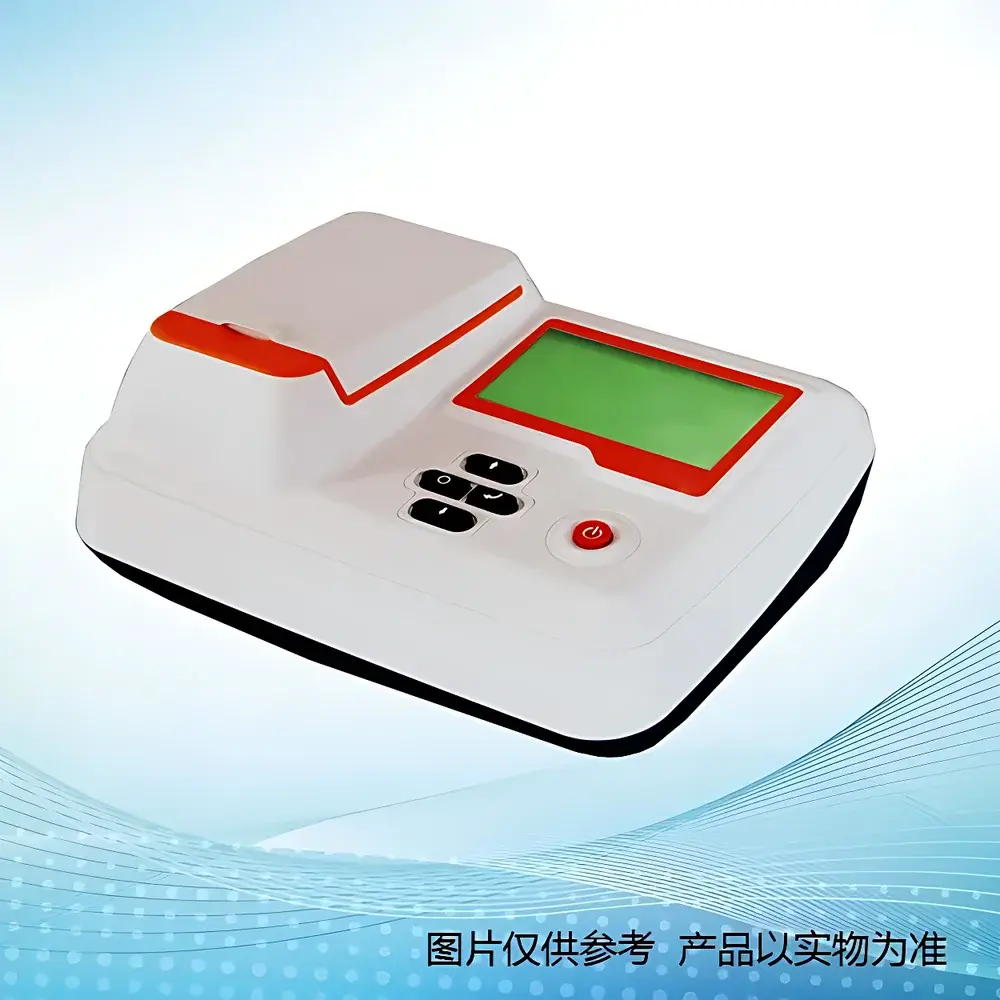
Jiada Xiaotian’e GDYQ-4000S Rapid Iodine Analyzer for Salt
| Brand | Jiada Xiaotian'e |
|---|---|
| Origin | Jilin, China |
| Manufacturer Type | Direct Manufacturer |
| Country of Origin | China |
| Model | GDYQ-4000S |
| Function Type | Single-Analyte Detection (Iodine) |
| Sample Versatility | Multi-Sample Compatible |
| Detection Limit | 2.0 mg/kg |
| Measurement Range | 0.0–80.0 mg/kg |
| Accuracy | ±2% |
| Analysis Time | ≤3 minutes per sample |
| Display | Backlit LCD with Chinese UI |
| Control System | Embedded MCU with data logging, parameter configuration, statistical processing, and RS232 communication |
| Sample Prep | Dedicated pretreatment kit + single-use reagent cartridges |
Overview
The Jiada Xiaotian’e GDYQ-4000S Rapid Iodine Analyzer for Salt is a dedicated benchtop photometric analyzer engineered for the quantitative determination of total iodine content in iodized table salt and iodine-containing dietary supplements. It operates on the principle of catalytic colorimetry: iodide ions in acidified samples react with ceric ammonium sulfate under controlled conditions to generate a stable yellow-orange chromophore, the absorbance of which is measured at 420 nm using an integrated solid-state photodiode detector. This method aligns with standardized rapid screening protocols referenced in GB/T 13025.7–2012 (Chinese National Standard for Determination of Iodine in Salt) and serves as a validated first-line tool for regulatory compliance verification, quality control in salt production facilities, and field-based food safety surveillance. The instrument is not intended for research-grade speciation (e.g., iodate vs. iodide distinction) or ultra-trace analysis (<2.0 mg/kg), but delivers high reproducibility within its defined operational envelope for routine pass/fail assessment and semi-quantitative grading.
Key Features
- Three-minute turnaround time per sample — optimized reaction kinetics and integrated thermal stabilization ensure consistent incubation and measurement timing without external timers or manual intervention.
- Dedicated hardware architecture with embedded microcontroller unit (MCU) enabling local execution of calibration routines, blank subtraction, concentration calculation via pre-stored calibration curves, and real-time statistical reporting (mean, SD, CV%).
- Backlit monochrome LCD display with native Chinese character support facilitates intuitive navigation across measurement, setup, data review, and system diagnostics menus — no external PC required for basic operation.
- Integrated RS232 serial interface supports bidirectional communication with laboratory information systems (LIS) or PCs for automated data export, firmware updates, and remote configuration management.
- Proprietary single-use reagent cartridges and matched sample preparation accessories minimize cross-contamination risk and eliminate pipetting errors — each cartridge contains pre-measured oxidant, buffer, and chromogenic reagents sealed under inert atmosphere.
- Onboard memory stores up to 500 test records with timestamp, operator ID (configurable), sample ID, and raw absorbance values — compliant with basic GLP documentation requirements for traceability.
Sample Compatibility & Compliance
The GDYQ-4000S accepts homogenized dry salt samples (particle size <250 µm), aqueous salt solutions (up to saturation), and powdered iodine-fortified nutraceutical tablets or capsules after standardized extraction. It does not support liquid dairy, seafood, or plant matrices without prior validated sample cleanup. Method performance meets the precision and accuracy criteria specified in GB/T 13025.7–2012 for rapid iodine screening in salt products. While not certified to ISO/IEC 17025, the instrument’s measurement uncertainty budget (±2% at mid-range) has been verified against NIST-traceable iodine reference materials (SRM 2629). Its design supports audit readiness for domestic food safety inspections under China’s Food Safety Law and provincial market supervision protocols.
Software & Data Management
No proprietary desktop software is required for core functionality; all operations are self-contained within the device firmware. However, optional terminal emulation software (provided on USB drive) enables ASCII-formatted data dump to CSV or TXT files for integration into Excel-based QC dashboards or LIMS. Audit trail features include immutable timestamps on all saved results and a protected system log recording calibration events, error codes, and power-cycle history. Firmware supports user-defined calibration curve import (via RS232) using two-point or multi-point standards — essential for laboratories maintaining internal reference material libraries.
Applications
- Routine verification of iodine fortification levels in packaged iodized salt prior to distribution.
- Field deployment by county-level CDC and market supervision bureaus for rapid counterfeit salt identification (e.g., non-iodized salt falsely labeled as iodized).
- In-process monitoring during salt blending and iodization lines to maintain batch consistency.
- Pre-screening of iodine-containing health supplements to flag out-of-spec lots before HPLC confirmation.
- Training and capacity building in regional food testing centers where access to spectrophotometers or ICP-MS is limited.
FAQ
What sample preparation is required before analysis?
Dry salt samples must be ground to pass through a 60-mesh sieve; 1.00 g is weighed precisely and dissolved in 10 mL deionized water. For tablets, one unit is crushed, extracted with 10 mL dilute HCl, and filtered prior to analysis.
Can the instrument differentiate between iodide and iodate forms?
No — the GDYQ-4000S measures total oxidizable iodine. Speciation requires separate methods such as ion chromatography or selective reduction titration.
Is calibration traceable to national standards?
Yes — factory calibration uses GBW(E) 080397 iodine standard solutions certified by the National Institute of Metrology (China), with certificate of analysis provided with each instrument shipment.
How often must the optical path be cleaned or maintained?
The cuvette holder and LED-photodiode optical path require cleaning only if visible residue accumulates; recommended quarterly inspection using lint-free wipes and isopropyl alcohol — no alignment or recalibration needed post-cleaning.
Does the system comply with FDA 21 CFR Part 11?
No — it lacks electronic signature capability, role-based access control, and full audit trail granularity required for Part 11 compliance; suitable for non-GMP environments only.





