
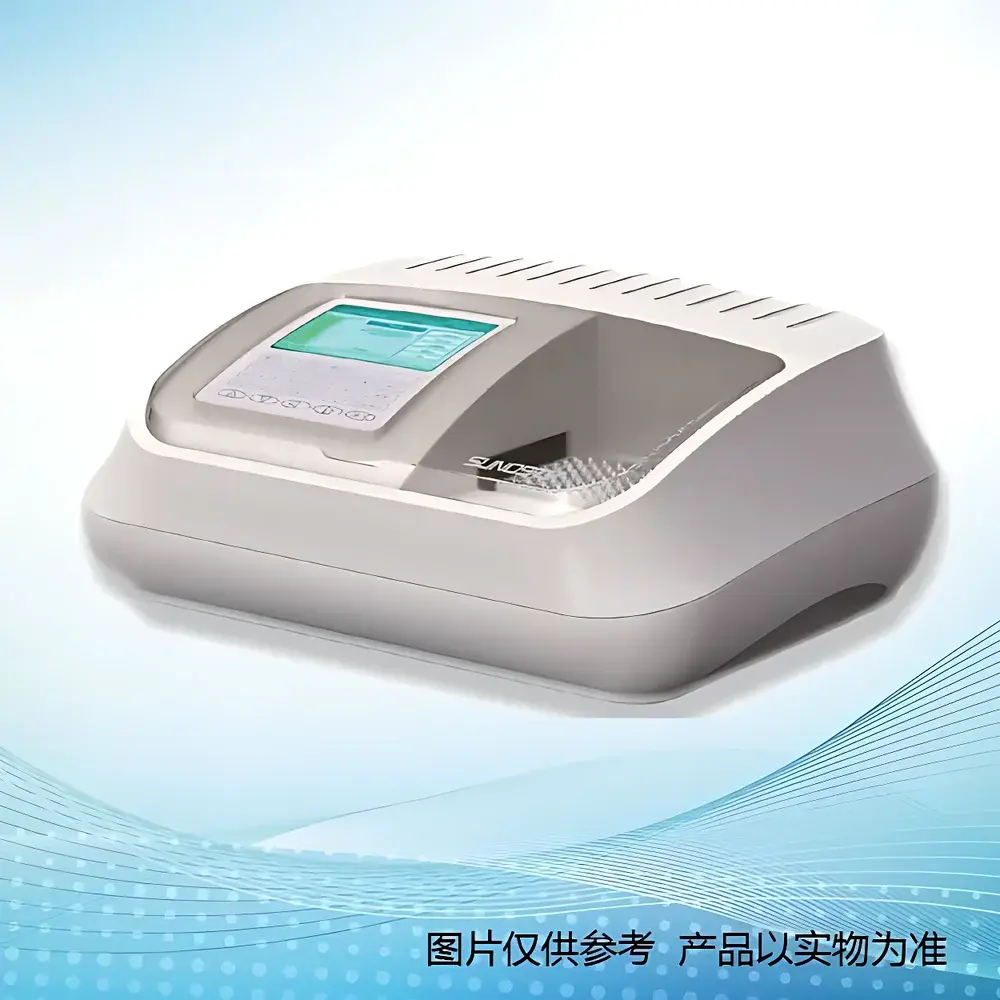
Jiada Xiaotian’e GDYQ-501S Veterinary Drug Residue Microplate Reader
| Brand | Jiada Xiaotian'e |
|---|---|
| Origin | Jilin, China |
| Manufacturer Type | Direct Manufacturer |
| Origin Category | Domestic (China) |
| Model | GDYQ-501S |
| Function Type | Single-Analyte Quantitative Detection |
| Sample Compatibility | Universal for Food & Biological Matrices |
| Wavelength Range | 400–700 nm |
| Throughput | 96-well plate in 5 seconds |
| Optical Resolution | 0.001 A (display), 0.0001 A (internal calculation) |
| Photometric Repeatability | ≤ ±1% |
| Linearity | ±1% (0.000–2.000 A) |
| Absorbance Range | 0.0000–4.0000 A |
| Measurement Modes | Single-, Dual-, and Multi-Wavelength |
| Built-in Oscillation | Adjustable speed & duration |
| Interface | RS232 serial port, parallel port |
| Power Supply | AC 220 V / 110 V ±22 V, 50 Hz / 60 Hz ±1 Hz |
Overview
The Jiada Xiaotian’e GDYQ-501S Veterinary Drug Residue Microplate Reader is a dedicated photometric detection platform engineered for quantitative immunoassay-based analysis of veterinary drug residues—including sulfonamides, tetracyclines, β-lactams, quinolones, and nitrofurans—in food matrices such as meat, milk, eggs, honey, and aquatic products. Operating on the principle of enzyme-linked immunosorbent assay (ELISA), the instrument measures absorbance changes at defined wavelengths following colorimetric reaction development. Its optical architecture employs a stable cold light source and precision interference filters (405 nm, 450 nm, 492 nm, 630 nm), enabling high reproducibility across standardized 96-well and 48-well microtiter plates. Designed for compliance with routine food safety screening workflows, the GDYQ-501S supports both qualitative (cut-off based) and quantitative (calibration curve-driven) reporting—fully aligned with national food safety standards (e.g., GB 29693–2013, GB/T 22969–2008) and internationally referenced ELISA protocols.
Key Features
- High-throughput photometry: Completes full 96-well plate reading in ≤5 seconds, optimizing laboratory throughput without compromising measurement integrity.
- Multi-wavelength flexibility: Four pre-installed optical filters (405/450/492/630 nm) plus four vacant slots for user-defined filter integration—enabling method adaptation across diverse ELISA kits and conjugate chemistries.
- Integrated programmable shaking: Motor-driven orbital oscillation with independently adjustable speed and duration ensures uniform termination reagent mixing—critical for minimizing edge effects and improving intra-plate precision.
- Self-diagnostic startup sequence: Automatic lamp intensity verification, zero-point calibration, and optical path validation prior to each run ensure consistent baseline stability and traceable instrument readiness.
- Advanced photometric performance: Internal calculation resolution of 0.0001 A and display resolution of 0.001 A, combined with ≤±1% repeatability and ±1% linearity over 0.000–2.000 A range, meets requirements for GLP-compliant ELISA data acquisition.
- Dual-control operation: Supports standalone use via front-panel membrane keypad and LCD interface, or full remote control via PC-connected software—facilitating integration into automated ELISA workstation environments.
Sample Compatibility & Compliance
The GDYQ-501S accommodates standard ANSI/SBS-format 96-well and 48-well microplates used in commercial veterinary residue ELISA kits. It is validated for use with samples prepared according to AOAC Official Method 2005.07, ISO 14501:2007, and China’s Ministry of Agriculture and Rural Affairs (MARA) technical guidelines for rapid screening. While not FDA 21 CFR Part 11–certified out-of-the-box, its data export capabilities (ASCII, CSV), audit trail logging (via optional PC software), and configurable QC flagging support alignment with GMP/GLP documentation practices. All firmware and calibration records are retained locally on-device and exportable for internal quality audits.
Software & Data Management
The instrument interfaces with Windows-based control software supporting method library management (up to 100 stored protocols), multi-curve fitting (linear, semi-log, 4PL, 5PL, polynomial, spline), and customizable report templates. Raw absorbance values, calculated concentrations, CV%, and pass/fail status per well are logged with timestamp and operator ID. Data files comply with LIMS-ready formats and include metadata fields for sample ID, dilution factor, kit lot number, and expiration date—enabling traceability from raw signal to final result. Optional password-protected user roles allow separation of instrument operation, method editing, and data review functions.
Applications
- Quantitative screening of chloramphenicol in shrimp and honey per GB/T 21312–2007
- Sulfonamide multi-residue detection in pork liver using competitive ELISA
- Tetracycline group confirmation in raw milk following MARA Notice No. 235
- β-lactam residue monitoring in bovine serum during withdrawal period verification
- Internal QC testing of ELISA kit performance (inter-assay precision, standard curve R² ≥ 0.995)
- On-site lab deployment in slaughterhouses, dairy collection centers, and border inspection points where rapid turnaround (<15 min/sample) is required
FAQ
What types of ELISA formats does the GDYQ-501S support?
It supports direct, indirect, sandwich, and competitive ELISA configurations through flexible wavelength selection and multi-parameter curve fitting algorithms.
Can the instrument be integrated into a LIMS environment?
Yes—via RS232 serial output, it exports structured ASCII/CSV files containing absorbance, concentration, and QC flags compatible with most LIMS ingestion modules.
Is calibration traceable to national standards?
The device uses factory-calibrated optical filters and undergoes daily self-checks; users may perform NIST-traceable verification using neutral density filters or certified reference standards.
Does the GDYQ-501S meet regulatory requirements for official food testing labs?
It fulfills technical prerequisites for initial screening under CNAS-CL01:2018 and GB/T 27404–2008; confirmatory analysis requires LC-MS/MS per GB 23200 series standards.
How is data security managed during remote PC operation?
All software sessions require role-based authentication; audit logs record all parameter changes, file exports, and calibration events—supporting basic 21 CFR Part 11 alignment when deployed with time-stamped electronic signatures.
Related Products




