
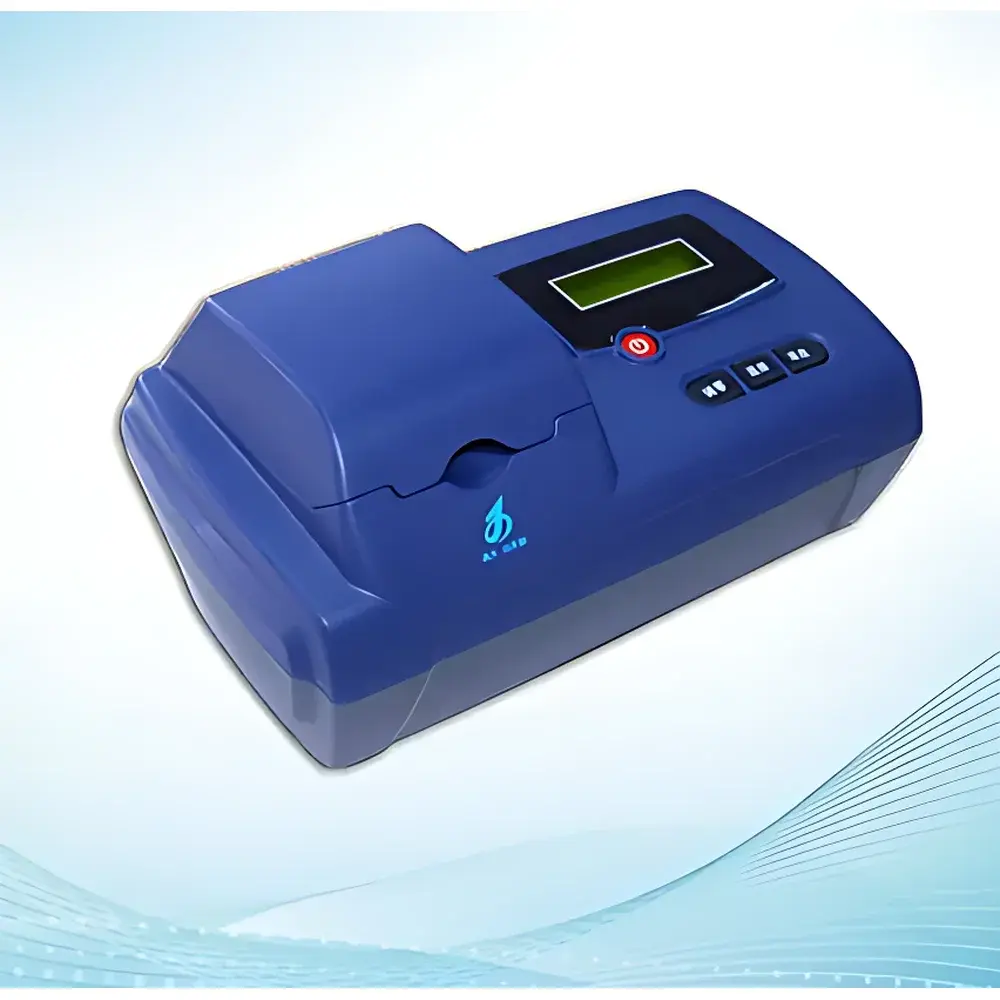
Jiada Xiaotian’e GDYS-101SA Portable Ammonia Nitrogen Analyzer
| Brand | Jiada Xiaotian'e |
|---|---|
| Origin | Jilin, China |
| Manufacturer Type | Direct Manufacturer |
| Country of Origin | China |
| Model | GDYS-101SA |
| Instrument Type | Portable |
| Measurement Principle | Colorimetric Method (Nessler Reagent) |
| Measurement Range | 0.00–5.00 mg/L as N |
| Accuracy | ±5% |
| Detection Limit | 0.10 mg/L as N |
| Light Source Wavelength | 430 nm |
| Compliance Standard | GB/T 5750.5–2006 |
Overview
The Jiada Xiaotian’e GDYS-101SA Portable Ammonia Nitrogen Analyzer is a field-deployable, benchtop-compatible instrument engineered for rapid, on-site quantification of ammonia nitrogen (NH₃–N) in freshwater, wastewater, surface water, and drinking water sources. It operates on the Nessler colorimetric principle—a well-established spectrophotometric method standardized under GB/T 5750.5–2006 (equivalent to APHA 4500-NH₃ B and ISO 7150-1). In this method, ammonia reacts with Nessler’s reagent (an alkaline solution of potassium iodide, mercuric iodide, and sodium hydroxide) to form a yellow-brown colloidal complex. The intensity of the resulting color, measured at 430 nm, is directly proportional to the ammonia nitrogen concentration. Designed for operational simplicity and analytical robustness, the GDYS-101SA delivers reproducible results without requiring laboratory infrastructure—making it suitable for environmental field technicians, municipal water operators, emergency response teams, and regulatory inspectors conducting routine or incident-driven monitoring.
Key Features
- Field-ready portable architecture with integrated optical path, LED light source (430 nm), and calibrated photodetector—no external spectrometer required
- Pre-optimized assay protocol aligned with GB/T 5750.5–2006, ensuring regulatory traceability for Chinese municipal and provincial environmental monitoring programs
- Single-use, pre-measured Nessler reagent kits eliminate reagent preparation errors and minimize cross-contamination risk
- Complete analysis cycle—including sample addition, reaction incubation, and measurement—in ≤10 minutes per sample
- Digital display with automatic zero calibration and built-in reference compensation to mitigate ambient light interference
- Non-volatile memory stores up to 200 test records with timestamp, sample ID, and result (mg/L as N)
Sample Compatibility & Compliance
The GDYS-101SA accepts clarified, non-turbid aqueous samples with minimal suspended solids (0.5 mg/L), heavy metal ions (e.g., Fe³⁺, Cu²⁺ >1 mg/L), or high concentrations of dissolved organic matter that may interfere with the Nessler reaction. While not certified to ISO/IEC 17025 or EPA Method 350.1, its methodology demonstrates functional equivalence to these standards when operated under controlled field conditions. For audit readiness, users are advised to maintain logbooks documenting reagent lot numbers, calibration verification dates, and environmental temperature/humidity during testing—practices consistent with GLP-aligned field data collection protocols.
Software & Data Management
The GDYS-101SA operates as a standalone instrument with no embedded Bluetooth, USB, or cloud connectivity. Data export is manual: users record results directly into field notebooks or transfer values via transcription into LIMS-compatible spreadsheets. Though lacking FDA 21 CFR Part 11-compliant electronic signatures or audit trails, its design supports compliance with basic QA/QC documentation requirements—particularly when paired with printed calibration certificates, reagent expiration tracking, and daily blank/reference checks. For organizations requiring digital integration, third-party mobile apps (e.g., custom Android-based logging tools) may be deployed alongside the device to capture geotagged, time-stamped measurements—though such implementations fall outside the manufacturer’s validation scope.
Applications
- Routine surveillance of ammonia nitrogen levels at drinking water intake points and distribution system nodes
- Emergency assessment following industrial spills, fish kills, or algal bloom events
- Compliance verification for discharge permits under local environmental protection bureau mandates
- Educational fieldwork and student laboratories focusing on water chemistry fundamentals
- Pre-screening prior to lab-based confirmation using ion-selective electrodes or flow injection analysis (FIA)
FAQ
What is the measurement principle used by the GDYS-101SA?
It employs the Nessler colorimetric method per GB/T 5750.5–2006, where ammonia nitrogen forms a yellow-brown complex measured at 430 nm.
Can the instrument measure samples with high turbidity?
No—samples must be filtered or centrifuged to remove particulates; turbidity >5 NTU may cause scattering errors and false-high readings.
Is the detection limit verified per ISO 11929?
The stated LOD of 0.10 mg/L as N is determined empirically per manufacturer’s internal protocol (3σ of blank variance); formal ISO 11929 validation requires independent laboratory assessment.
How often should the instrument be calibrated?
Zero calibration is performed before each measurement session; full-range verification using certified reference standards (e.g., 1.00 mg/L and 3.00 mg/L NH₃–N) is recommended daily or per shift in continuous operation.
Are reagents supplied by the manufacturer only?
Yes—only original Jiada Xiaotian’e Nessler reagent kits are validated for use; third-party reagents may alter stoichiometry, shelf life, or color stability and invalidate accuracy claims.
Related Products







