
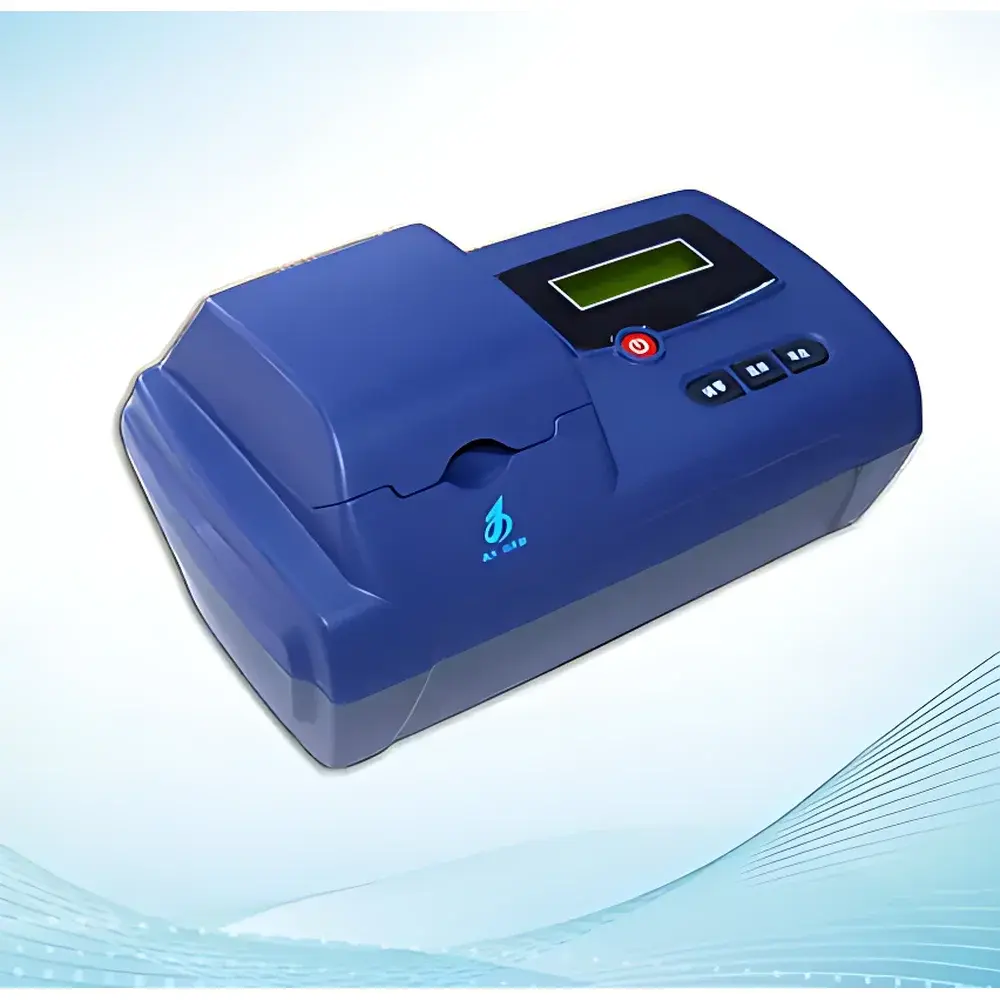
Jiada Xiaotian’e GDYS-101SN2 Portable Residual Chlorine Analyzer
| Brand | Jiada Xiaotian'e |
|---|---|
| Origin | Jilin, China |
| Manufacturer Type | Direct Manufacturer |
| Instrument Type | Portable Analyzer |
| Model | GDYS-101SN2 |
| Measurement Principle | DPD Colorimetric Spectrophotometry |
| Measured Parameter | Free Residual Chlorine |
| Measurement Range | 0.00–5.00 mg/L |
| Accuracy | ±5% of reading |
| Detection Limit | 0.05 mg/L |
| Analysis Time | ≤3 minutes per sample |
| Reagent Format | Single-use, pre-calibrated DPD reagent vials |
| Compliance | Designed for field-deployable water quality screening in accordance with standard methods aligned with APHA 4500-Cl G, ISO 7393-2, and EPA Method 334.0 |
Overview
The Jiada Xiaotian’e GDYS-101SN2 Portable Residual Chlorine Analyzer is a field-deployable spectrophotometric instrument engineered for rapid, on-site quantification of free residual chlorine in aqueous matrices. It operates on the well-established N,N-diethyl-p-phenylenediamine (DPD) colorimetric method—recognized internationally as a reference procedure for chlorine residual determination in drinking water, wastewater effluents, swimming pools, and industrial process streams. The analyzer integrates a fixed-wavelength optical system (typically centered at 515 nm) optimized for DPD-chlorine complex absorbance, coupled with embedded calibration algorithms to convert measured optical density into concentration values (mg/L). Its compact, battery-powered architecture enables operation under variable ambient lighting and temperature conditions without requiring laboratory infrastructure, making it suitable for routine surveillance, emergency response, and regulatory compliance verification where immediate data acquisition is critical.
Key Features
- Three-minute analysis cycle—from sample introduction to validated concentration output—minimizing downtime during high-throughput field campaigns.
- Pre-packaged, single-use DPD reagent vials eliminate manual reagent preparation, reducing operator error and cross-contamination risk while ensuring batch-to-batch consistency.
- Integrated photometric cell with optical path length optimized for low-concentration sensitivity (LOD = 0.05 mg/L), enabling reliable detection near regulatory action thresholds (e.g., WHO guideline value of 0.2–0.5 mg/L for drinking water).
- Ruggedized housing rated IP65 for dust and water resistance, supporting operation in humid, outdoor, or semi-industrial environments including pump stations, reservoir perimeters, and distribution network sampling points.
- Non-volatile memory stores up to 500 measurement records with timestamp, operator ID, and location metadata—facilitating traceability and preliminary data aggregation prior to lab-based reporting.
Sample Compatibility & Compliance
The GDYS-101SN2 is validated for use with clarified or filtered samples across diverse water types: potable water (post-disinfection), treated wastewater (secondary/tertiary effluent), cooling tower make-up water, seawater desalination brine streams (after dechlorination verification), and surface water subject to chlorination-based algal control. Turbidity < 5 NTU is recommended; higher turbidity requires filtration (e.g., 0.45 µm membrane) to prevent scattering interference. The methodology conforms to core principles of APHA Standard Method 4500-Cl G (2022), ISO 7393-2:2018 (Water quality — Determination of free chlorine and total chlorine — Part 2: Method using DPD), and U.S. EPA Method 334.0 (Colorimetric Determination of Residual Chlorine). While not a GLP-certified platform, its documented calibration protocol, reagent lot traceability, and audit-ready data logs support integration into ISO/IEC 17025-accredited laboratories’ auxiliary field testing workflows.
Software & Data Management
Data export is supported via USB-C interface to Windows-compatible desktop software (provided), enabling CSV-formatted report generation with customizable fields (sample ID, date/time, operator, site code). The onboard firmware supports user-defined calibration curve selection (factory-default or user-loaded), password-protected parameter modification, and automatic zero-point validation before each measurement sequence. All stored records include cryptographic checksums to ensure data integrity during transfer. No cloud connectivity or remote telemetry is implemented—consistent with operational security requirements for municipal utilities and defense-related water infrastructure.
Applications
- Real-time verification of chlorine residual decay along distribution networks to identify stagnation zones or pipe biofilm activity.
- Validation of dechlorination efficacy prior to aquatic discharge or reuse applications (e.g., irrigation, industrial cooling).
- Compliance monitoring at point-of-entry (POE) and point-of-use (POU) devices in healthcare facilities, food processing plants, and pharmaceutical water systems.
- Field assessment during disaster response (e.g., post-flooding water safety triage) where centralized lab access is unavailable.
- Educational use in environmental science curricula for hands-on instruction in redox chemistry, disinfectant kinetics, and regulatory standards interpretation.
FAQ
What sample volume is required for analysis?
A minimum of 10 mL of homogenized, unfiltered (but non-turbid) water sample is required per test.
Can the instrument measure combined chlorine (chloramines)?
No—the GDYS-101SN2 is configured exclusively for free residual chlorine detection using the DPD-1 reaction pathway; combined chlorine requires sequential DPD-1 + DPD-3 addition and is outside its design scope.
How often must the optical system be calibrated?
Factory calibration remains stable for ≥12 months under normal field use; users should perform daily blank verification using deionized water and conduct full recalibration if drift exceeds ±0.02 absorbance units over baseline.
Is the reagent compatible with international DPD standards?
Yes—reagent composition adheres to ASTM D1253-20 specifications for DPD powder purity and stability, with lot-specific certificate of analysis provided.
Does the device meet FDA 21 CFR Part 11 requirements?
No—it lacks electronic signature capability, audit trail logging, and role-based access control; it is intended for non-GMP field screening rather than regulated manufacturing release testing.
Related Products







