
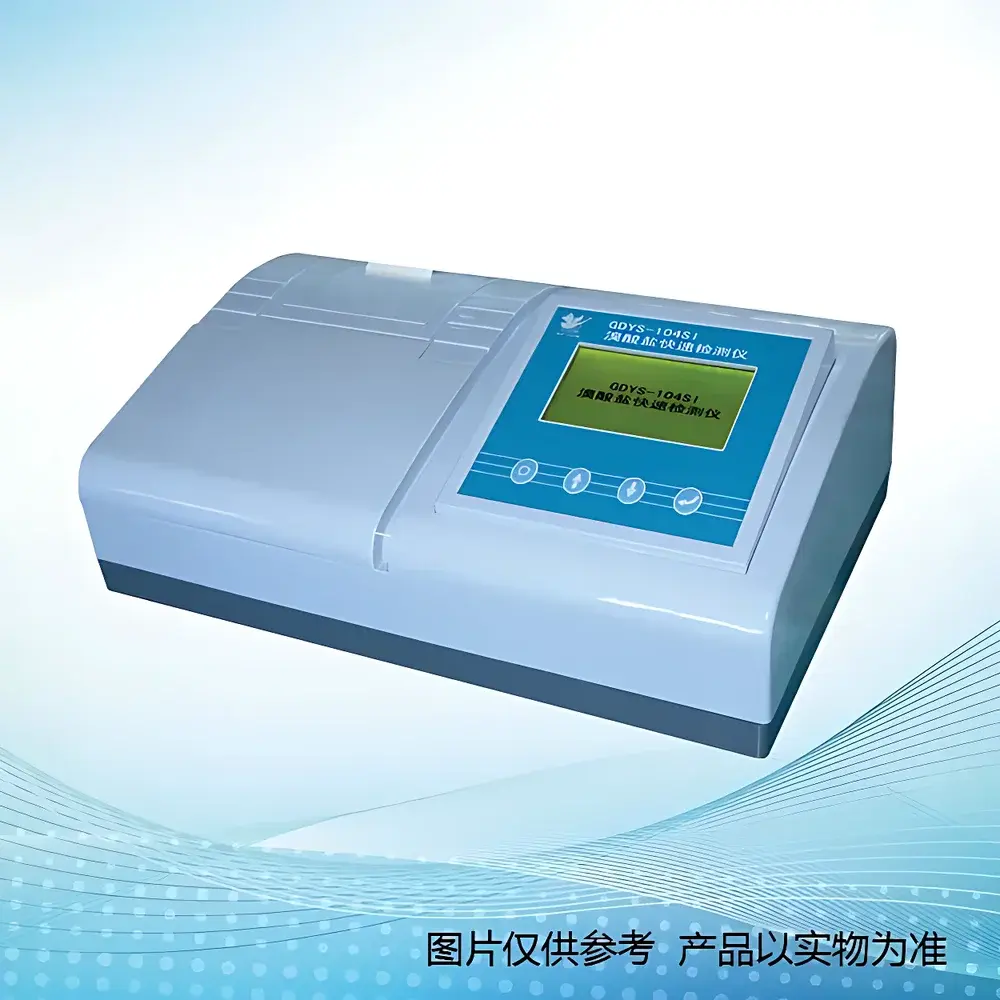
Jiada Xiaotian’e GDYS-104SI Bromate Rapid Detection Analyzer
| Brand | Jiada Xiaotian'e |
|---|---|
| Origin | Jilin, China |
| Manufacturer Type | Direct Manufacturer |
| Product Category | Domestic Laboratory Water Quality Analyzer |
| Model | GDYS-104SI |
| Detection Target | Bromate (BrO₃⁻) |
| Measurement Range | 0.004–0.040 mg/L |
| LOD | 0.004 mg/L |
| Accuracy | ±0.001 mg/L |
| Analysis Time | ≤30 min (sample-to-result) |
| Light Source Lifetime | ≥100,000 hours |
| Control System | Embedded Microcontroller |
| Display | Large LCD Screen |
| Data Output | Built-in Thermal Printer Support |
| Regulatory Context | Designed for compliance with GB/T 5750.10–2023 (China Standard Methods for Examination of Drinking Water – Disinfection By-products), suitable for routine monitoring under ISO/IEC 17025-accredited laboratories |
Overview
The Jiada Xiaotian’e GDYS-104SI Bromate Rapid Detection Analyzer is a dedicated photometric instrument engineered for the quantitative determination of bromate (BrO₃⁻) in drinking water and bottled water matrices. It operates on the principle of selective colorimetric reaction: bromate ions react with proprietary reagents under controlled acidic conditions to form a stable chromophore, the absorbance of which is measured at a defined wavelength (typically 520–550 nm) using a high-stability LED light source and precision optical detection system. Unlike ion chromatography (IC) or inductively coupled plasma mass spectrometry (ICP-MS), this analyzer eliminates the need for high-pressure pumps, separation columns, or complex mobile phase preparation—making it purpose-built for high-throughput screening in municipal water quality labs, bottling plant QC facilities, and third-party environmental testing centers where rapid, cost-effective, and operator-independent bromate verification is required.
Key Features
- Sub-ppb-level sensitivity: Achieves a limit of detection (LOD) of 0.004 mg/L (4 µg/L), meeting regulatory thresholds set by WHO (10 µg/L), US EPA (10 µg/L), and EU Directive 98/83/EC (10 µg/L).
- Turnkey analysis workflow: Integrated sample pretreatment module enables parallel processing of up to 6 samples; full quantification—from pipetting to printed report—is completed within 30 minutes.
- Passive optical architecture: No moving parts, no fluidic valves or pistons; LED light source rated for ≥100,000 hours ensures long-term photometric stability without recalibration drift.
- Embedded microcontroller platform: Real-time data acquisition, internal calibration curve storage (up to 10 user-defined curves), statistical functions (mean, SD, CV%), and timestamped result logging.
- Operator-agnostic design: Minimal training required; intuitive menu navigation via membrane keypad and large backlit LCD display; thermal printer interface supports immediate hardcopy output per GLP documentation requirements.
Sample Compatibility & Compliance
The GDYS-104SI is validated for use with ozone-treated purified water, mineral water, and natural spring water—matrix types known to generate bromate during disinfection when bromide is present. It accommodates standard 10–25 mL sample volumes and tolerates typical background interferences (e.g., chloride ≤200 mg/L, nitrate ≤10 mg/L, sulfate ≤200 mg/L) without requiring matrix-matched calibration. Method performance aligns with Chinese National Standard GB/T 5750.10–2023 “Standard Methods for Examination of Drinking Water – Disinfection By-products”, and its operational protocol supports traceability and audit readiness in accordance with ISO/IEC 17025:2017 Clause 7.2 (Method Validation) and Clause 7.7 (Ensuring Validity of Results). While not FDA 21 CFR Part 11–compliant out-of-the-box, its data export capability (CSV via USB) facilitates integration into LIMS environments with electronic signature controls.
Software & Data Management
The analyzer features firmware-based data handling with non-volatile memory capable of storing ≥500 test records, each including sample ID, measurement time, operator code, raw absorbance value, concentration result, and pass/fail flag against preset limits. All stored data are retrievable via on-device scroll navigation or exported as comma-separated values (CSV) through a standard USB Type-A port. No external PC software is required for basic operation; however, optional desktop utility (Windows-compatible) enables batch report generation, trend charting, and export to Excel or PDF formats compliant with laboratory QA documentation workflows. Audit trail functionality includes automatic timestamping of all parameter changes and measurement events—critical for internal quality audits and CNAS accreditation maintenance.
Applications
- Routine bromate surveillance in bottled water production lines post-ozone contact tanks.
- Verification testing at municipal water treatment plants implementing advanced oxidation processes (AOPs).
- Field-deployable screening in provincial CDC laboratories lacking IC infrastructure.
- Educational use in university environmental science labs for teaching disinfection by-product chemistry and analytical method validation principles.
- Contract testing laboratories performing accredited bromate analysis under CNAS accreditation scope (CNAS-CL01:2018).
FAQ
What sample volume is required for one analysis?
A minimum of 10 mL of filtered, unacidified water sample is required; 25 mL is recommended for optimal precision.
Does the instrument require daily calibration?
No—factory-calibrated curves are retained in non-volatile memory; only periodic verification with certified reference material (CRM) every 30 days is recommended per GB/T 5750.10–2023.
Can it measure other disinfection by-products?
No—the GDYS-104SI is analyte-specific to bromate; separate instruments are required for chlorite, chlorate, or haloacetic acids.
Is reagent kit shelf life documented?
Yes—unopened reagent kits maintain stability for 18 months when stored at 2–8 °C; lot-specific expiration dates and CRM traceability certificates are provided with each shipment.
What maintenance is required beyond reagent replacement?
None—no consumables other than reagents and thermal paper; optical path cleaning with lint-free cloth and isopropyl alcohol is advised only if visible contamination occurs.







