
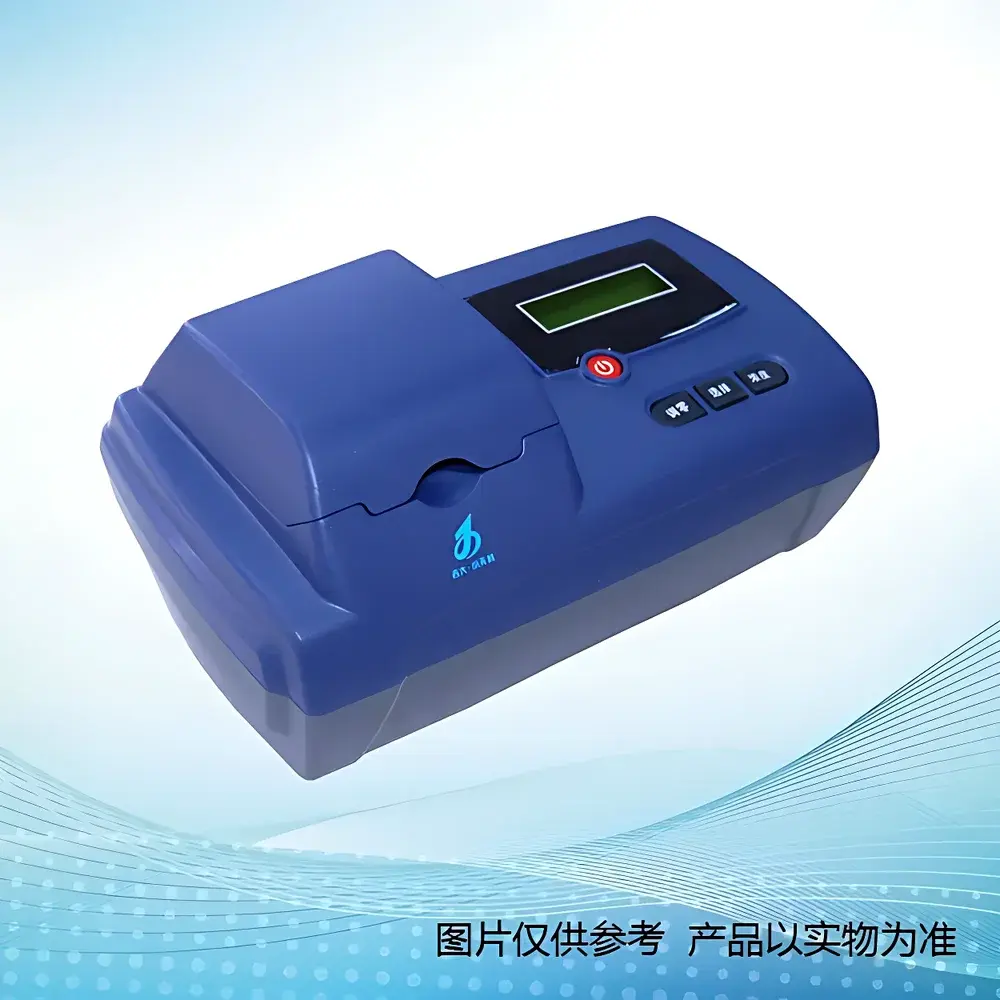
Jiada Xiaotian’e GDYS-104SN Molybdenum Blue Spectrophotometric Silicic Acid Analyzer
| Brand | Jiada Xiaotian'e |
|---|---|
| Origin | Jilin, China |
| Manufacturer Type | Direct Manufacturer |
| Country of Origin | China |
| Model | GDYS-104SN |
| Light Source | High-Brightness LED |
| Wavelength | 430 nm |
| Detection Limit | 1.0 mg/L |
| Measurement Range | 0.0–50.0 mg/L |
| Accuracy | ±5% |
| Power Supply | DC 9 V |
| Dimensions | 190 × 110 × 95 mm |
| Weight | 0.4 kg |
Overview
The Jiada Xiaotian’e GDYS-104SN Molybdenum Blue Spectrophotometric Silicic Acid Analyzer is a dedicated benchtop photometer engineered for rapid, field-deployable quantification of metasilicic acid (H2SiO3) in natural and treated water matrices. It operates on the standardized molybdo-silicic acid colorimetric principle: in acidic medium, silicic acid reacts with ammonium molybdate to form yellow heteropolyacid (silicomolybdic acid), which is subsequently reduced to an intense blue complex (molybdenum blue) by a reducing agent—typically ascorbic acid or 1-amino-2-naphthol-4-sulfonic acid. The absorbance of this chromophore at 430 nm is linearly proportional to silicic acid concentration within the validated range. Designed for compliance with established water quality protocols—including GB/T 5750.6–2023 (Standard Methods for Examination of Drinking Water – Inorganic Nonmetallic Indicators) and ISO 10587:2007 (Water quality — Determination of silica — Molybdenum blue spectrophotometric method)—the GDYS-104SN delivers trace-level sensitivity and reproducibility suitable for routine monitoring in drinking water utilities, mineral water bottling facilities, environmental laboratories, and source water surveillance programs.
Key Features
- Fixed-wavelength photometric detection at 430 nm using a high-stability, low-drift LED light source—eliminating need for mechanical filters or wavelength calibration drift correction.
- Pre-programmed calibration curve optimized for the molybdenum blue reaction kinetics, supporting direct readout in mg/L SiO2-equivalent (reported as silicic acid, H2SiO3).
- Integrated cuvette chamber with precision optical path alignment (10-mm path length) and ambient light shielding to minimize stray-light interference.
- Low-power DC 9 V operation enables extended battery-powered use in mobile labs or remote sampling sites; compatible with standard 9 V alkaline or rechargeable Ni-MH batteries.
- Compact ergonomic housing (190 × 110 × 95 mm; 0.4 kg) with chemical-resistant ABS casing—designed for durability in field conditions and benchtop stability during sequential analysis.
- No embedded microprocessor-based data logging; measurement output is analog-displayed via integrated LCD—ensuring electromagnetic compatibility (EMC) in electrically noisy environments such as pump stations or wastewater treatment plants.
Sample Compatibility & Compliance
The GDYS-104SN is validated for use with clarified, low-turbidity aqueous samples including potable water, groundwater, spring water, and bottled natural mineral water. Sample pretreatment—such as filtration through 0.45 µm membrane filters—is required for turbid or particulate-laden sources to prevent scattering artifacts. Interference from phosphate (>10 mg/L PO43−), arsenate, or high concentrations of Fe3+ may suppress color development and necessitates matrix-matched calibration or masking agents per GB/T 5750.6–2023 Annex B. While not certified to IEC 61000-4 electromagnetic immunity standards, its passive optical architecture meets basic industrial EMC requirements for non-networked instrumentation. The analyzer supports documentation practices aligned with GLP principles, including manual recording of batch reagent lot numbers, calibration dates, operator ID, and raw absorbance values for audit trail reconstruction.
Software & Data Management
This instrument does not incorporate onboard firmware, USB connectivity, or proprietary software. All operational parameters—including zero adjustment, blank subtraction, and concentration calculation—are implemented via hardwired analog circuitry and fixed-gain amplification. Users record results manually in laboratory notebooks or LIMS-compatible spreadsheets. For laboratories operating under FDA 21 CFR Part 11 or ISO/IEC 17025 requirements, external digital capture (e.g., via calibrated camera imaging of the LCD display paired with timestamped metadata) may be implemented as a documented SOP. Reagent kits supplied by Jiada Xiaotian’e include lot-specific calibration verification certificates traceable to NIM (National Institute of Metrology, China) reference materials.
Applications
- Routine surveillance of silicic acid in municipal drinking water distribution systems to assess corrosion control efficacy and scaling potential.
- Quality control testing of natural mineral water products prior to bottling—ensuring compliance with national labeling thresholds (e.g., ≥25 mg/L for “silica-rich” claims in China’s QB/T 4099–2010).
- Baseline characterization of silicate geochemistry in springs, aquifers, and surface waters during environmental impact assessments.
- Verification of silica removal efficiency in reverse osmosis or ion exchange treatment units serving semiconductor or pharmaceutical manufacturing facilities.
- Educational use in university environmental chemistry laboratories for teaching classical wet-chemical spectrophotometric methods and stoichiometric reaction kinetics.
FAQ
What is the chemical species measured by the GDYS-104SN?
It quantifies total reactive silicic acid (monomeric H4SiO4 and its equilibrium forms, reported as H2SiO3), not colloidal or polymeric silica.
Can the instrument measure seawater or brackish water samples?
No—high chloride and ionic strength cause significant color inhibition and precipitate formation; desalination or dilution with deionized water is required prior to analysis.
Is annual recalibration required?
The LED light source and analog circuitry exhibit long-term stability; however, users must verify performance quarterly using certified reference standards (e.g., NIST SRM 1643f diluted appropriately) per internal QA procedures.
Are reagents supplied with the instrument?
Yes—each unit ships with one set of molybdate reagent tablets, reducing agent tablets, and sulfuric acid solution vials sufficient for approximately 100 determinations.
Does the GDYS-104SN comply with US EPA methods?
It follows the reaction chemistry of EPA Method 370.1 (Silica, Molybdenum Blue, Colorimetric), though it is not EPA-listed due to lack of third-party validation under 40 CFR Part 136; method adaptation requires laboratory-specific demonstration of precision and recovery.







