
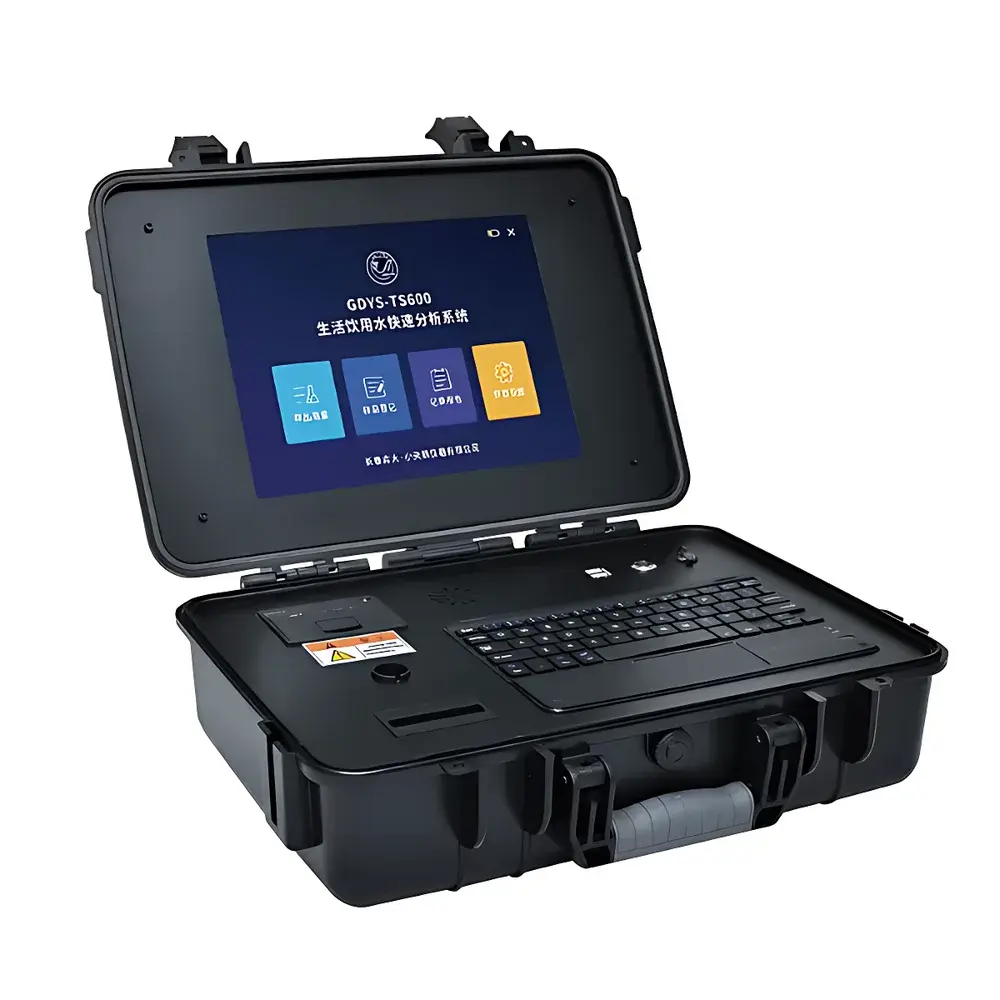
Jiada Xiaotian’e GDYS-TS600 Portable Drinking Water Rapid Analysis System
| Brand | Jiada Xiaotian’e |
|---|---|
| Origin | Jilin, China |
| Model | GDYS-TS600 |
| Instrument Type | Portable/Handheld Water Quality Analyzer |
| Measurable Parameters | Color, Turbidity, pH, Total Hardness, Free Chlorine, Total Chlorine, Residual Chlorine Species, Heavy Metals (As, Cr⁶⁺, Fe, Mn, Cu, Zn, Al, etc.), Microbiological Indicators (Total Coliforms, E. coli, Heterotrophic Plate Count), Oxidants (O₃, ClO₂, ClO₂⁻), Nutrients (NO₃⁻-N, NH₃-N, PO₄³⁻, NO₂⁻-N), Organic Indices (CODₘₙ, Formaldehyde, Phenols), Conductivity, Sulfate, Fluoride, Cyanide, Chloride, Sulfide, etc. |
| Display | 10-inch capacitive color touchscreen with integrated QWERTY keyboard |
| Connectivity | Wi-Fi & Bluetooth 5.0 |
| Data Storage | Internal ≥32 GB SSD + cloud-sync capable |
| Printing | Built-in thermal printer + external USB/Bluetooth printer support |
| Power Supply | Rechargeable Li-ion battery (≥8 h continuous operation) |
| Enclosure | IP65-rated ABS carrying case with shock-absorbing design |
| Compliance | Designed to support ASTM D1293 (pH), ASTM D1889 (turbidity), ISO 7027 (turbidity), ISO 8694 (color), USP <643> (conductivity), EPA 180.1 (coliforms), GB/T 5750 series (Chinese Standard Methods for Drinking Water) |
Overview
The Jiada Xiaotian’e GDYS-TS600 Portable Drinking Water Rapid Analysis System is an integrated, field-deployable analytical platform engineered for on-site and laboratory-grade assessment of drinking water quality in accordance with national and international regulatory frameworks. It employs a hybrid detection architecture combining spectrophotometric colorimetry (for parameters such as color, turbidity, free/total chlorine, nitrate, phosphate, and heavy metals), electrochemical sensing (for pH, conductivity, ORP), and enzymatic/microbial enumeration (for total coliforms and E. coli via membrane filtration or chromogenic substrate methods). The system is calibrated against NIST-traceable standards and validated per ISO/IEC 17025 requirements for method performance—ensuring data integrity across decentralized testing environments including water utilities, public health laboratories, third-party environmental testing providers, and municipal infrastructure departments.
Key Features
- 10-inch high-resolution capacitive touchscreen with full QWERTY keyboard for rapid parameter selection, calibration input, and report generation—eliminating dependency on external peripherals.
- Modular optical engine featuring patented integrated light source and monochromator design, delivering stable spectral output over >20 years of service life with minimal drift (<±0.5% absorbance stability over 8 h).
- Multi-parameter cuvette chamber with vibration-dampened, moisture-resistant optical path alignment—enabling reliable measurements under variable ambient conditions (10–40 °C, 20–90% RH non-condensing).
- Dual-mode data transmission: local Wi-Fi (802.11ac) and Bluetooth 5.0 support real-time synchronization with LIMS, cloud-based dashboards, or mobile supervision apps without requiring intermediate gateways.
- Onboard data management with ≥32 GB solid-state storage, supporting timestamped audit trails, user authentication logs, and version-controlled method files compliant with FDA 21 CFR Part 11 electronic record requirements.
- Integrated thermal printer with automatic report formatting (including sample ID, analyst ID, calibration status, QC flagging) and optional USB/Bluetooth interface for enterprise-grade report archiving.
Sample Compatibility & Compliance
The GDYS-TS600 accommodates raw, filtered, chlorinated, and UV-treated drinking water samples without pre-concentration or dilution for >90% of listed parameters. Sample volume requirements range from 5 mL (spectrophotometric assays) to 100 mL (microbiological membrane filtration). All test protocols align with GB/T 5750.1–5750.13 (Standard Methods for Examination of Drinking Water, China), while individual modules meet equivalency benchmarks for EPA Method 180.1 (coliforms), ASTM D1293 (pH), ISO 7027 (turbidity), ISO 8694 (platinum-cobalt color), and USP (conductivity). The system supports GLP-compliant workflows through configurable user roles, electronic signatures, and immutable data export (CSV, PDF, XML) with embedded metadata.
Software & Data Management
Firmware v3.2+ includes embedded Windows IoT Enterprise OS with dedicated analytical software suite. Each assay module contains built-in calibration curves, QC check routines (e.g., blank verification, standard recovery checks), and adaptive algorithm correction for matrix interference (e.g., humic acid masking in chlorine assays). Data export options include encrypted USB transfer, TLS-secured cloud upload (AWS S3-compatible), and direct API integration with major LIMS platforms (LabWare, STARLIMS, Thermo Fisher SampleManager). Audit trail records capture operator ID, timestamp, instrument configuration, raw absorbance values, and pass/fail status for every measurement—fully traceable for regulatory inspections.
Applications
This system serves critical operational needs across multiple tiers of water safety governance: routine compliance monitoring at water treatment plants; emergency response screening during contamination events (e.g., post-flooding or pipeline rupture); validation of point-of-use filter performance; verification of disinfection byproduct control; and surveillance sampling in rural distribution networks. Its portability and ruggedized design enable deployment in mobile labs, field vehicles, and temporary command centers—supporting WHO Water Safety Plan implementation and China’s “Blue Sky & Clear Water” environmental enforcement initiatives.
FAQ
Does the GDYS-TS600 require daily recalibration?
No—factory-calibrated optical and electrochemical modules maintain accuracy for up to 30 days under normal use; however, a quick verification using certified reference standards is recommended before each sampling shift.
Can it quantify low-level heavy metals such as arsenic or hexavalent chromium below 10 µg/L?
Yes—using optimized colorimetric chemistries with pre-concentration steps (where required), the system achieves detection limits of 2 µg/L for As and 1.5 µg/L for Cr⁶⁺, validated per GB/T 5750.6–2023.
Is microbiological testing performed entirely onboard?
The system supports rapid qualitative/quantitative detection of total coliforms and E. coli via chromogenic enzyme substrates (e.g., ONPG/MUG), with incubation handled externally; membrane filtration workflows are supported with optional accessory kits.
How is data security ensured during wireless transmission?
All Wi-Fi and Bluetooth communications employ AES-256 encryption; cloud uploads utilize OAuth 2.0 authentication and TLS 1.3 channel protection, meeting ISO/IEC 27001-aligned cybersecurity baselines.
What maintenance intervals are recommended?
Optical path cleaning every 90 days; battery health check every 6 months; annual firmware updates and NIST-traceable sensor verification by authorized service centers.







