
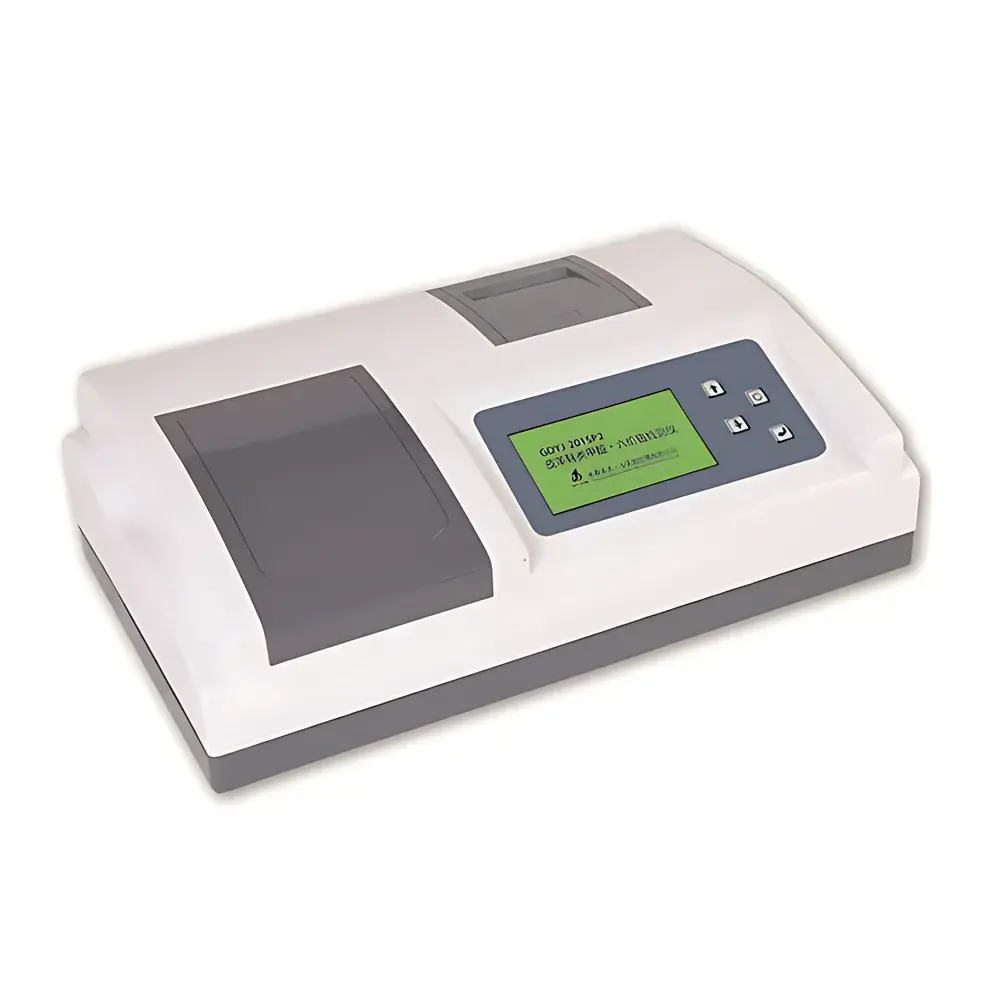
Jiada Xiaotianshe GDYJ-201SP2 Leather & Footwear Formaldehyde and Hexavalent Chromium Analyzer
| Brand | Jiada Xiaotianshe |
|---|---|
| Origin | Jilin, China |
| Manufacturer Type | Direct Manufacturer |
| Country of Origin | China |
| Model | GDYJ-201SP2 |
| Principle | Colorimetric Method (Acetylacetone for Formaldehyde |
| Measurement Range | Formaldehyde: 0.0–125.0 mg/kg |
| Hexavalent Chromium | 0.0–50.0 mg/kg |
| Detection Limits | Formaldehyde: 5.0 mg/kg |
| Cr(VI) | 1.5 mg/kg |
| Accuracy | ±5% |
| Operating Temperature | 10–40 °C |
| Power Supply | 220 V, 50/60 Hz |
| Dimensions | 465 × 280 × 160 mm |
| Weight | 3.0 kg |
| Interface | USB |
| Integrated Thermal Printer | Yes |
| Prepackaged Sample Prep Kit | Yes |
Overview
The Jiada Xiaotianshe GDYJ-201SP2 Leather & Footwear Formaldehyde and Hexavalent Chromium Analyzer is a dedicated benchtop colorimetric instrument engineered for quantitative determination of formaldehyde and hexavalent chromium (Cr(VI)) in leather, footwear, and associated raw materials—including lining fabrics, adhesives, and finishing agents. It implements two standardized spectrophotometric methods: the acetylacetone method for formaldehyde (per GB/T 19941–2005) and the 1,5-diphenylcarbazide (DPC) method for Cr(VI) (per GB/T 22807–2008). These methods rely on stable chromophore formation under controlled pH and temperature conditions, with absorbance measured at defined wavelengths (typically 412 nm for formaldehyde and 540 nm for Cr(VI)). The analyzer integrates optical detection, embedded calibration curves, thermal printing, and USB connectivity into a compact, self-contained platform designed for routine compliance testing in QC laboratories, third-party testing facilities, and R&D centers serving the global footwear and leather supply chain.
Key Features
- Preloaded, factory-validated calibration curves compliant with Chinese national standards (GB/T 19941–2005 and GB/T 22807–2008), eliminating manual curve construction and reducing inter-operator variability.
- Integrated thermal printer enabling immediate hard-copy generation of test results—including sample ID, date/time stamp, measured concentration, method reference, and operator ID—supporting GLP documentation requirements.
- Dual-channel measurement capability with independent optical paths optimized for each analyte’s absorption profile, minimizing cross-interference during sequential or parallel analysis.
- USB interface for bidirectional data exchange with Windows-based workstation software, supporting audit-trail-enabled result logging, report export (PDF/CSV), and instrument configuration backup.
- Robust mechanical architecture with shock-absorbing housing and precision-machined cuvette holder, ensuring optical alignment stability across variable ambient temperatures (10–40 °C).
- Onboard memory stores ≥500 test records with timestamp and method metadata, facilitating traceability without continuous PC connection.
Sample Compatibility & Compliance
The GDYJ-201SP2 is validated for use with solid matrices commonly encountered in leather and footwear manufacturing: finished leathers (chrome-tanned, vegetable-tanned, synthetic), shoe uppers, soles, insoles, adhesives, coatings, and textile linings. Sample preparation follows standardized extraction protocols—aqueous extraction at elevated temperature (e.g., 60 °C for 60 min per GB/T 19941) for formaldehyde, and alkaline digestion followed by selective Cr(VI) elution for chromium analysis. The system supports full traceability from raw material receipt to final report generation, aligning with ISO/IEC 17025:2017 documentation expectations for accredited testing laboratories. While not FDA 21 CFR Part 11–certified out-of-the-box, its digital audit trail and user-access controls provide a foundation for validation in regulated environments requiring electronic record integrity.
Software & Data Management
The companion workstation software enables centralized instrument management, including user role assignment (administrator, analyst, reviewer), method parameter configuration, and customizable report templates compliant with internal QA formats or external client specifications. All measurements are time-stamped and linked to user credentials; software logs all critical events—including calibration updates, method changes, and data exports—for review during internal audits. Data export supports CSV for LIMS integration and PDF for regulatory submission. Firmware updates are delivered via encrypted USB drive, maintaining version control and cybersecurity best practices for laboratory instrumentation.
Applications
- QC screening of incoming leather hides and synthetic alternatives against REACH Annex XVII limits (formaldehyde ≤ 75 mg/kg for direct skin contact; Cr(VI) ≤ 3 mg/kg).
- Verification of chrome-free tanning processes and post-treatment efficacy in reducing residual Cr(VI) formation.
- Supporting technical documentation for OEKO-TEX® Standard 100 Class II/III certification submissions.
- Internal method validation studies comparing extraction efficiency across different solvent systems or digestion times.
- Educational use in university textile science and analytical chemistry labs for teaching standardized colorimetric assay principles.
FAQ
Does the GDYJ-201SP2 require external spectrophotometer calibration?
No—the instrument includes factory-calibrated optical modules and pre-programmed absorbance-to-concentration algorithms aligned with GB/T methods; annual verification using NIST-traceable reference standards is recommended.
Can it measure both analytes simultaneously in a single sample extract?
No—formaldehyde and Cr(VI) require distinct extraction chemistries and reaction conditions; separate aliquots must be processed per respective GB standard protocols.
Is the included reagent kit compatible with ISO 17226-1 or EN ISO 14184-1?
The reagents are formulated to meet GB/T performance criteria; users performing ISO/EN testing must validate extraction recovery and matrix interference per their accredited scope.
What maintenance is required beyond routine cleaning?
Optical path inspection every 6 months, cuvette holder alignment check annually, and thermal printer head cleaning after every 500 prints.
Does the software support multi-user login with permission tiers?
Yes—administrator, analyst, and reviewer roles are configurable, with password enforcement and session timeout settings enabled by default.
Related Products







