
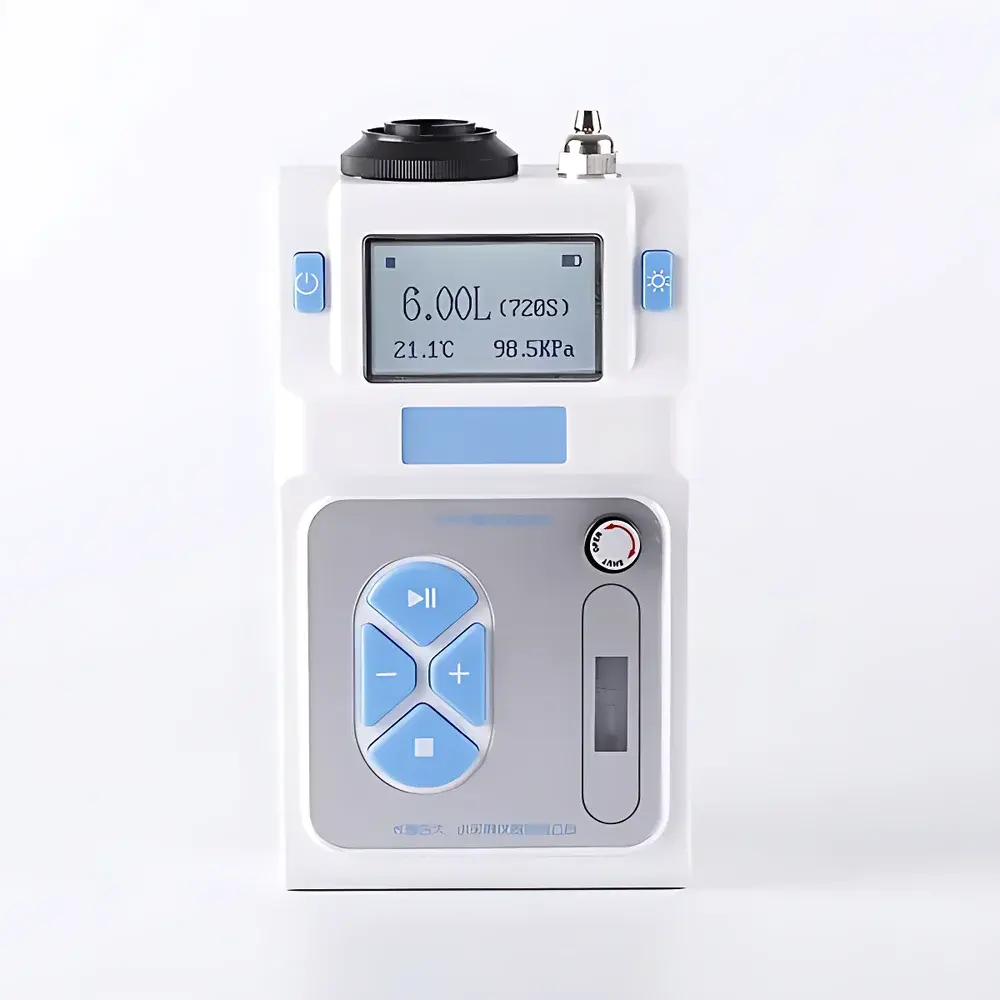
Jiada Xiaotianshe GDYK-208SA On-Site Formaldehyde Analyzer
| Brand | Jiada Xiaotianshe |
|---|---|
| Origin | Jilin, China |
| Manufacturer Type | Direct Manufacturer |
| Country of Origin | China |
| Model | GDYK-208SA |
| Price Range | USD 700–1,400 (FOB) |
| Measurement Principle | Colorimetric Method (Acetylacetone Derivatization) |
| Measurement Range | 0.00–1.00 mg/m³ (6 L air sample) |
| Detection Limit | 0.01 mg/m³ |
| Optical Source | High-Brightness LED |
| Wavelength | 635 nm |
| Accuracy | ±5% FS |
| Power Supply | AC 220 V ±10%, 50 Hz ±2% |
| Rechargeable Battery | 7.4 V, 900 mAh |
Overview
The Jiada Xiaotianshe GDYK-208SA On-Site Formaldehyde Analyzer is a portable, field-deployable instrument engineered for rapid, quantitative determination of gaseous formaldehyde in ambient and indoor air environments. It operates on the well-established colorimetric principle using acetylacetone derivatization—where formaldehyde reacts with acetylacetone under acidic conditions and heat to form a yellow-colored 3,5-diacetyl-1,4-dihydrolutidine (DDL) compound. This chromophore exhibits strong absorbance at 635 nm, enabling quantification via LED-based photometric detection. Unlike electrochemical or semiconductor sensors, this method delivers high specificity for formaldehyde without cross-sensitivity to common interferents such as methanol, ethanol, or volatile organic compounds (VOCs) at typical indoor concentrations. The device is calibrated for a fixed 6 L air sampling volume, making it suitable for standardized short-term exposure assessments aligned with national occupational health guidelines and residential indoor air quality protocols.
Key Features
- Integrated dual-power architecture: simultaneous operation from AC mains (220 V ±10%, 50 Hz) or internal rechargeable lithium-ion battery (7.4 V, 900 mAh), supporting >4 hours of continuous field use per charge.
- High-stability optical system featuring a narrow-band, high-intensity 635 nm LED light source and precision photodiode detector—engineered for minimal drift and long-term repeatability.
- Pre-programmed calibration curve stored in non-volatile memory, traceable to NIM (National Institute of Metrology, China) reference standards; user-accessible calibration verification mode included.
- Compact, ruggedized housing rated IP54 for dust and splash resistance—designed for transport in laboratory carts, inspection kits, or mobile environmental monitoring units.
- Real-time display of concentration (mg/m³), sampling progress, battery status, and error codes via backlit LCD interface with intuitive icon-driven navigation.
Sample Compatibility & Compliance
The GDYK-208SA is validated for direct analysis of formaldehyde in undiluted ambient and indoor air matrices, including residential dwellings, office buildings, schools, newly renovated spaces, and furniture manufacturing facilities. Sample introduction is performed via built-in diaphragm pump with flow-controlled sampling (0.5–1.0 L/min, adjustable). The instrument complies with Chinese national standard HJ 482–2009 “Ambient Air—Determination of Formaldehyde—Acetylacetone Spectrophotometric Method” and aligns with technical requirements outlined in GB/T 18204.2–2014 “Public Places Health Inspection Methods—Part 2: Chemical Pollutants”. While not certified to ISO 16000-23 or EN 16516, its analytical methodology is fully compatible with these international frameworks for indoor air quality assessment when used within defined operational constraints (e.g., controlled temperature/humidity, absence of heavy particulate loading).
Software & Data Management
Data output is limited to on-device storage of up to 200 test records, each timestamped and tagged with operator ID (manually entered). No proprietary PC software or cloud connectivity is provided. Raw absorbance values and calculated concentrations are exportable only via manual transcription or optional RS-232 serial interface (cable sold separately). The device does not support FDA 21 CFR Part 11-compliant electronic signatures, audit trails, or data integrity features required for regulated GLP/GMP environments. For laboratories requiring full traceability, external documentation (e.g., paper logbooks with witness signatures) is recommended per ISO/IEC 17025 clause 7.5.2.
Applications
- Routine indoor air quality (IAQ) screening during building commissioning, post-renovation verification, and tenant occupancy assessments.
- Field-based compliance checks against China’s GB 50325–2020 “Code for Indoor Environmental Pollution Control of Civil Building Engineering” (limit: 0.07 mg/m³ for Class I buildings).
- Educational demonstrations in environmental science curricula, emphasizing colorimetric assay fundamentals and air sampling protocol design.
- Pre-screening tool for industrial hygiene professionals prior to deploying more sensitive methods (e.g., DNPH-HPLC or GC-MS) in suspected high-exposure scenarios.
- Quality assurance for formaldehyde-emitting product testing (e.g., particleboard, adhesives, textiles) under controlled chamber conditions (when paired with appropriate dilution and sampling accessories).
FAQ
What is the minimum detectable concentration of formaldehyde with this instrument?
The instrument achieves a method detection limit (MDL) of 0.01 mg/m³ when sampling 6 L of air, as verified per HJ 482–2009 protocol.
Does the GDYK-208SA require consumables or reagent kits?
Yes—each test requires a pre-filled, single-use formaldehyde detection reagent vial containing acetylacetone, ammonium acetate, and glacial acetic acid; vials are supplied in sealed aluminum pouches with desiccant.
Can the device be used outdoors in high-humidity or low-temperature conditions?
Operation is specified for 10–35 °C and ≤80% RH (non-condensing); performance outside this range may affect reaction kinetics and photometric stability.
Is factory recalibration available, and what is the recommended calibration interval?
Annual recalibration using NIM-traceable formaldehyde gas standards is recommended; the manufacturer offers return-to-factory service with NIST-traceable certificate issuance.
How does the GDYK-208SA compare to electrochemical formaldehyde sensors?
Unlike electrochemical sensors, this analyzer eliminates false positives from CO, NO₂, or humidity fluctuations due to its selective derivatization chemistry and fixed-wavelength photometry.
Related Products







