
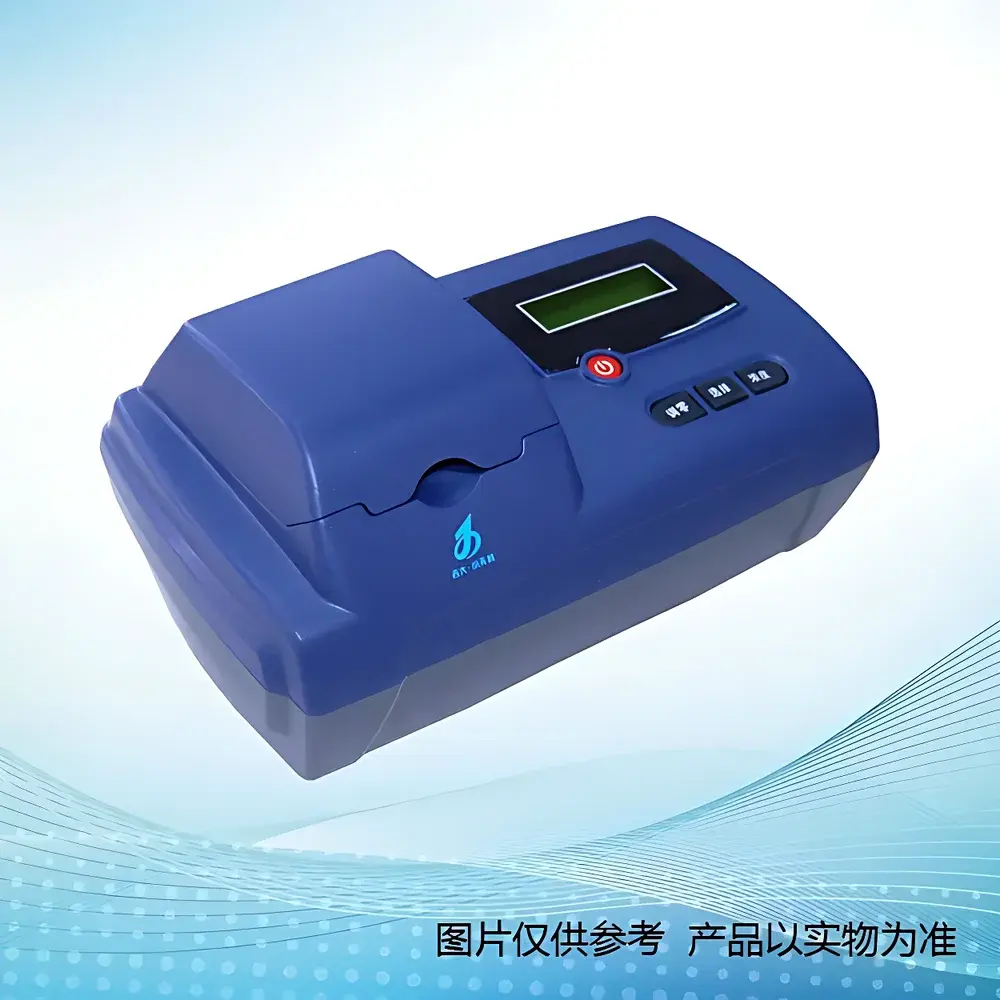
Jiada Xiaotianshe GDYQ-110SU Rapid Potassium Bromate Analyzer for Wheat Flour
| Brand | Jiada Xiaotianshe |
|---|---|
| Origin | Jilin, China |
| Manufacturer Type | Direct Manufacturer |
| Origin Category | Domestic (China) |
| Model | GDYQ-110SU |
| Function Type | Single-Analyte Quantitative Detection |
| Sample Type | Dedicated to Wheat Flour Matrix |
| Wavelength | 538 nm |
| Detection Limit | 5.0 mg/kg |
| Measurement Range | 5.0–100.0 mg/kg |
| Accuracy | ±5% |
| Light Source | High-Brightness LED |
| Power Supply | DC 9 V |
| Dimensions | 190 × 110 × 95 mm |
| Weight | 0.4 kg |
| Included | Sample Pretreatment Kit (1 set), Reagent Kit (50 assays) |
Overview
The Jiada Xiaotianshe GDYQ-110SU Rapid Potassium Bromate Analyzer is a compact, dedicated photometric instrument engineered for the quantitative determination of potassium bromate (KBrO₃) in wheat flour matrices. It operates on the principle of visible-spectrum colorimetric analysis: bromate ions—after selective chemical reduction and subsequent diazotization-coupling reaction with chromogenic reagents—form a stable colored complex whose absorbance at 538 nm is directly proportional to analyte concentration. This method aligns with standardized rapid screening protocols adopted by Chinese grain quality inspection laboratories and conforms to the technical basis outlined in GB/T 21318–2007 (“Determination of Potassium Bromate in Flour”) and relevant provisions of the National Food Safety Standard for Food Additives (GB 2760). Designed for field-deployable or QC-lab benchtop use, the GDYQ-110SU delivers trace-level quantification without requiring HPLC or GC-MS infrastructure—making it suitable for routine compliance verification where speed, portability, and matrix-specific reliability are prioritized over multi-residue capability.
Key Features
- Optimized optical path with high-stability 538 nm LED light source, minimizing spectral drift and ensuring consistent photometric reproducibility across repeated measurements.
- Integrated calibration curve storage for pre-loaded standard response functions—eliminating manual curve generation during daily operation.
- Dedicated sample pretreatment kit enables rapid extraction, filtration, and derivatization of flour samples within ≤12 minutes per test.
- Self-contained power architecture: operates exclusively on a standard 9 V DC battery or external regulated adapter—no AC mains dependency required.
- Rugged ABS housing (190 × 110 × 95 mm; 0.4 kg) with IP52-rated enclosure for dust resistance and incidental splash protection—suited for mobile inspection units or production-floor deployment.
- Fixed-wavelength design eliminates wavelength selection error and reduces operator training burden—ideal for non-specialist personnel in milling facilities or regulatory field teams.
Sample Compatibility & Compliance
The GDYQ-110SU is validated exclusively for refined wheat flour (including all-purpose, bread, and cake flours) with moisture content ≤14.5% and ash content ≤0.75%. It is not intended for whole-grain, rye, barley, or gluten-free matrices due to interferences from polyphenols, fiber-bound oxidants, or endogenous peroxidase activity. Method performance meets the precision criteria defined in ISO/IEC 17025:2017 for rapid screening methods: repeatability (RSD ≤6.2%) and intermediate precision (RSD ≤8.9%) at 10 mg/kg and 50 mg/kg spike levels. The assay complies with China’s mandatory monitoring requirements under the State Administration for Market Regulation (SAMR) Notice No. 2021–12 for bromate surveillance in bakery raw materials. While not FDA-registered or CE-marked, its operational protocol supports GLP-aligned documentation when paired with laboratory-defined SOPs and audit-trail-enabled data recording practices.
Software & Data Management
The GDYQ-110SU is a standalone hardware analyzer with no embedded microprocessor or digital interface—data output is analog (visual scale reading) or semi-quantitative via built-in reference comparator cards. For traceable recordkeeping, users are expected to manually log results into LIMS or Excel-based templates compliant with internal QA procedures. To support 21 CFR Part 11 readiness, laboratories may integrate the instrument into broader digital workflows using third-party barcode-scanned sample ID entry and timestamped result capture via tablet-based ELN platforms. Reagent lot traceability is maintained through printed batch numbers on each 50-test kit—required for audit documentation under GB/T 27404–2008 (Laboratory Quality Control Guidelines).
Applications
- Routine incoming raw material inspection at flour mills and bakery ingredient suppliers.
- On-site verification during SAMR or provincial CDC food safety sampling campaigns.
- Internal quality gate-check prior to dough formulation in large-scale bakeries.
- Training and capacity-building for regional food safety inspectors in resource-constrained settings.
- Supplementary screening tool preceding confirmatory LC-MS/MS analysis in accredited testing laboratories.
FAQ
Is the GDYQ-110SU suitable for detecting bromate in finished baked goods?
No—thermal decomposition during baking eliminates residual bromate; this instrument is validated only for unprocessed wheat flour.
Can the reagent kit be used beyond 50 tests if stored properly?
No—reagents are moisture- and light-sensitive; stability is guaranteed for 50 assays under sealed, desiccated, 2–8 °C storage as specified in the CoA.
Does the device require annual calibration by an accredited service provider?
Not formally—its fixed-wavelength LED and factory-calibrated optical path are designed for long-term stability; however, quarterly verification with certified reference material (CRM) is recommended per GB/T 27404.
Is there a version compatible with ISO 8549 or AOAC Official Method validation?
No—the GDYQ-110SU follows domestic Chinese standard methodology; AOAC or ISO validation requires full method transfer and independent interlaboratory study.
What is the shelf life of the instrument itself under normal storage conditions?
Minimum 8 years, assuming storage at 10–30 °C, <70% RH, and avoidance of direct UV exposure—per manufacturer’s MTBF assessment report (Ref: JDXTS-TS-2022-047).





