
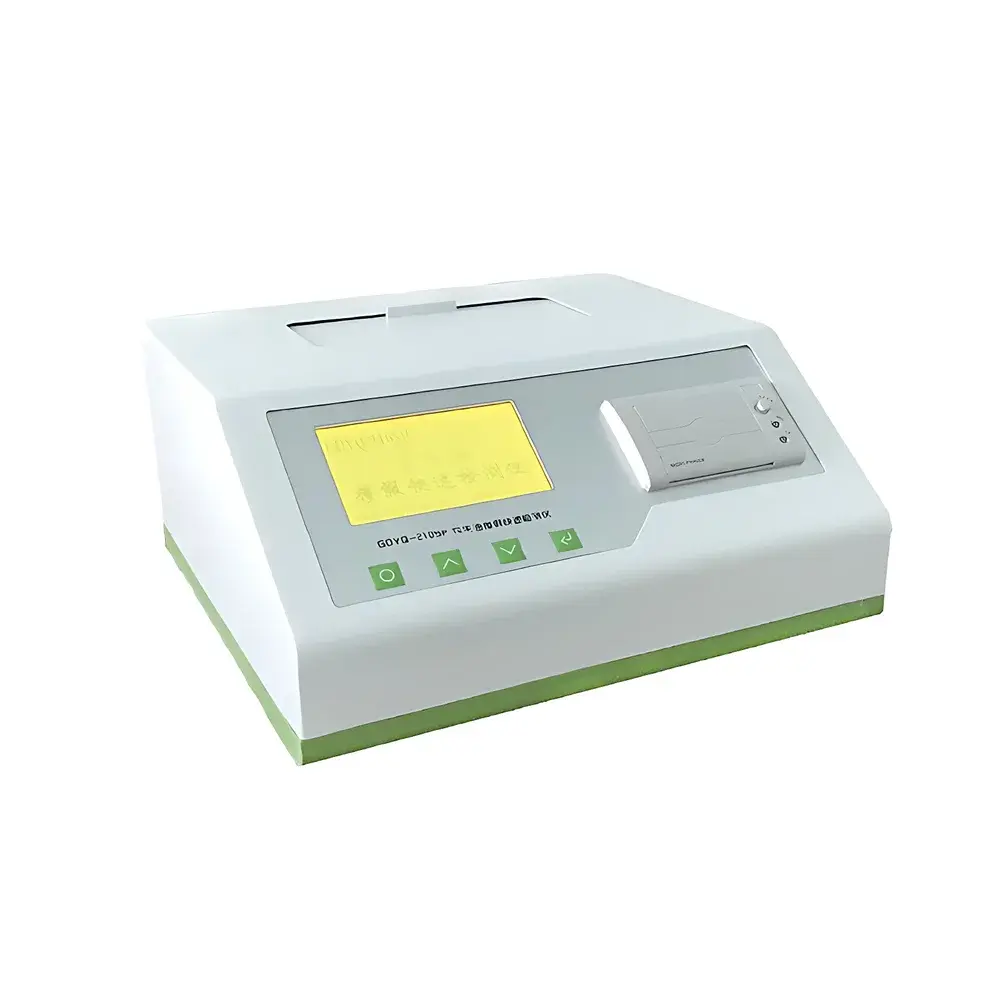
Jiada Xiaotianshe GDYQ-210SP Peanut Oil Adulteration Rapid Analyzer
| Brand | Jiada Xiaotianshe |
|---|---|
| Origin | Jilin, China |
| Manufacturer Type | Direct Manufacturer |
| Region of Manufacture | Domestic (China) |
| Model | GDYQ-210SP |
| Price Range | USD 2,800–4,200 (FOB) |
| Functionality | Single-Analyte Quantitative Detection |
| Sample Compatibility | Multi-Sample Universal Design |
| Detection Range | 10.0%–50.0% (adulteration level) |
| Limit of Detection | 10.0% (adulteration level) |
| Power Supply | 220 V ±20 V, 50–60 Hz |
| Operating Ambient Temperature | 10–30 °C |
Overview
The Jiada Xiaotianshe GDYQ-210SP Peanut Oil Adulteration Rapid Analyzer is a dedicated near-infrared (NIR) spectral discrimination instrument engineered for the quantitative assessment of adulteration in refined peanut oil. It operates on the principle of spectral fingerprint matching—comparing the acquired NIR reflectance/transmission profile of an unknown sample against a pre-validated library of authentic, brand-specific peanut oil reference spectra. This methodology enables rapid, non-destructive quantification of common adulterants—including soybean oil, cottonseed oil, corn oil, and palm oil—without chemical reagents or solvent-based extraction. Designed for frontline food safety screening in quality control laboratories, regulatory inspection units, and edible oil processing facilities, the GDYQ-210SP delivers actionable results within 30 minutes per sample, supporting high-throughput batch verification under ambient laboratory conditions (10–30 °C).
Key Features
- Quantitative adulteration analysis: Reports adulteration level as a percentage (10.0%–50.0%), with saturation output (≥50%) for higher contamination levels.
- Embedded spectral library: Pre-loaded with fingerprint spectra of major domestic peanut oil brands, enabling origin authentication and brand verification alongside adulteration detection.
- Reagent-free operation: Eliminates consumables, hazardous solvents, and time-intensive sample preparation—enabling direct measurement of liquid oil samples in standard glass vials.
- Integrated microcontroller architecture: Features an embedded single-chip system with real-time data acquisition, onboard calibration management, and automatic baseline correction.
- Human-centric interface: 5.7-inch backlit monochrome LCD with Chinese-language menu navigation, intuitive soft-key controls, and context-sensitive help prompts.
- Local data handling: Supports internal storage of up to 500 test records with timestamp, sample ID, and result metadata; exportable via RS-232 serial interface for external database integration.
Sample Compatibility & Compliance
The GDYQ-210SP is validated for use with clarified, filtered, and commercially refined peanut oil samples at room temperature (20–25 °C). It accommodates minor viscosity and color variation across batches but requires homogeneous, particle-free liquids—turbid or sedimented samples must be centrifuged prior to analysis. While not certified to ISO/IEC 17025 or accredited per AOAC Official Method standards, the instrument’s performance aligns with preliminary screening requirements outlined in GB/T 21098–2007 (Chinese National Standard for Edible Oil Authenticity Testing) and supports internal GLP-aligned workflows. Its LOD (10.0% adulteration) meets typical regulatory thresholds for rapid triage in provincial food safety supervision programs.
Software & Data Management
The analyzer runs proprietary firmware (v3.2+) with embedded calibration algorithms and spectral preprocessing routines—including Savitzky-Golay smoothing and vector normalization. All measurement data are stored locally with full audit trail: operator ID (manual entry), date/time stamp, instrument serial number, and raw spectrum checksum. The RS-232 port enables bidirectional communication with Windows-based host software (supplied separately) for report generation (PDF/CSV), statistical summary (mean, SD, CV%), and trend charting across production lots. Data export complies with basic FDA 21 CFR Part 11 principles—user authentication, electronic signature placeholder, and immutable record logging—though full Part 11 validation requires site-specific configuration and IQ/OQ documentation.
Applications
- Routine QC screening of incoming peanut oil raw materials at edible oil refineries and blending facilities.
- On-site verification during market surveillance by municipal food and drug administration (FDA-equivalent) inspection teams.
- Authenticity confirmation for branded peanut oil products prior to labeling and distribution.
- Supporting root-cause analysis in supplier qualification audits where adulteration history is suspected.
- Educational use in food science laboratories for teaching spectroscopic authenticity assessment principles.
FAQ
What adulterants does the GDYQ-210SP detect?
It quantifies common vegetable oil adulterants—including soybean, corn, cottonseed, and palm oils—in peanut oil matrices using spectral deviation scoring against reference libraries.
Can it distinguish between different grades or processing methods of peanut oil?
No—it is optimized for adulteration quantification and brand-level authentication, not for grading or oxidative stability assessment.
Is method validation required before routine use?
Yes. Users must perform initial verification using at least five independently prepared reference blends (10%, 20%, 30%, 40%, 50% adulteration) to confirm linearity and repeatability in their operational environment.
Does the instrument require annual recalibration by the manufacturer?
No factory recalibration service is mandated; however, users must execute daily blank verification and monthly spectral stability checks using the supplied reference oil standard.
Is third-party software compatibility supported?
Raw spectral data (ASCII format) can be exported for import into MATLAB, Unscrambler, or other chemometric platforms—but no native API or driver SDK is provided.






