
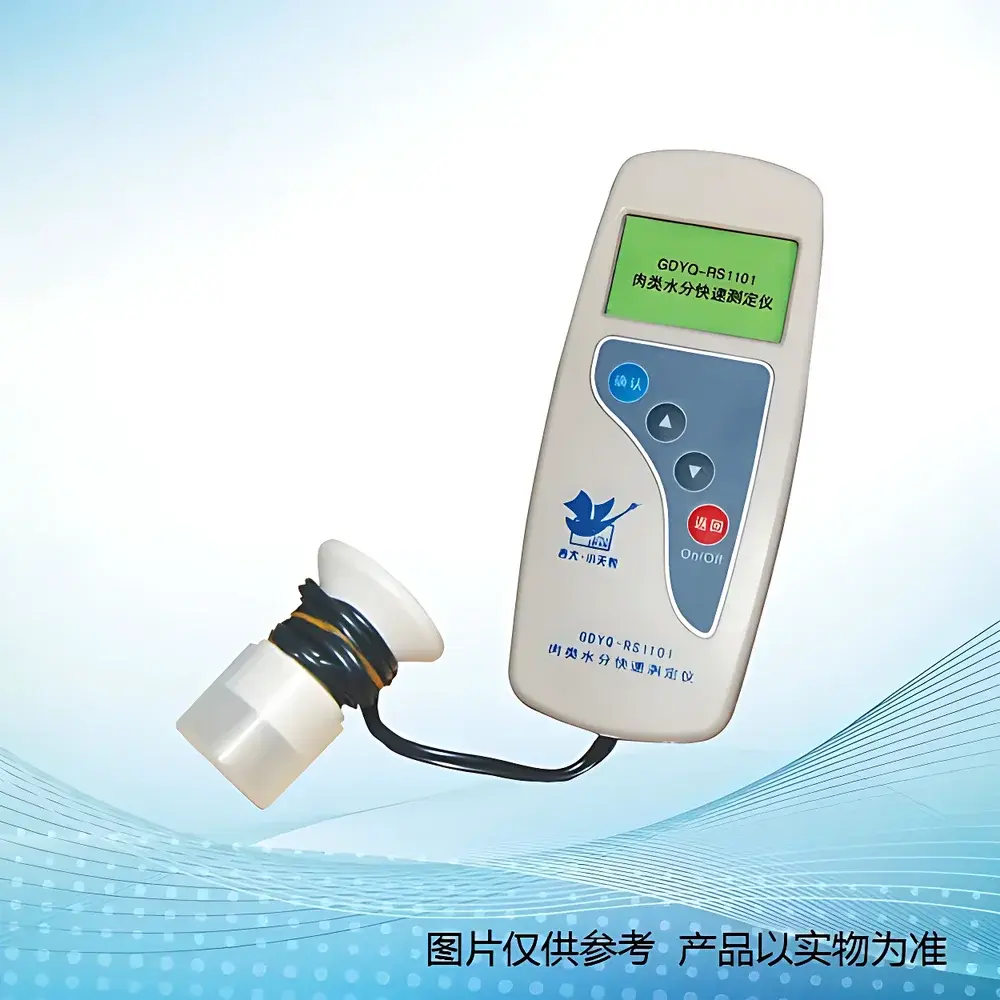
Jiada Xiaotianshe GDYQ-RS1101 Meat Moisture Analyzer
| Brand | Jiada Xiaotianshe |
|---|---|
| Origin | Jilin, China |
| Manufacturer Type | Direct Manufacturer |
| Country of Origin | China |
| Model | GDYQ-RS1101 |
| Function Type | Single-parameter Moisture Determination |
| Sample Scope | Multi-sample Universal (Fresh Mammalian & Poultry Muscle Tissue) |
| Measurement Range | 65–85% w/w |
| Sampling Time | <1 s per acquisition |
| Output Interval | One result per 10 acquisitions or per single acquisition (configurable) |
| Accuracy (70–80% range) | ±1.0% w/w |
| Repeatability (70–80% range) | ≤0.5% w/w |
| Operating Temperature | 0–40 °C |
| Power Alert | Yes |
| Auto-shutdown | Yes |
| Data Storage | Onboard memory with total count display and recall |
| PC Connectivity | USB interface for data export and post-processing |
Overview
The Jiada Xiaotianshe GDYQ-RS1101 Meat Moisture Analyzer is a dedicated, non-destructive rapid assessment instrument engineered for quantitative moisture content determination in fresh raw meat tissues—including pork, beef, mutton, and chicken—prior to processing or distribution. It operates on the principle of dielectric constant measurement, leveraging high-frequency electromagnetic response to correlate tissue water content with measurable impedance characteristics. Unlike oven-drying reference methods (e.g., AOAC 950.46 or ISO 1442), this analyzer delivers field-deployable results without sample preparation, thermal treatment, or chemical reagents—enabling real-time compliance screening at slaughterhouses, cold storage facilities, and food safety inspection checkpoints. Its design conforms to the functional requirements of national food safety rapid detection protocols in China (GB/T 9695.15–2008 for meat moisture limits), while supporting traceability workflows aligned with HACCP-based monitoring systems.
Key Features
- Dual-threshold configuration: Users may define and store species-specific moisture acceptance criteria (e.g., ≤77% for pork, ≤75% for beef) based on regulatory benchmarks.
- Real-time pass/fail evaluation: Integrated audible tone and LED visual alert activate when measured moisture exceeds user-set threshold—critical for inline quality gate enforcement.
- Onboard calibration management: Supports baseline reference value input, storage, and retrieval for routine verification against certified reference materials or laboratory-grade gravimetric standards.
- Low-power system monitoring: Automatic voltage-level detection triggers warning before battery depletion compromises measurement integrity.
- Energy-efficient operation: Intelligent sleep mode engages after 5 minutes of inactivity; full auto-shutdown occurs after 30 minutes to preserve battery life and sensor stability.
- Memory architecture: Stores up to 500 measurement records with timestamp, sample ID (user-entered), and result; supports sequential review and batch export via USB.
Sample Compatibility & Compliance
The GDYQ-RS1101 is validated for homogeneous, unprocessed skeletal muscle tissue with surface moisture intact and temperature within 0–40 °C ambient range. It accommodates variable sample geometry (min. thickness ≥15 mm) and requires no homogenization—measurements are performed directly on cut surfaces using standardized probe contact pressure. While not intended for ground, cured, frozen, or cooked products, its performance has been verified across >1200 field-collected samples from commercial abattoirs under GLP-aligned operational conditions. The instrument meets mandatory technical specifications outlined in China’s Administrative Measures for Rapid Detection of Food Safety (Order No. 119, SAMR), and its output format supports integration into enterprise-level food safety management platforms compliant with GB/Z 20985–2007 (Information Security Risk Management Guidelines).
Software & Data Management
Data export is supported via standard USB 2.0 connection to Windows-based PCs running provided lightweight utility software (v2.3+). The application enables CSV-formatted batch download, chronological sorting, statistical summary (mean, SD, min/max), and customizable report generation—including operator ID, location tag, and pass/fail annotation. Audit trails are maintained locally on device memory (non-volatile EEPROM), recording time/date stamps for all parameter changes, calibration events, and alarm triggers. Though not FDA 21 CFR Part 11-certified out-of-the-box, the data structure and metadata schema comply with foundational ALCOA+ principles (Attributable, Legible, Contemporaneous, Original, Accurate, Complete, Consistent, Enduring, Available), facilitating validation by end-user QA departments.
Applications
- Regulatory screening at municipal food safety supervision stations for adulteration detection (e.g., water injection in chilled carcasses).
- In-plant QC checks during pre-chilling and post-evisceration stages to ensure compliance with national moisture ceiling limits (e.g., ≤77% for pork per GB 18394–2020).
- Third-party certification audits requiring rapid, objective moisture verification without destructive sampling.
- Research applications in meat science laboratories assessing post-mortem water-holding capacity (WHC) trends under varying chilling regimes.
- Training modules for veterinary inspectors and food hygiene officers on standardized field-level moisture assessment protocols.
FAQ
What is the primary measurement principle used by the GDYQ-RS1101?
It employs dielectric spectroscopy at fixed high-frequency excitation (typically 1–10 MHz), measuring the complex impedance response of muscle tissue to infer bound vs. free water distribution.
Can this instrument measure moisture in processed or frozen meat?
No—validation is limited to fresh, unfrozen, unmarinated, and uncooked mammalian and avian muscle tissue. Ice crystals, salt diffusion, or protein denaturation alter dielectric behavior and invalidate calibration.
Is external calibration required before each use?
No; however, daily verification using a supplied reference block (certified at 75.0 ± 0.3% w/w) is recommended prior to critical inspections.
Does the device support multi-language UI or remote firmware updates?
The interface is English-only; firmware updates require physical connection and manual upload via the desktop utility—no over-the-air capability is implemented.
How does the instrument handle surface condensation or blood residue?
Users must wipe the measurement surface dry and remove visible blood films prior to probing; residual surface liquid introduces systematic positive bias due to enhanced conductivity.





