
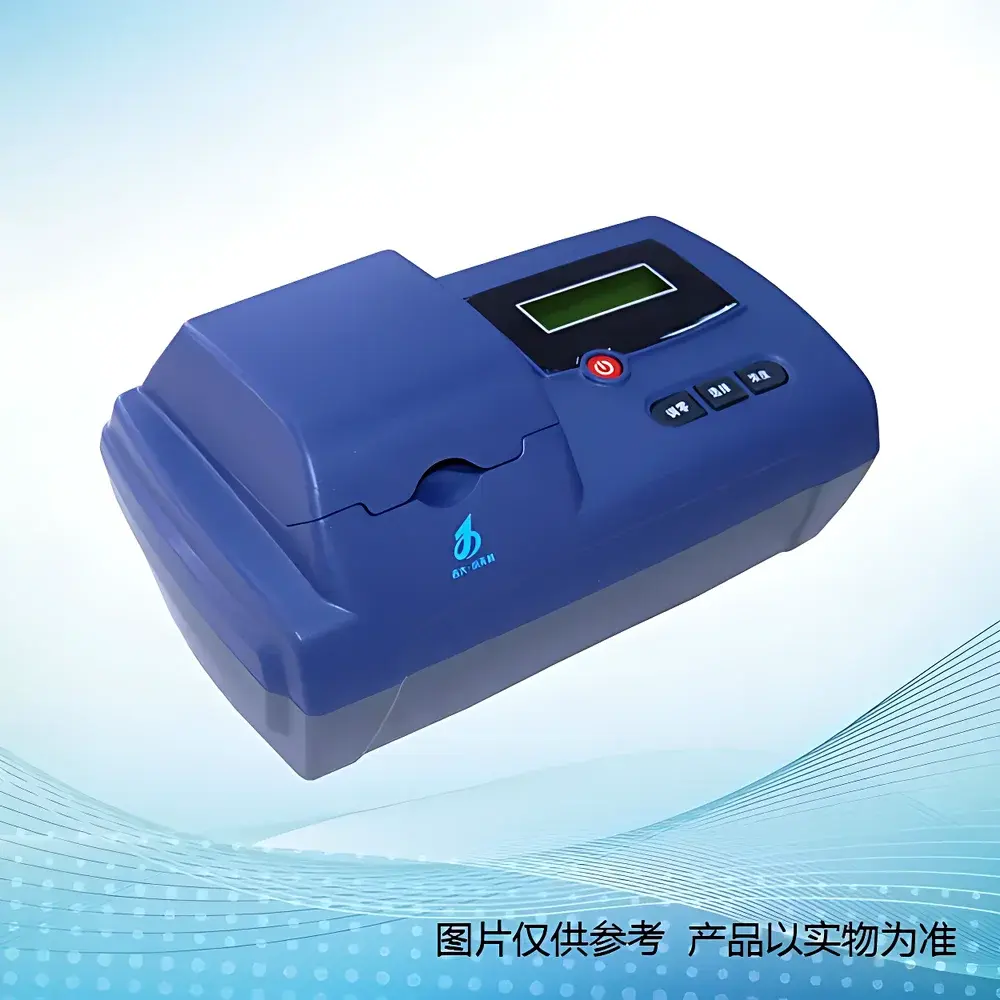
Jiada Xiaotianshe GDYS-101SZ2 Turbidity Meter
| Brand | Jiada Xiaotianshe |
|---|---|
| Origin | Jilin, China |
| Manufacturer Type | Direct Manufacturer |
| Origin Category | Domestic (China) |
| Model | GDYS-101SZ2 |
| Pricing | Available Upon Request |
| Detection Limit | 0.5 NTU |
| Measurement Range | 0.0–60.0 NTU |
| Accuracy | ±5% of reading |
| Compliance | GB/T 5750.4–2006 |
| Analysis Time | ≤3 minutes per sample |
Overview
The Jiada Xiaotianshe GDYS-101SZ2 Turbidity Meter is a portable, benchtop-capable optical instrument engineered for rapid, field-deployable quantification of turbidity in aqueous matrices according to the Chinese national standard GB/T 5750.4–2006. It operates on the principle of nephelometric measurement—detecting scattered light intensity at a 90° angle relative to the incident beam path—ensuring alignment with internationally recognized turbidity metrology frameworks, including ISO 7027 and EPA Method 180.1. Designed for routine water quality surveillance, the device delivers traceable, reproducible results across a calibrated range of 0.0 to 60.0 NTU, with a validated detection limit of 0.5 NTU. Its optical architecture incorporates a stable LED light source (850 nm nominal wavelength), precision-aperture detector assembly, and temperature-compensated signal processing to minimize drift under variable ambient conditions. The meter is intended for use in fixed laboratories, mobile environmental monitoring units, and on-site field operations where regulatory-grade data integrity is required without reliance on centralized infrastructure.
Key Features
- Nephelometric detection geometry compliant with ISO 7027 and harmonized with GB/T 5750.4–2006 methodology
- Single-button operation with automatic zero calibration and built-in reference validation sequence
- Integrated sample cell holder accommodating standard 25 mm round glass vials (10 mL volume)
- Real-time display of NTU values with auto-ranging and unit confirmation (NTU only)
- Non-volatile memory storing up to 200 measurement records with timestamp and operator ID fields
- Low-power consumption design enabling continuous operation for >12 hours on rechargeable Li-ion battery
- IP65-rated enclosure for dust resistance and limited water ingress protection during field deployment
Sample Compatibility & Compliance
The GDYS-101SZ2 is validated for direct analysis of clarified and unfiltered liquid samples including potable water, distilled water, surface water, seawater (after appropriate salinity correction per protocol), wastewater effluents, and treated industrial process water. Sample preparation requires no chemical reagents; however, particulate settling or air bubble removal is recommended prior to measurement to ensure optical path integrity. Instrument compliance is formally anchored to GB/T 5750.4–2006 “Standard Examination Methods for Drinking Water – Sensory and Physical Parameters”, which defines turbidity as an indicator of suspended particulate matter affecting light transmission. While not certified to ISO/IEC 17025 for accredited testing, the device supports GLP-aligned workflows through audit-ready data logging, user-accessible calibration history, and traceable reference standards (e.g., Formazin or StablCal® suspensions). It meets functional requirements for routine monitoring under China’s “Environmental Monitoring Technical Specifications (HJ/T 91–2002)” and supports data submission to provincial environmental information platforms.
Software & Data Management
Data export is facilitated via USB-C interface to Windows-based desktop software (supplied), supporting CSV-formatted output compatible with LIMS integration. The software enables batch calibration curve management, statistical summary generation (mean, SD, CV%), outlier flagging based on user-defined thresholds, and PDF report generation with embedded instrument metadata (serial number, firmware version, calibration date). All stored measurements include embedded timestamps and optional operator identification codes. The system supports FDA 21 CFR Part 11–aligned features—including electronic signature prompts, audit trail activation, and password-protected configuration access—when deployed in regulated QC environments. Firmware updates are delivered via signed binary packages with SHA-256 verification to ensure integrity.
Applications
- Routine compliance monitoring of drinking water distribution systems per municipal water safety plans
- Pre- and post-filtration assessment in water treatment plants and decentralized purification units
- Field-based evaluation of sediment resuspension events in rivers, lakes, and reservoirs
- Effluent quality verification prior to discharge in industrial wastewater treatment facilities
- Educational laboratory instruction for water chemistry and environmental engineering curricula
- Emergency response screening during flood or landslide events impacting watershed clarity
FAQ
What reference standards are recommended for calibration?
Formazin suspension (400 NTU stock) or NIST-traceable StablCal® standards are recommended. Calibration must be performed at ≥3 points within the 0–60 NTU range.
Can the instrument measure samples with high color or dissolved organic content?
Yes, but absorbance interference above 0.5 AU at 850 nm may require matrix-matched calibration or application of correction algorithms per GB/T 5750.4 Annex B.
Is temperature compensation automatic or manual?
Automatic compensation is applied across 5–40 °C using an integrated thermistor; no user input is required.
How often does the optical path require cleaning or maintenance?
The cuvette chamber and lens surfaces should be inspected and cleaned with lint-free wipes and isopropyl alcohol after every 20 measurements or when visible residue is observed.
Does the device support external power supply during extended lab use?
Yes—DC 5 V/2 A input is supported via USB-C port, enabling uninterrupted operation while charging the internal battery.







