
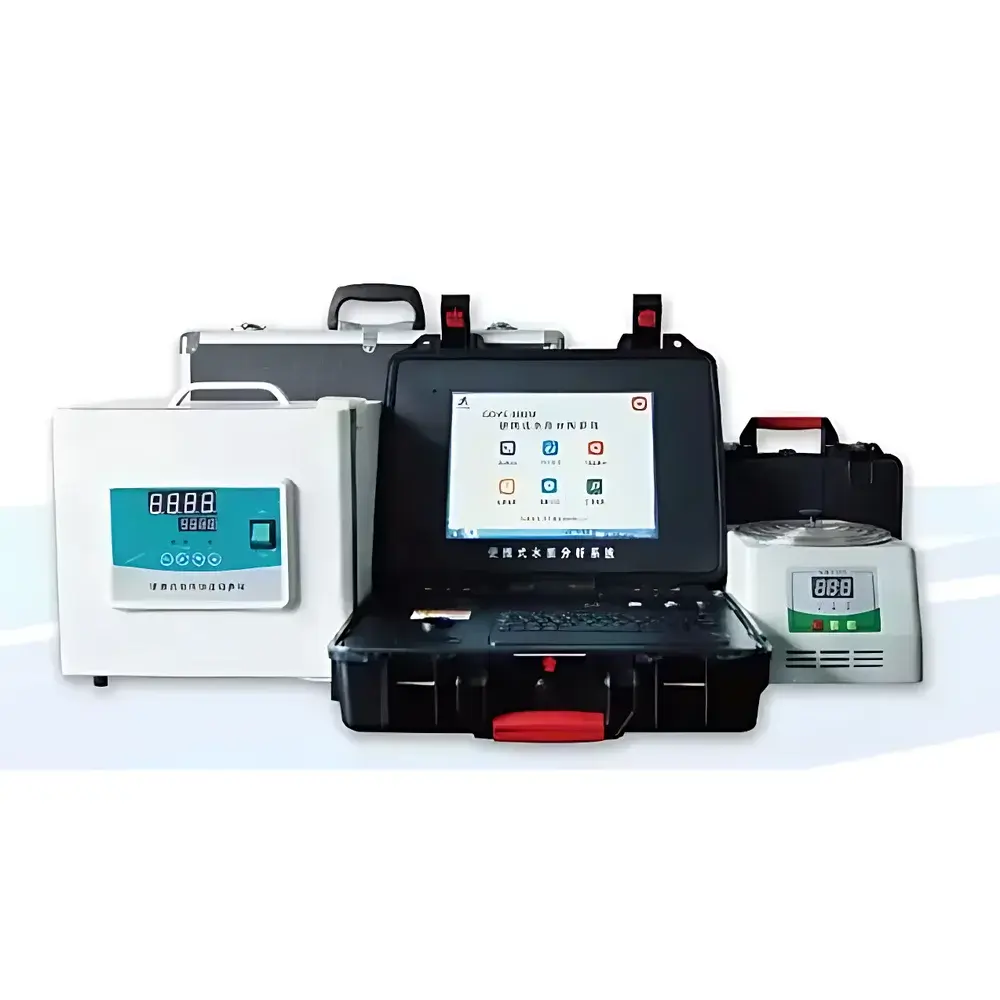
Jiada Xiaotianshe GDYS-800M Portable Water Quality Analyzer
| Brand | Jiada Xiaotianshe |
|---|---|
| Origin | Jilin, China |
| Manufacturer Type | Direct Manufacturer |
| Country of Origin | China |
| Model | GDYS-800M |
| Instrument Type | Portable / Handheld Water Quality Analyzer |
| Measurable Parameters | Free Chlorine, Chlorine Dioxide, COD (Chemical Oxygen Demand), Total Hardness, Color, Turbidity |
| Display | 12-inch Multi-Touch LCD |
| Connectivity | Ethernet, USB, Wi-Fi, 4G |
| Power Supply | AC/DC Dual Mode |
| Light Source | High-Brightness LEDs |
| Wavelengths | 380, 430, 470, 520, 538, 595, 630 nm |
| Photometric Stability | ±0.005 Abs/h |
| Detector | Integrated Photodiode Sensor |
| Sample Cell | Cylindrical Glass Cuvettes & Rectangular Glass Cuvettes |
| Operating Temperature | 5–40 °C |
| Enclosure | IP65-Rated Waterproof & Shock-Resistant Carry Case |
| Built-in Thermal Printer | Yes |
| Compliance | Designed for ASTM D1253, ISO 7888, ISO 7027, ISO 8694, USP <643>, and GB/T 5750 series methods |
Overview
The Jiada Xiaotianshe GDYS-800M Portable Water Quality Analyzer is an integrated, field-deployable photometric system engineered for rapid, on-site quantification of critical physicochemical parameters in drinking water, source water, surface water, and groundwater. Based on fixed-wavelength absorbance spectroscopy using high-stability light-emitting diodes (LEDs) and precision-calibrated optical paths, the instrument implements standardized colorimetric and turbidimetric methodologies aligned with international regulatory protocols—including ASTM D1253 (free chlorine), ISO 7888 (chlorine dioxide), ISO 7027 (turbidity), ISO 8694 (color), and GB/T 5750 (China’s Standard Methods for Examination of Drinking Water). Its modular architecture enables simultaneous method selection across seven discrete wavelengths (380–630 nm), supporting multi-analyte screening without hardware reconfiguration. The system operates independently of laboratory infrastructure, delivering laboratory-grade repeatability (±0.005 Abs/h baseline stability) under variable ambient conditions—from municipal distribution points to remote rural wells.
Key Features
- 12-inch industrial-grade multi-touch display with intuitive graphical interface, enabling full instrument control without external peripherals.
- Integrated thermal printer for immediate hard-copy documentation of results, calibration logs, sample IDs, timestamps, and operator credentials—supporting audit-ready record retention.
- Dual-mode power architecture: accepts 100–240 V AC input or 12 V DC (via vehicle adapter or external battery pack), ensuring uninterrupted operation in mobile labs, emergency response vehicles, or off-grid sampling locations.
- Ruggedized IP65-rated carry case featuring shock-absorbing foam inserts, gasket-sealed compartments, and corrosion-resistant latches—designed for transport over rough terrain and exposure to rain, dust, and temperature fluctuations (5–40 °C operational range).
- Optomechanically stabilized optical path: solid-state LED光源 and photodiode detector eliminate moving parts, minimizing drift and enhancing long-term reliability in high-vibration environments such as transport or field deployment.
- Pre-configured assay compatibility: supports standardized glass cuvettes (cylindrical and rectangular formats) and factory-prepared reagent kits—eliminating manual dilution, weighing, or hazardous chemical handling.
Sample Compatibility & Compliance
The GDYS-800M accommodates liquid samples ranging from clear potable water to moderately turbid surface water, with automatic blank compensation and dynamic range adaptation per parameter. It complies with method-specific sample volume requirements (typically 10–25 mL) and accepts standard 10 mm and 16 mm pathlength cuvettes. All analytical procedures align with GLP-aligned data integrity principles: each measurement event is timestamped, user-authenticated, and stored with full metadata (wavelength, calibration curve ID, reagent lot number, ambient temperature). The system supports configuration-locking for routine monitoring workflows and generates exportable CSV reports compatible with LIMS integration. Regulatory alignment includes traceability to ISO/IEC 17025–accredited reference materials and adherence to performance criteria outlined in US EPA Method 334.1 (chlorine), APHA Standard Methods 4500-Cl G (free chlorine), and WHO Guidelines for Drinking-water Quality (4th ed.).
Software & Data Management
Firmware v3.2+ includes embedded database management with local storage for ≥10,000 test records. Data synchronization occurs via encrypted Wi-Fi or LTE (4G) to cloud-hosted platforms or on-premise servers, supporting role-based access control and configurable auto-upload triggers (e.g., post-measurement, daily batch sync). All transmitted data include digital signatures compliant with FDA 21 CFR Part 11 Annex 11 requirements for electronic records and signatures. Audit trails capture operator login/logout events, method changes, calibration updates, and result modifications—with immutable timestamps and user identifiers. USB export supports raw absorbance values, calibration coefficients, and QC check logs in vendor-neutral formats (.csv, .xml).
Applications
- Real-time verification of disinfectant residual (free chlorine, ClO₂) at water treatment plant effluent points and distribution network nodes.
- Routine surveillance of total hardness and alkalinity in groundwater sources serving rural communities.
- Emergency response assessment following natural disasters or infrastructure failure—measuring turbidity, color, and COD to triage contamination risk.
- Regulatory compliance testing for small water systems operating under revised Total Coliform Rule (TCR) or Groundwater Rule (GWR) reporting mandates.
- Educational use in environmental science field courses, where portability and pedagogical clarity support hands-on method validation and QA/QC exercises.
FAQ
Does the GDYS-800M require annual factory recalibration?
No—its solid-state optical design and factory-installed NIST-traceable calibration curves eliminate mandatory annual recalibration. Users perform daily zero-point verification with deionized water and periodic verification using certified reference standards per ISO/IEC 17025 internal quality control protocols.
Can third-party reagents be used with this analyzer?
Only manufacturer-certified reagent kits are validated for use; substitution may compromise accuracy, linearity, and regulatory acceptability due to unverified reaction kinetics and matrix interference profiles.
Is the instrument suitable for seawater or highly saline samples?
Not without pretreatment—the system is optimized for freshwater matrices. Salinity >5,000 µS/cm may interfere with chlorine and hardness assays; users must apply dilution or ion-selective electrode cross-validation per APHA 2017 guidelines.
How is firmware updated?
Updates are delivered via USB flash drive or secure OTA (Over-The-Air) channel; all versions undergo cryptographic signature verification prior to installation to ensure integrity and prevent unauthorized modification.
What is the expected service life of the LED light source?
Rated for ≥50,000 hours of continuous operation under nominal conditions—equivalent to over 5 years of daily field use—without measurable spectral shift or intensity decay.







