
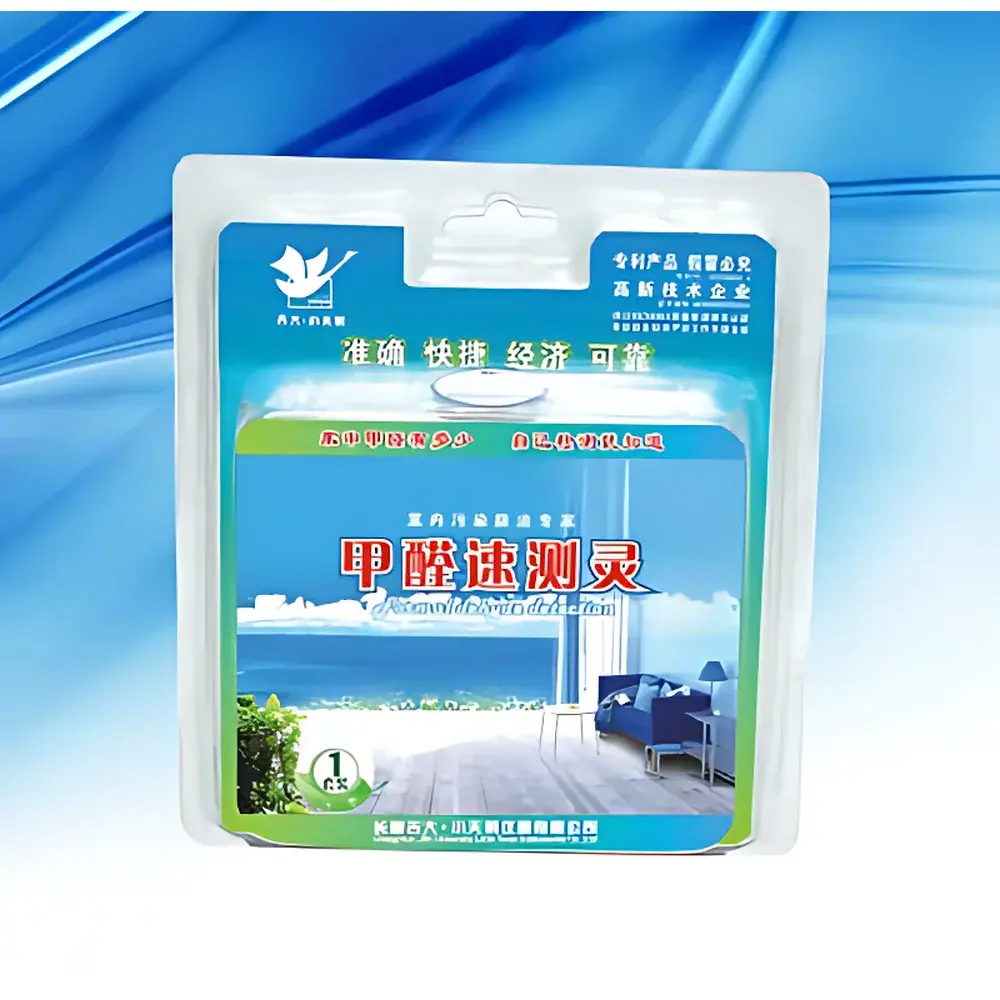
Jiada Xiaotianshe JCL-01 Formaldehyde Analyzer (Colorimetric, Phenol Reagent Method)
| Brand | Jiada Xiaotianshe |
|---|---|
| Model | JCL-01 |
| Origin | Jilin, China |
| Manufacturer Type | Direct Manufacturer |
| Compliance | GB/T 18204.26–2000 |
| Detection Principle | Spectrophotometric Colorimetry (Phenol Reagent Method) |
| Lower Detection Limit | 0.1 mg/m³ |
| Measurement Range | 0.0–1.0 mg/m³ |
| Accuracy | ±10% |
| Analysis Time | ~2 hours per sample |
| Format | Single-use reagent kit with visual colorimetric readout using standardized chromatic scale card |
Overview
The Jiada Xiaotianshe JCL-01 Formaldehyde Analyzer is a portable, field-deployable environmental monitoring instrument engineered for rapid qualitative and semi-quantitative assessment of formaldehyde (HCHO) concentrations in indoor air. It operates on the internationally recognized phenol reagent spectrophotometric method, fully aligned with the Chinese national standard GB/T 18204.26–2000—“Method for Determination of Formaldehyde in Public Places Air.” This technique relies on the condensation reaction between formaldehyde and acetylacetone under acidic conditions, forming a stable yellow chromophore (3,5-diacetyl-1,4-dihydrolutidine), whose absorbance at 412 nm correlates linearly with formaldehyde concentration within the specified range. Unlike real-time electrochemical or PID-based sensors, the JCL-01 delivers laboratory-grade method traceability in a simplified, non-instrumented format—requiring no power supply, calibration gases, or optical hardware. Its design prioritizes procedural robustness, operator independence, and audit-ready documentation when used within structured indoor air quality (IAQ) screening protocols.
Key Features
- Full compliance with GB/T 18204.26–2000, enabling direct comparability with regulatory reporting frameworks in China and other jurisdictions recognizing this methodology.
- Pre-packaged, single-use reagent kits eliminate cross-contamination risk and ensure consistent reagent aging control—critical for reproducibility across sampling events and operators.
- Integrated chromatic reference card calibrated against NIST-traceable formaldehyde standards; each color block corresponds to discrete concentration increments (0.0, 0.1, 0.2, …, 1.0 mg/m³) with defined tolerance bands.
- No external instrumentation required: analysis completed entirely via visual comparison under controlled daylight-equivalent illumination (CIE D65 standard illuminant recommended).
- Optimized for ambient temperature (15–30 °C) and relative humidity (30–70% RH) conditions typical of residential and commercial indoor environments.
- Minimal training requirement: field technicians can achieve proficiency after supervised verification of inter-operator color-matching consistency (inter-rater agreement ≥92% per ASTM E287).
Sample Compatibility & Compliance
The JCL-01 is validated exclusively for gaseous formaldehyde in undiluted, unfiltered indoor air samples collected via active sampling using a calibrated low-flow air pump (e.g., 0.5–1.0 L/min over 20–30 min into a 5 mL absorption solution). It is not suitable for industrial stack emissions, high-humidity fog environments (>85% RH), or atmospheres containing >5 ppm of sulfur dioxide (SO₂) or nitrogen oxides (NOₓ), which may interfere with chromophore formation. While GB/T 18204.26–2000 remains the primary compliance anchor, the assay’s chemical basis is consistent with ISO 16000-3:2019 (Indoor air — Part 3: Determination of formaldehyde — Chromotropic acid method variant) and supports preliminary screening under US EPA Compendium Method TO-11A when adapted with documented SOPs. The system meets GLP documentation requirements when paired with chain-of-custody logs, lot-controlled reagent records, and analyst qualification files.
Software & Data Management
The JCL-01 operates without embedded firmware or digital interfaces. However, it integrates seamlessly into digital QA/QC workflows: users may photograph color comparisons using calibrated smartphone cameras (with X-Rite ColorChecker Passport validation) and log results into LIMS platforms such as LabWare LIMS or Thermo Fisher SampleManager via CSV upload. Optional companion Excel-based templates—provided by Jiada Xiaotianshe—support automatic uncertainty propagation (±10% accuracy band), date/time stamping, location tagging, and PDF report generation compliant with ISO/IEC 17025 clause 7.8. All reagent lots include CoA documentation with batch-specific LOD/LOQ verification data, supporting full traceability during regulatory audits.
Applications
- Routine IAQ screening in newly renovated residential and office buildings prior to occupancy.
- Post-furniture installation verification testing (e.g., particleboard, MDF, laminate flooring).
- Educational laboratory instruction on volatile organic compound (VOC) analytical principles and method validation fundamentals.
- Third-party environmental inspection agencies conducting pre-certification assessments for green building standards (e.g., China Green Building Label, LEED IEQ Credit 3.2).
- Public health departments executing large-scale exposure surveys where instrument portability and operational simplicity outweigh continuous monitoring needs.
FAQ
Is the JCL-01 suitable for outdoor or industrial stack sampling?
No. It is validated only for indoor ambient air sampling per GB/T 18204.26–2000. High particulate load, extreme humidity, or oxidant-rich exhaust streams invalidate the colorimetric response.
Can results be used for regulatory enforcement in non-Chinese jurisdictions?
Results are admissible as screening data under EU Indoor Air Quality Guidelines and US HUD guidelines if accompanied by full method documentation, reagent CoAs, and analyst competency records—but not as standalone legal evidence without parallel GC-MS confirmation.
What is the shelf life of unopened reagent kits?
24 months from manufacture date when stored at 2–8 °C in original aluminum-laminated packaging; desiccant integrity must be verified prior to use.
Does the system require annual recalibration?
No hardware calibration is performed. Instead, quarterly performance verification using certified formaldehyde gas standards (NIST SRM 2789) is recommended to confirm color card fidelity and reagent stability.
How does humidity affect measurement accuracy?
Relative humidity between 30–70% RH introduces <±2% bias; outside this range, absorption efficiency declines nonlinearly—users should record RH alongside each sample and apply correction factors published in Jiada’s Technical Bulletin TB-JCL-01-Rev4.







