
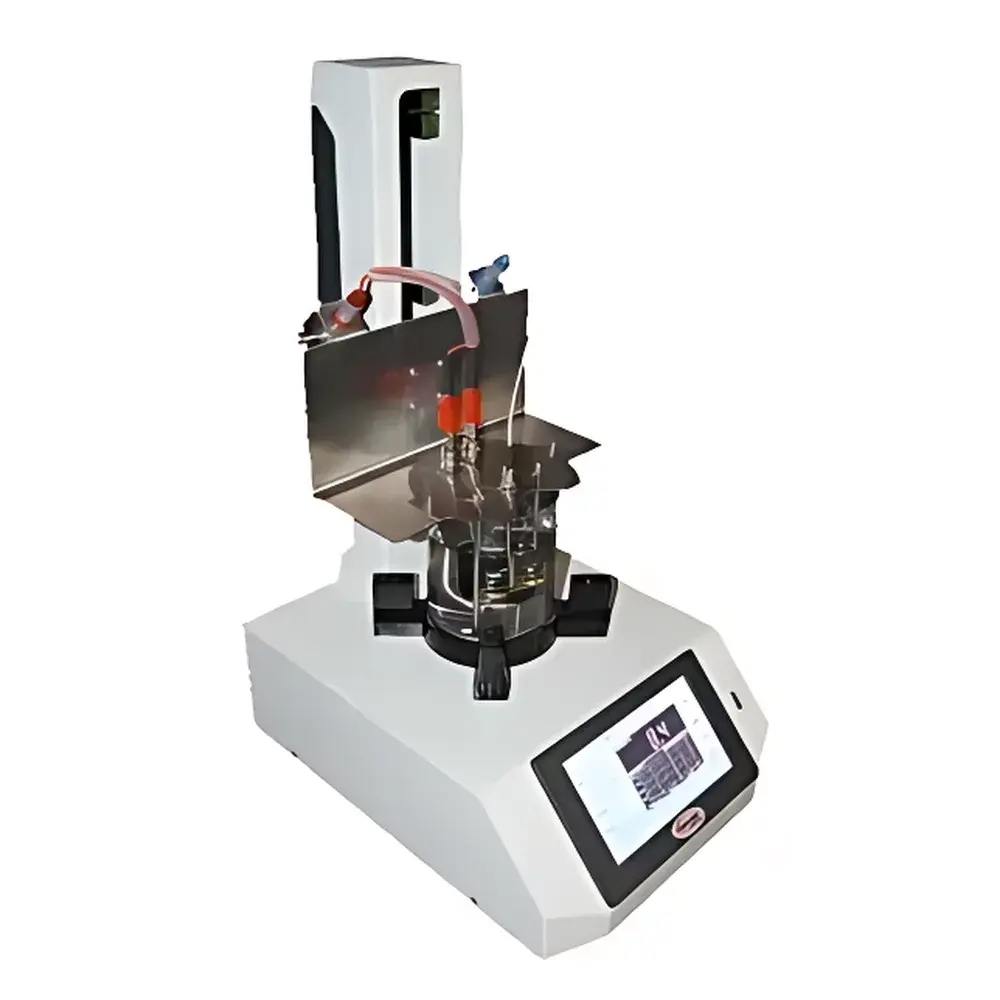
JIAHANG JH-D2102 Automatic Ring-and-Ball Softening Point Tester (USP <741> / ChP 2020 Edition Method 2102)
| Brand | JIAHANG |
|---|---|
| Origin | Shanghai, China |
| Manufacturer Type | Direct Manufacturer |
| Country of Origin | China |
| Model | JH-D2102 |
| Price Range | USD 1,400 – 2,800 |
| Measurement Principle | Ring-and-Ball Method (ASTM D36 / ISO 4625 / ChP 2020 General Chapter 2102 / USP <741>) |
| Temperature Range | 5–80 °C (water bath) / 32–162 °C (glycerol bath) |
| Temp. Resolution | 0.1 °C |
| Heating Rate | 1.0–1.5 °C/min (linear ramp, PID-controlled) |
| Sample Capacity | 2 specimens simultaneously |
| Stirring | Adjustable magnetic stirrer (infinitely variable speed) |
| Detection Method | Dual-channel laser beam interruption detection |
| Data Storage | 200 test records (CSV export via USB) |
| Compliance | Fully compliant with ChP 2020 Edition General Chapter 2102, supports audit trail per FDA 21 CFR Part 11 requirements |
| Interface | RS-485 (Modbus RTU) |
| Dimensions (L×W×H) | 390 × 300 × 575 mm |
| Weight | 12.0 kg |
| Power Supply | 220 ±10% VAC, 50 Hz |
| Max. Power Consumption | ≤800 W |
Overview
The JIAHANG JH-D2102 Automatic Ring-and-Ball Softening Point Tester is a precision laboratory instrument engineered for pharmaceutical and traditional Chinese medicine (TCM) quality control laboratories requiring strict adherence to pharmacopoeial standards. It implements the classical ring-and-ball method—standardized in the Chinese Pharmacopoeia (ChP) 2020 Edition General Chapter 2102, ASTM D36, ISO 4625, and USP <741>—to determine the temperature at which thermoplastic adhesive formulations (e.g., plasters, ointments, bituminous binders) undergo structural transition from rigid to viscoelastic flow under defined thermal and mechanical conditions. The instrument operates by heating two sample rings—each loaded with a standardized disc of test material—immersed in a thermostatically controlled liquid medium (distilled water or glycerol). A steel ball rests atop each sample. As temperature rises linearly at 1.0–1.5 °C/min, the material softens; when the softened specimen deforms sufficiently under the ball’s weight to contact the lower support plate, the corresponding temperature is recorded as the softening point. Dual independent laser photodetectors monitor descent events with high temporal resolution and immunity to ambient light interference, ensuring objective, operator-independent endpoint determination.
Key Features
- Dual-sample testing architecture: Simultaneous evaluation of two specimens improves throughput and enables intra-batch repeatability assessment per ICH Q2(R2) guidelines.
- PID-based linear temperature ramping: Precision digital control algorithm maintains ±0.1 °C stability over full range (5–162 °C), minimizing overshoot and ensuring compliance with pharmacopoeial heating rate tolerances.
- Motorized vertical positioning system: Stepper-driven platform ensures repeatable, vibration-free descent of test assemblies, aligning laser beams precisely relative to the lower reference plate.
- Adjustable magnetic stirring: Infinitely variable rotation speed guarantees uniform thermal distribution across the bath volume—critical for minimizing radial/axial gradients per ASTM E77 calibration requirements.
- Integrated human-machine interface: 7-inch capacitive touchscreen displays real-time temperature curves, animated test progression, and interactive parameter configuration without external PC dependency.
- Regulatory-ready data handling: Built-in audit trail functionality logs user actions, method changes, and result modifications with timestamps and operator IDs—fully traceable for GLP/GMP and FDA 21 CFR Part 11 validation.
Sample Compatibility & Compliance
The JH-D2102 accommodates standard brass test rings (15.9 mm OD, 8.6 mm ID, 6.4 mm height) and 9.5 mm diameter steel balls conforming to ISO 4625 and ChP 2020 specifications. It supports both aqueous (5–80 °C) and high-temperature glycerol baths (32–162 °C), enabling characterization of low-melting TCM plasters and high-melting industrial adhesives. All operational parameters—including ramp rate, dwell time, and detection sensitivity—are configurable to meet method-specific validation protocols. The instrument complies with national and international regulatory frameworks: ChP 2020 General Chapter 2102, USP <741>, ASTM D36, ISO 4625, and EU Pharmacopoeia 2.2.17. Its firmware architecture supports IQ/OQ documentation packages and integrates seamlessly into LIMS environments via Modbus RTU over RS-485.
Software & Data Management
No external software installation is required: all instrument control, data acquisition, and reporting are executed onboard. Test results—including individual drop temperatures, arithmetic mean softening point, test date/time, operator ID, and method version—are stored locally in non-volatile memory (200-test capacity). Data export is supported via USB flash drive in comma-separated values (.csv) format for statistical analysis in Excel or validated analytical software (e.g., JMP, Minitab). Optional thermal printing provides immediate hard-copy output with header metadata (batch ID, analyst name, equipment ID). Audit trail records capture every critical event—including parameter edits, calibration adjustments, and result approvals—with immutable timestamps and role-based access control—satisfying ALCOA+ principles (Attributable, Legible, Contemporaneous, Original, Accurate, Complete, Consistent, Enduring, Available).
Applications
- Quality control of transdermal plasters and medicated ointments in pharmaceutical manufacturing (GMP-compliant release testing).
- Batch consistency verification of traditional Chinese medicine (TCM)膏药 (gāo yào) during production and stability studies.
- R&D screening of polymer-based pressure-sensitive adhesives (PSAs) and hot-melt formulations.
- Regulatory submission support for ANDA, NDA, and DMF dossiers requiring ChP/USP-compliant softening point data.
- Raw material qualification of rosin esters, terpene resins, and synthetic tackifiers used in topical dosage forms.
FAQ
Does the JH-D2102 comply with FDA 21 CFR Part 11 requirements for electronic records?
Yes—the instrument implements role-based user authentication, electronic signatures for result approval, and tamper-evident audit trails with time-stamped entries for all critical operations.
Can the heating medium be changed during a single test sequence?
No—bath fluid must be selected prior to test initiation based on expected softening range (water for ≤80 °C; glycerol for >80 °C). Switching requires manual draining, cleaning, and recalibration.
Is external PC connectivity mandatory for operation?
No—all functions are fully autonomous via the integrated touchscreen interface. PC connection is optional and limited to firmware updates or advanced diagnostics.
What calibration standards are recommended for routine verification?
NIST-traceable reference materials such as pure indium (156.6 °C) and pure tin (231.9 °C) are advised for high-range verification; certified water ice point (0.0 °C) and paraffin wax (48–50 °C) for low-range checks.
How is thermal uniformity across the bath validated?
The instrument includes a built-in multi-point thermal mapping protocol using three calibrated PT100 sensors at defined radial/axial positions—reporting maximum deviation from setpoint to ensure compliance with ASTM E77 Section 7.3.





