
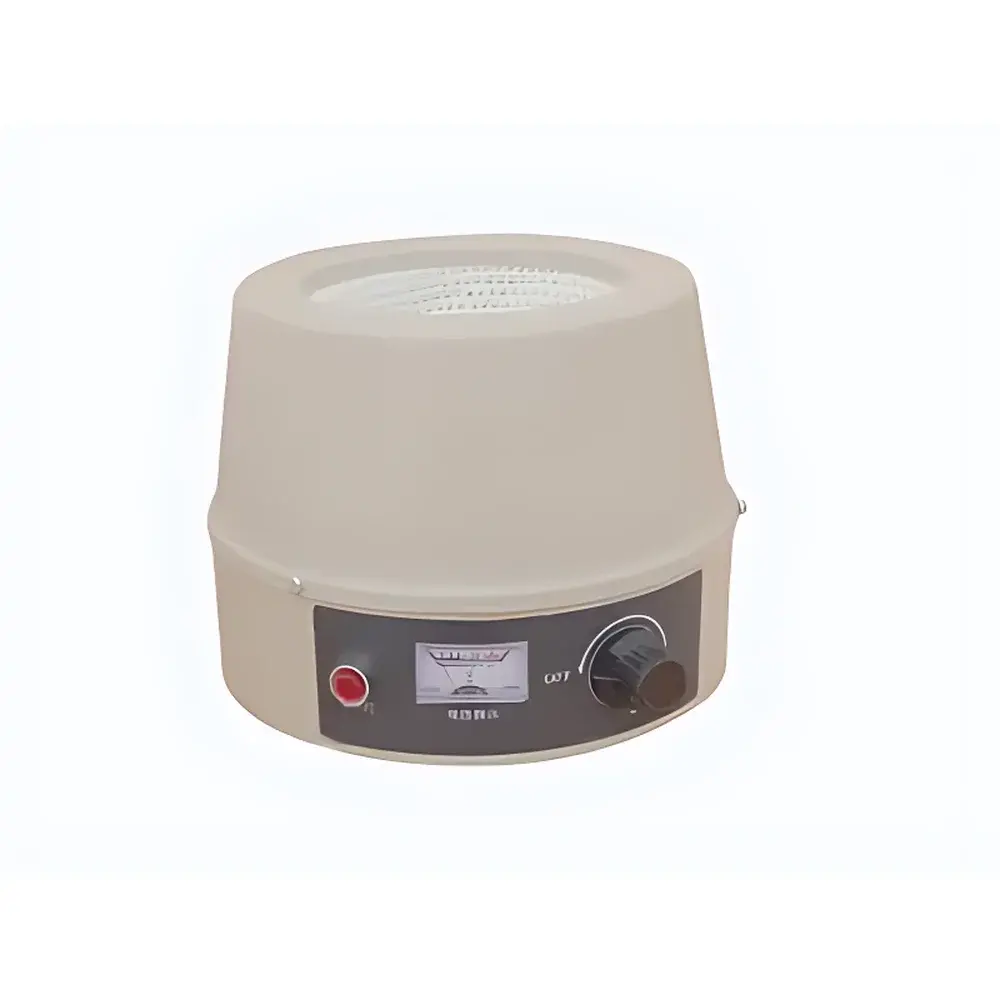
Jianfeng DZ Series Temperature-Controlled Electric Heating Mantle (100–2000 mL Capacity)
| Brand | Jianfeng |
|---|---|
| Origin | Jiangsu, China |
| Manufacturer Type | Authorized Distributor |
| Country of Origin | China |
| Model Range | 100–2000 mL |
| Voltage | 220 V ±10% AC |
| Max Surface Heater Temperature | 380 °C |
| Temperature Control Range | Ambient to 380 °C |
| Insulation Material | High-Temperature Alkali-Free Glass Fiber |
| Heating Element | Encapsulated Resistance Wire |
| Power Ratings | 100 W (100 mL) / 180 W (250 mL) / 250 W (500 mL) / 300 W (1000 mL) / 500 W (2000 mL) |
Overview
The Jianfeng DZ Series Temperature-Controlled Electric Heating Mantle is an engineered solution for precise, uniform, and flameless heating of laboratory glassware—primarily round-bottom flasks, distillation vessels, and reaction kettles—across capacities from 100 mL to 2000 mL. Designed on the principle of resistive radiant heating, the mantle integrates a tightly woven, semi-spherical heating element composed of resistance wire fully encapsulated within alkali-free glass fiber insulation. This construction eliminates exposed coils or open flames, minimizing thermal shock to glassware while ensuring broad-area contact heating and high thermal efficiency. Unlike hot plates or oil baths, the DZ mantle delivers directional heat transfer with minimal ambient energy loss, making it especially suitable for applications requiring stable thermal input under inert atmospheres, reflux conditions, or solvent-sensitive syntheses. Its maximum heater surface temperature of 380 °C supports high-boiling-point solvents (e.g., ethylene glycol, diphenyl ether) and moderate-temperature catalytic reactions—within safe operational limits defined by IEC 61010-1 for laboratory electrical equipment.
Key Features
- Flameless, contact-based heating architecture—eliminates ignition hazards and mechanical abrasion risk to glassware
- Alkali-free glass fiber insulation provides dielectric strength >3 kV/mm and thermal stability up to 600 °C, ensuring long-term insulation integrity even after repeated thermal cycling
- Electronically regulated voltage control via non-contact potentiometric circuitry—enables smooth, stepless adjustment across full output range without mechanical wear or contact arcing
- Integrated visual feedback: LED indicator lights and analog voltage meter provide real-time power delivery status for process repeatability
- Grounded metal-reinforced outer shell meets Class I protection requirements per IEC 61010-1; mandatory grounding terminal included for compliance with lab safety protocols
- Continuous-duty rated design supports unattended operation under GLP-aligned workflows when paired with external temperature monitoring
Sample Compatibility & Compliance
The DZ mantles are dimensionally optimized for standard ASTM E288-22 round-bottom flasks (e.g., 14/20, 19/22, 24/40 joints) and compatible with borosilicate 3.3 (e.g., Pyrex®, Duran®) and fused quartz vessels. The semi-spherical cavity geometry ensures ≥85% surface contact area coverage, reducing localized overheating and promoting thermal homogeneity. Not intended for use with pressurized reactors, microwave-active solvents, or halogenated hydrocarbons above 150 °C without supplemental venting. Complies with GB/T 12805–2011 (Chinese national standard for laboratory electric heating devices) and conforms to general safety clauses of ISO/IEC 17025:2017 regarding equipment suitability for accredited testing environments. CE marking not applicable; users must verify local regulatory acceptance prior to installation in EU-based facilities.
Software & Data Management
The DZ Series operates as a standalone analog-controlled instrument without embedded firmware or digital interfaces. Temperature regulation is achieved manually via front-panel voltage adjustment—making it inherently compliant with environments where electromagnetic interference (EMI) sensitivity or cybersecurity constraints prohibit microprocessor-based controllers. For laboratories operating under FDA 21 CFR Part 11 or EU Annex 11 requirements, external validation of temperature profiles is recommended using calibrated PT100 probes and data loggers (e.g., Omega OM-DAQPRO-5300). Audit trails for setpoint changes may be maintained manually in lab notebooks or integrated into ELN systems via operator-entered metadata. No firmware updates, cloud connectivity, or remote diagnostics are supported—ensuring deterministic behavior and eliminating software obsolescence risks.
Applications
- Solvent reflux and concentration in organic synthesis (e.g., esterification, Grignard reactions)
- Controlled evaporation of aqueous and organic extracts in environmental sample preparation (EPA Method 3510C)
- Pre-heating and thermal conditioning of reagents prior to HPLC or GC injection
- Viscosity measurement support for rotational rheometers requiring constant bath temperature
- Distillation setup heating in pharmaceutical QC labs (USP <1058> analytical instrument qualification)
- Educational demonstrations of thermodynamics and heat transfer principles in university teaching labs
FAQ
Is the DZ mantle compatible with Teflon-coated or stainless-steel reaction vessels?
No—this mantle is specifically engineered for thermal expansion matching and contact geometry with standard borosilicate glassware. Use with non-glass vessels may result in uneven heating, reduced efficiency, or mechanical damage.
What is the recommended break-in procedure before first use?
Initial conditioning requires slow ramping to 100 °C for 15 minutes, followed by cooling and repeat cycles until no visible white smoke (residual binder volatilization) is observed—typically 3–5 cycles. This ensures full polymerization of the glass fiber matrix.
Can the mantle be used in a fume hood with active airflow?
Yes, but airflow rates exceeding 0.5 m/s may reduce surface temperature stability by up to 15 °C; users should validate setpoints under actual hood conditions using a traceable thermometer.
Does the unit include over-temperature protection?
No independent thermal cutoff is built in. Safe operation relies on operator vigilance and external monitoring. We recommend pairing with a separate high-limit controller (e.g., Omega CNi16D) for critical applications.
What maintenance is required to sustain insulation performance?
Wipe exterior with dry lint-free cloth after each use; inspect for fiber fraying or carbon tracking annually. Do not immerse or clean with solvents—moisture ingress permanently degrades dielectric strength.



