
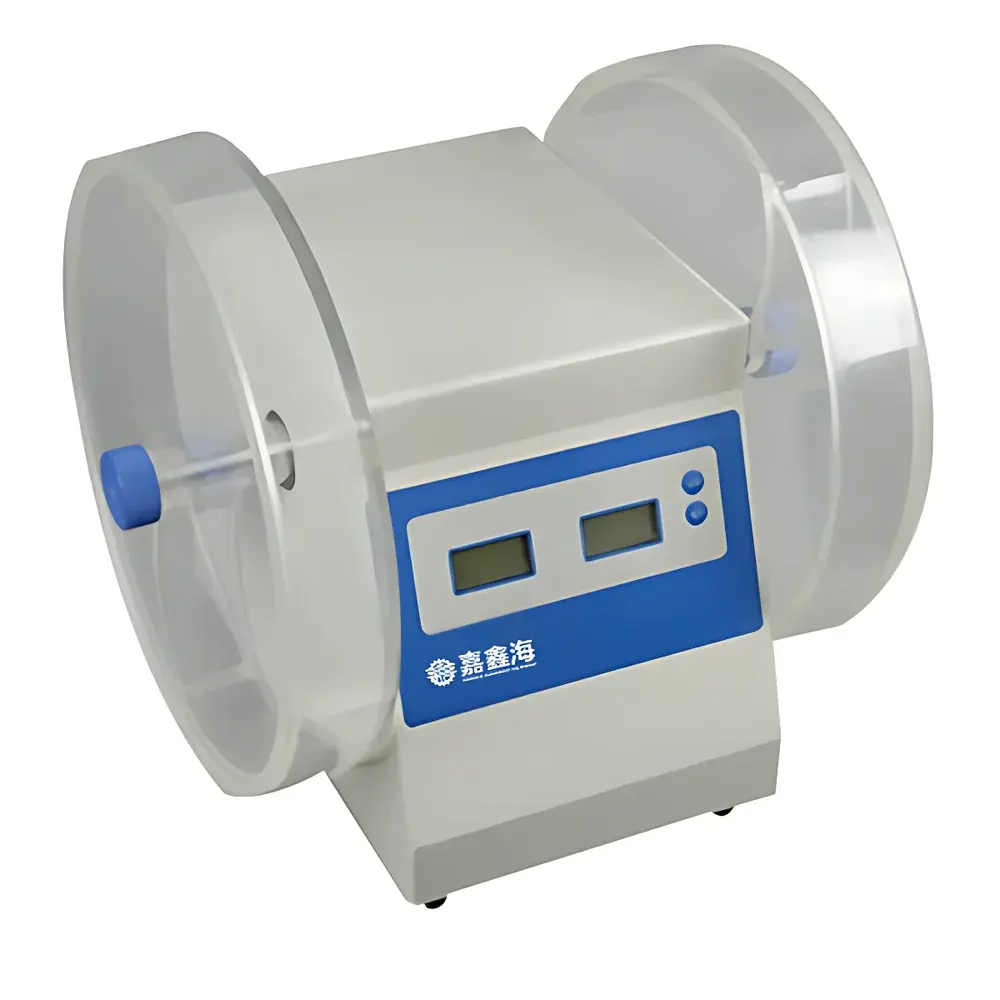
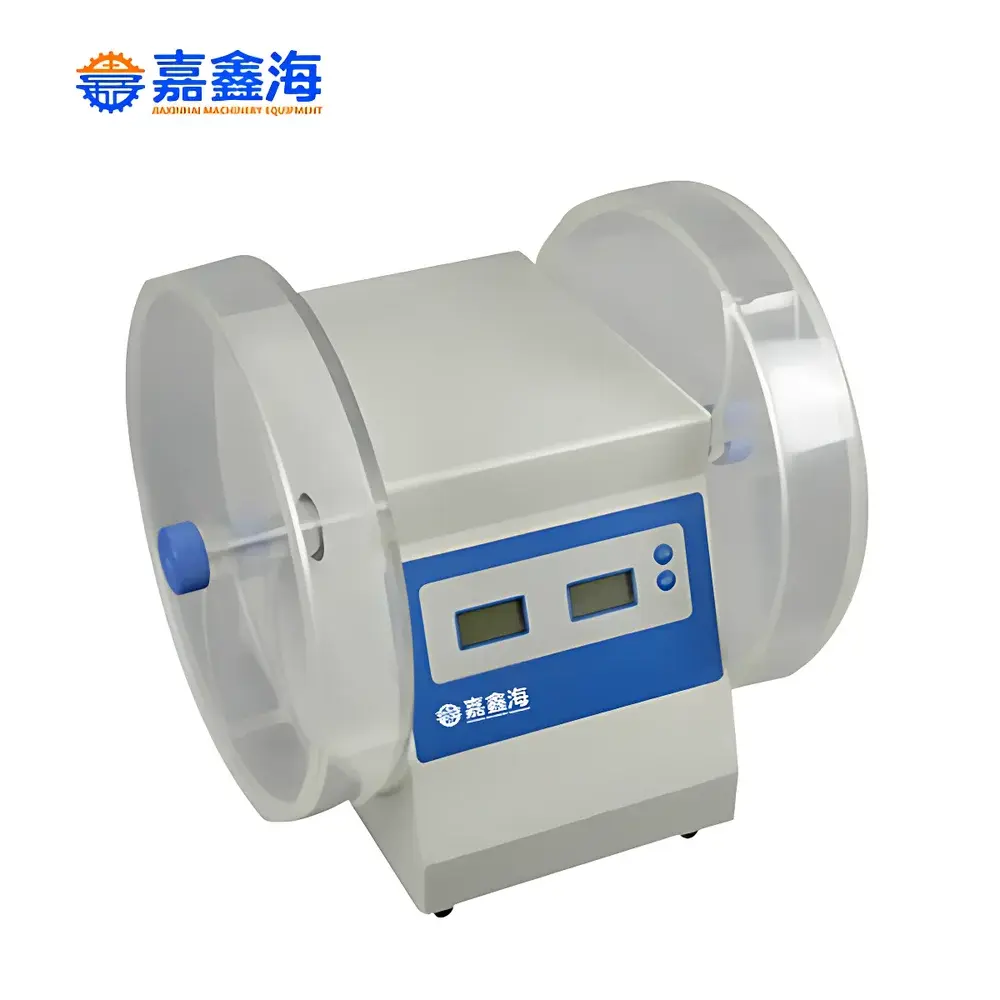
JIAXINHAI CS-2 Friability Tester
| Brand | JIAXINHAI |
|---|---|
| Origin | Tianjin, China |
| Manufacturer Type | Direct Manufacturer |
| Country of Origin | China |
| Model | CS-2 |
| Rotation Speed | 25 rpm ±1 rpm |
| Drum Quantity | 2 |
| Drum Internal Diameter | 286 mm |
| Drum Depth | 39 mm |
| Drop Height | 156 mm |
| Pre-set Revolution Count | 100 revolutions (downward counting) |
| Power Supply | 220 V, 50 Hz |
| Power Consumption | 20 W |
| Dimensions (L×W×H) | 370 mm × 300 mm × 340 mm |
| Display | LCD with simultaneous preset/real-time value display |
| Drum Material | High-transparency optical-grade acrylic |
| Control System | Microcontroller-based intelligent control |
| Compliance | Meets requirements of ChP (Chinese Pharmacopoeia), USP <1216>, and EP 2.9.7 |
Overview
The JIAXINHAI CS-2 Friability Tester is a precision-engineered laboratory instrument designed for the quantitative assessment of mechanical robustness in uncoated and film-coated pharmaceutical tablets. It operates on the standardized tumbling principle defined in pharmacopoeial monographs—specifically USP <1216>, European Pharmacopoeia 2.9.7, and Chinese Pharmacopoeia (ChP) Volume IV—where tablets are subjected to controlled rotational impact within a cylindrical drum under gravity-driven free-fall conditions. Each rotation lifts and drops the sample through a fixed vertical displacement (156 mm), simulating mechanical stresses encountered during packaging, transportation, and handling. The device delivers high reproducibility across repeated test cycles by maintaining strict adherence to the mandated 25 rpm ±1 rpm rotational speed and precisely timed 100-revolution endpoint. Its dual-drum configuration enables parallel testing of two independent sample batches under identical environmental and operational parameters, improving throughput without compromising inter-test comparability.
Key Features
- Microcontroller-based intelligent control system ensures stable, drift-free operation of both rotation speed and revolution count—eliminating manual timing errors and operator-dependent variability.
- Dual-drum architecture (2 × 286 mm internal diameter × 39 mm depth drums) allows concurrent evaluation of two distinct tablet formulations or batches, enhancing lab efficiency while preserving regulatory traceability per batch.
- Optical-grade transparent acrylic drums provide full visual access to sample behavior during testing—enabling real-time observation of chipping, cracking, or fragmentation patterns critical for root-cause analysis.
- LCD interface displays both preset parameters (target revolutions, nominal speed) and live operational values (elapsed revolutions, actual rpm), supporting immediate verification and GLP-compliant documentation.
- Self-terminating cycle logic automatically halts rotation upon reaching the pre-programmed 100-revolution count, preventing over-testing and ensuring consistency with pharmacopoeial methodology.
- Compact footprint (370 × 300 × 340 mm) and low power consumption (20 W) make it suitable for regulated QC laboratories with space constraints and energy efficiency requirements.
Sample Compatibility & Compliance
The CS-2 accommodates standard tablet sizes up to 25 mm in diameter and ≤10 g total mass per drum load, aligning with USP <1216> loading guidelines (typically 6.5 g ± 0.5 g for most solid dosage forms). It supports routine testing of immediate-release, sustained-release, enteric-coated, and effervescent tablets—provided samples meet minimum hardness thresholds to avoid premature disintegration during tumbling. All performance specifications—including rotational accuracy, drum geometry, drop height, and counting resolution—are validated against the physical design criteria outlined in ChP, USP, and EP. The instrument does not require calibration certificates for routine use but is compatible with external validation protocols (e.g., IQ/OQ/PQ) required under GMP Annex 15 and FDA 21 CFR Part 211. While the unit itself is not certified to IEC 61000-6-3 or ISO 13485, its construction and operational logic support integration into quality systems governed by ISO 9001 and ISO/IEC 17025.
Software & Data Management
The CS-2 operates as a standalone hardware platform with no embedded data export functionality; however, its deterministic control architecture ensures full auditability of test execution. All user inputs (e.g., target revolutions) and real-time outputs (actual rpm, elapsed count) are visible on the LCD panel—facilitating manual transcription into electronic lab notebooks (ELN) or LIMS entries. For labs requiring digital traceability, the device can be paired with external time-stamped video recording or integrated into automated workflows via optional RS-232 or TTL-level trigger interfaces (available upon request). While native software is not provided, the unit’s repeatable mechanical behavior satisfies FDA 21 CFR Part 11 requirements when used in conjunction with validated procedural controls—particularly where test initiation, parameter confirmation, and result recording follow documented SOPs with dual-operator verification.
Applications
- QC release testing of tablet batches prior to packaging, verifying compliance with friability limits (typically ≤1.0% weight loss).
- Formulation development studies assessing the impact of binder type, granulation method, or compression force on tablet mechanical stability.
- Stability program monitoring—tracking friability changes across accelerated and long-term storage conditions per ICH Q1 guidelines.
- Supplier qualification of excipients, especially those influencing particle cohesion (e.g., microcrystalline cellulose grades, disintegrants).
- Educational use in pharmacy and pharmaceutics curricula for hands-on demonstration of solid dosage form robustness principles.
- Regulatory submission support, providing raw data consistent with pharmacopoeial test descriptions for ANDA, NDA, or DMF dossiers.
FAQ
Does the CS-2 comply with USP <1216> and ChP friability testing requirements?
Yes—the instrument meets all geometric, kinematic, and procedural specifications cited in USP <1216>, ChP General Chapter 0921, and EP 2.9.7, including drum dimensions, rotation rate, drop height, and 100-revolution cycle definition.
Can the rotation speed be adjusted outside the standard 25 rpm?
No—the firmware is locked to 25 rpm ±1 rpm to maintain pharmacopoeial compliance; variable-speed operation would invalidate test validity under regulatory review.
Is calibration required before each test?
No formal calibration is mandated, but periodic verification of drum rotation speed using a calibrated tachometer and visual inspection of drum integrity are recommended as part of preventive maintenance per GMP Annex 15.
What maintenance procedures are recommended for long-term reliability?
Monthly cleaning of drum interiors with lint-free isopropyl alcohol wipes, biannual inspection of drive belt tension and motor coupling alignment, and annual verification of microcontroller timing accuracy using an external stopwatch and encoder feedback.
Does the CS-2 support GLP-compliant data archiving?
As a non-networked, non-data-logging device, it requires manual entry into ELN/LIMS systems—but its deterministic operation, visible real-time parameters, and automatic stop logic fully support GLP documentation practices when paired with standardized worksheet templates and reviewer sign-offs.






