
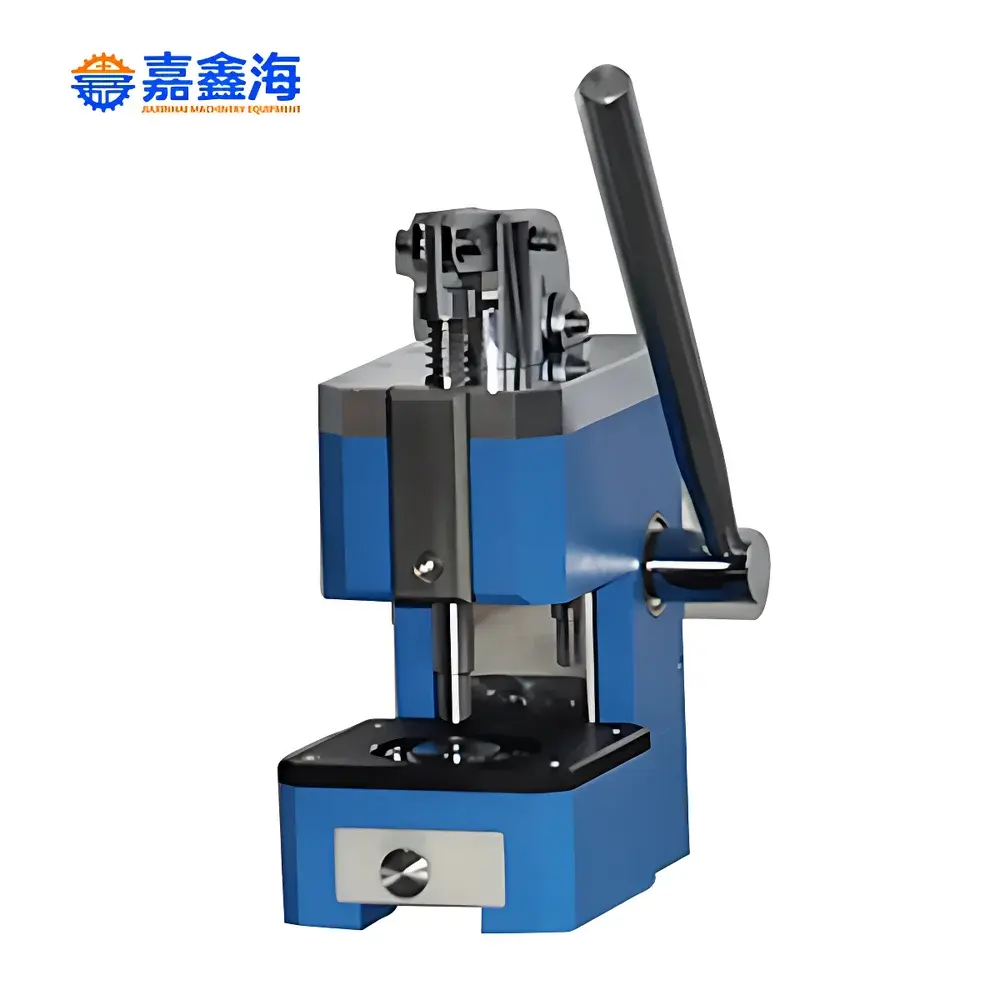
Jiaxinhai JPT-10 Button Cell Coin Cell Punching Machine
| Brand | Jiaxinhai |
|---|---|
| Origin | Tianjin, China |
| Manufacturer Type | Direct Manufacturer |
| Country of Origin | China |
| Model | JPT-10 |
| Price | USD 850 (FOB Tianjin) |
Overview
The Jiaxinhai JPT-10 Button Cell Coin Cell Punching Machine is a precision manual die-cutting instrument engineered for the consistent, repeatable preparation of circular electrode and separator discs used in laboratory-scale coin cell (CR2032, CR2025, etc.) fabrication. Unlike hydraulic or motorized systems, the JPT-10 employs a robust mechanical lever-arm mechanism to deliver controlled, uniform compressive force—enabling clean, burr-free cutting of thin, brittle, or layered materials such as lithium metal foils, graphite anodes, NMC cathodes, polymer separators (e.g., Celgard), and solid-state electrolyte membranes. Its design prioritizes dimensional accuracy (±0.05 mm diameter tolerance), edge integrity, and operator safety during high-frequency sample prep workflows common in battery R&D labs, QC environments, and university electrochemistry facilities.
Key Features
- Manual lever-driven actuation ensures precise, tactile control over punch force—eliminating variability from inconsistent hand pressure or motor speed drift.
- Interchangeable hardened steel die sets (standard 10 mm, 12 mm, 14 mm, 16 mm diameters) with replaceable tungsten-carbide cutting edges for extended service life and minimal material deformation.
- Adjustable depth stop prevents over-penetration into the lower anvil, protecting both die integrity and substrate backing plates (e.g., aluminum or stainless steel support blocks).
- Integrated alignment guide with vernier scale enables rapid repositioning of multi-layer stacks (electrode + separator + current collector) prior to punching—critical for minimizing misalignment-induced short-circuit risk in assembled cells.
- Compact benchtop footprint (220 × 150 × 280 mm) and corrosion-resistant powder-coated steel frame ensure stability on vibration-sensitive lab surfaces without anchoring requirements.
Sample Compatibility & Compliance
The JPT-10 accommodates substrates up to 0.5 mm thickness and hardness ≤ 200 HV—including metallic foils (Cu, Al, Li), carbon-coated films, ceramic-coated separators, and composite solid electrolytes. It is routinely used in protocols aligned with ASTM D790 (flexural properties of plastics), ISO 178 (determination of flexural modulus), and internal battery material qualification SOPs. While not certified to UL or CE for industrial production lines, its construction adheres to ISO 12100:2012 principles for mechanical safety in laboratory equipment. All tooling meets RoHS 2011/65/EU restrictions on hazardous substances.
Software & Data Management
As a fully manual, non-electronic device, the JPT-10 requires no firmware, drivers, or software integration. This architecture eliminates cybersecurity risks, power dependency, calibration drift, or compatibility constraints associated with digital controllers—making it ideal for GLP-compliant labs where audit trails must reflect physical process parameters (e.g., operator ID, date/time stamp, die set lot number, material batch code) recorded manually in bound lab notebooks per 21 CFR Part 11 Annex 11 guidance for paper-based systems. Optional traceability accessories include engraved serial-numbered die holders and calibrated micrometer verification kits (sold separately).
Applications
- Preparation of standardized electrode discs for half-cell and full-cell electrochemical testing (cycling, impedance spectroscopy, rate capability).
- Cutting separator membranes for dendrite penetration resistance studies under controlled stack pressure.
- Generating uniform solid electrolyte pellets for ionic conductivity measurement via AC impedance.
- Prototyping multilayer heterostructures (e.g., Li₃PS₄–LiNbO₃ composites) prior to hot-press sintering.
- Quality assurance sampling in pilot-line battery material synthesis—ensuring geometric consistency across batches prior to automated roll-to-roll processing.
FAQ
Is the JPT-10 compatible with lithium metal foil handling?
Yes—the low-force, slow-stroke mechanical action minimizes foil wrinkling, tearing, or oxidation exposure compared to high-speed rotary cutters. Use in an argon-filled glovebox is recommended for air-sensitive Li metal.
What maintenance does the JPT-10 require?
Monthly application of light mineral oil to the pivot pin and die guide rails; annual inspection of die edge wear using optical microscopy at 50× magnification.
Can custom die diameters be ordered?
Yes—Jiaxinhai offers OEM die fabrication for diameters from 8 mm to 25 mm with ±0.02 mm tolerance, subject to minimum order quantity of five sets.
Does the machine include calibration documentation?
Each unit ships with a factory-verified dimensional certificate (traceable to CNAS-accredited metrology lab) confirming anvil parallelism (< 5 µm deviation) and die concentricity (< 0.03 mm runout).
Is technical support available outside China?
Yes—remote troubleshooting, video-guided alignment procedures, and English-language SOP templates are provided free of charge for all international purchasers.



