
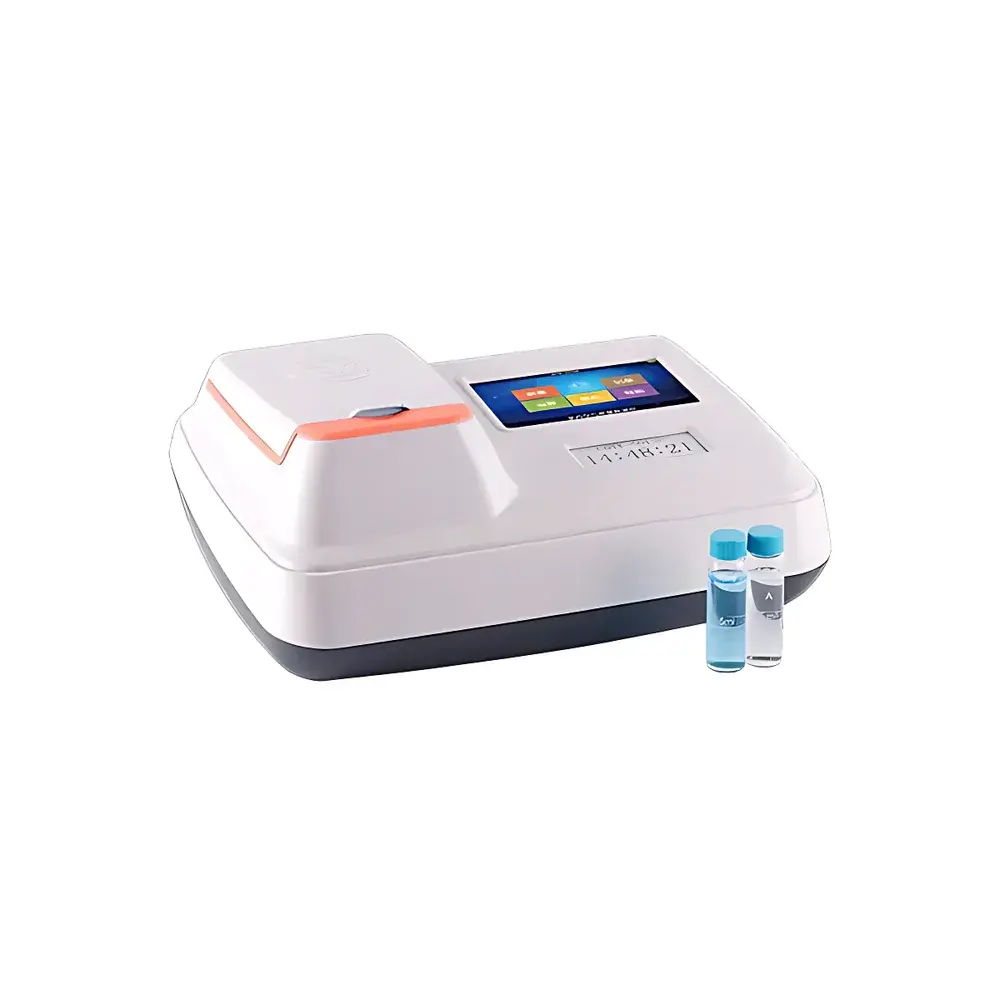
JiDa Xiaotian’e GDYJ-501SP Leather & Footwear Formaldehyde and Hexavalent Chromium Analyzer
| Brand | JiDa Xiaotian'e |
|---|---|
| Origin | Jilin, China |
| Model | GDYJ-501SP |
| Measurement Range | Formaldehyde: 0.0–125.0 mg/kg |
| Hexavalent Chromium | 0.0–50.0 mg/kg |
| Wavelengths | 412 nm (formaldehyde), 540 nm (Cr(VI)) |
| Detection Limits | Formaldehyde: 2.0 mg/kg |
| Cr(VI) | 0.5 mg/kg |
| Accuracy | ±5% |
| Operating Temperature | 10–40 °C |
| Power | 5 W |
| Input Voltage | AC 220 V ±10%, 50 Hz ±1 Hz |
| Display | 5″ color TFT touchscreen + 2.9″ e-ink customizable standby screen |
| Data Storage | ≥10,000 test records with conditional search |
| Connectivity | USB 2.0, RS232, Bluetooth (for wireless thermal printer) |
Overview
The JiDa Xiaotian’e GDYJ-501SP Leather & Footwear Formaldehyde and Hexavalent Chromium Analyzer is a dedicated benchtop spectrophotometric instrument engineered for precise, routine quantification of free and hydrolyzable formaldehyde and extractable hexavalent chromium (Cr(VI)) in leather, footwear, textiles, and related composite materials. It operates on established colorimetric principles compliant with major national and international regulatory methods—including GB/T 2912.1–2009 (formaldehyde) and GB/T 22807–2008 (Cr(VI))—and aligns functionally with ISO 17226-1:2014 and ISO 17075-1:2017. The system employs dual-wavelength optical detection (412 nm for formaldehyde–acetylacetone adduct formation; 540 nm for Cr(VI)–diphenylcarbazide complexation), ensuring high specificity and minimal interferences under controlled extraction conditions. Designed for QC laboratories in tanneries, footwear OEMs, third-party testing facilities, and regulatory compliance units, the GDYJ-501SP delivers reproducible results without requiring HPLC or ICP-MS infrastructure.
Key Features
- Dual-channel fixed-wavelength photometer with calibrated LED sources at 412 nm and 540 nm—no moving parts, no lamp replacement, long-term optical stability
- Integrated sample preparation guidance: pre-programmed extraction protocols aligned with GB/T 2912.1 and GB/T 22807, including temperature-controlled water bath timing cues
- 5-inch high-resolution color TFT touchscreen with intuitive icon-driven workflow navigation; supports multilingual UI (English, Chinese)
- Dedicated 2.9-inch e-ink standby display for customizable shutdown messages, batch ID labeling, or audit trail prompts—low-power, glare-free, and readable under ambient lab lighting
- Onboard data management: stores ≥10,000 test records with timestamp, operator ID, sample ID, method ID, raw absorbance, calculated concentration, and pass/fail flag per result
- Advanced query engine: filter records by date range, analyte type, sample ID prefix, or compliance status—exportable via USB to CSV or PDF report templates
- Standardized connectivity suite: native RS232 and USB 2.0 ports for LIMS integration; optional Bluetooth 4.2 module for certified thermal printers (e.g., Zebra ZQ520, Star SM-L200)
Sample Compatibility & Compliance
The GDYJ-501SP is validated for solid matrices commonly encountered in footwear and leather supply chain testing: full-grain and corrected-grain bovine leather, synthetic leathers (PU, PVC), lining fabrics (cotton, polyester blends), adhesives, and finished shoes (cut sections per ISO 17075-1 sampling guidelines). Sample preparation follows standardized aqueous extraction (buffered or distilled water, 60 °C, 60 min) prior to colorimetric reaction. All measurement protocols are traceable to reference standards issued by the China National Institute of Metrology (NIM) and cross-verified against Certified Reference Materials (CRMs) from LGC Standards (UK) and AccuStandard (USA). The instrument meets essential requirements of GB/T 27025–2019 (equivalent to ISO/IEC 17025:2017) for testing laboratories and supports GLP-compliant operation through mandatory electronic signature fields, audit-log timestamps, and immutable record archiving.
Software & Data Management
Firmware v3.2 includes embedded calibration verification routines, automatic blank subtraction, and real-time deviation alerts when absorbance exceeds linear range thresholds. Data export supports both structured formats (CSV with UTF-8 encoding, compatible with Excel, Minitab, and LabWare LIMS) and regulatory-ready PDF reports containing QR-coded test certificates. Optional PC software (GDYJ-PC Suite v2.1) enables remote firmware updates, method library synchronization, and automated generation of trend charts across batches. All stored records retain full metadata—including environmental temperature/humidity logged at time of analysis—and support FDA 21 CFR Part 11–compliant electronic signatures when paired with approved biometric or token-based authentication modules.
Applications
- Pre-shipment screening of leather components for EU REACH Annex XVII (formaldehyde ≤ 75 mg/kg; Cr(VI) ≤ 3 mg/kg) and US CPSIA compliance
- In-process quality control in tannery finishing lines to monitor residual formaldehyde after retanning and fatliquoring
- Supplier qualification audits requiring rapid, on-site verification of Cr(VI) in chrome-tanned hides
- Research into alternative tanning agents (e.g., glutaraldehyde, vegetable tannins) where Cr(VI) migration potential must be ruled out
- Third-party certification labs performing accredited testing per CNAS-CL01:2018 (ISO/IEC 17025)
FAQ
Does the GDYJ-501SP require external calibration standards for daily use?
No—each unit ships with two NIST-traceable CRMs (formaldehyde and Cr(VI)) for initial validation and quarterly recalibration. Routine checks use factory-preloaded zero and span points verified during startup self-test.
Can the instrument distinguish between total chromium and hexavalent chromium?
Yes—the method is specific to Cr(VI) only. Total chromium requires separate digestion (e.g., EPA 3060A) and ICP-OES analysis; this device does not measure trivalent or elemental chromium.
Is method validation documentation available for ISO/IEC 17025 accreditation?
Yes—full validation reports (linearity, LOD/LOQ, precision, robustness, matrix interference studies) and uncertainty budgets are provided in English upon request and meet ILAC-G8:2022 guidance.
What maintenance is required beyond routine cleaning?
None beyond wiping optical windows with lint-free tissue and 70% ethanol every 200 tests; no alignment, lamp replacement, or fluidics servicing needed due to solid-state optical design.
Related Products







