
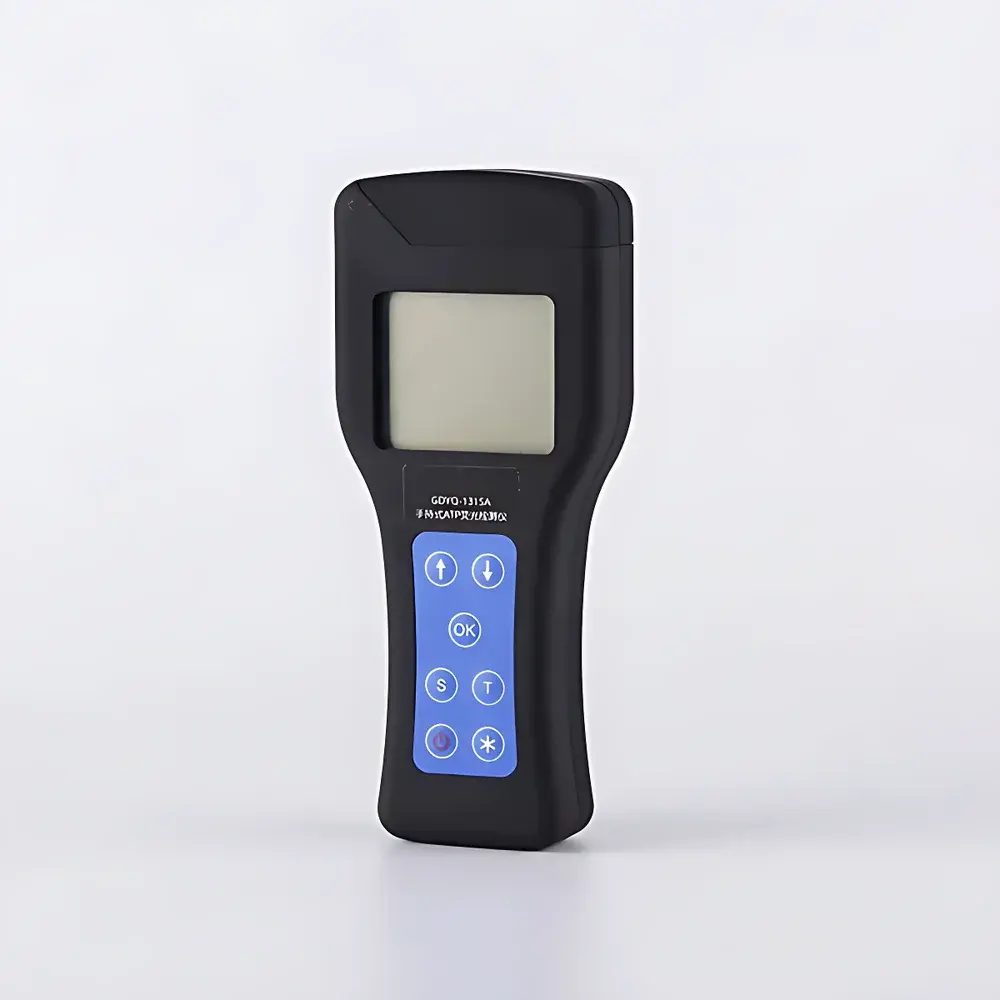
JiDa-Xiaotian’e GDYQ-131SA ATP Bioluminescence Analyzer
| Brand | JiDa-Xiaotian'e |
|---|---|
| Origin | Jilin, China |
| Manufacturer Type | Direct Manufacturer |
| Region of Origin | Domestic (China) |
| Model | GDYQ-131SA |
| Detection Time | 10 s |
| Detection Range | 0–9999 RLU |
| Limit of Detection | 4×10⁻¹⁸ mol ATP |
| Detection Lower Limit | 1 CFU/mL |
| Repeatability | ≤15% CV |
| Correlation Coefficient | ≥0.995 |
| Measurement Error | ±5% or ±5 RLU |
| Threshold Groups | 100 |
| Data Storage Capacity | >2000 records |
| Operating Temperature | 5–40 °C |
| Operating Relative Humidity | 20–80% RH |
| Weight | ~260 g |
| Battery Life | Up to 20 h continuous operation |
| Interface | USB/Bluetooth data export |
| Software Compatibility | Windows-based analysis suite with pass/fail logic engine |
Overview
The JiDa-Xiaotian’e GDYQ-131SA ATP Bioluminescence Analyzer is a compact, field-deployable instrument engineered for rapid, quantitative assessment of microbial contamination via adenosine triphosphate (ATP) bioluminescence detection. It operates on the principle of luciferase-catalyzed oxidation of ATP, where light emission intensity—measured in relative light units (RLUs)—is directly proportional to ATP concentration. This enzymatic reaction provides a surrogate metric for viable biomass, enabling real-time hygiene verification across food processing surfaces, equipment, and environmental swabs. Designed for high reproducibility and operational simplicity, the GDYQ-131SA meets core requirements for routine sanitation monitoring in compliance-driven environments including HACCP, ISO 22000, and FDA Food Safety Modernization Act (FSMA) preventive controls frameworks.
Key Features
- Quantitative detection sensitivity down to 4×10⁻¹⁸ mol ATP—enabling reliable detection at single-colony-forming-unit (CFU) levels (1 CFU/mL equivalent)
- Single-sample measurement completed within 10 seconds, supporting high-throughput screening in production line settings
- Ultra-portable form factor (260 g) with integrated rechargeable lithium battery delivering up to 20 hours of continuous operation without external power
- Minimalist human-machine interface with dedicated function keys and intuitive LCD display—designed for glove-compatible use in wet or cold environments
- Open reagent architecture compatible with commercially available ATP swab kits from multiple global suppliers (e.g., Hygiena, 3M, Charm Sciences), reducing consumable lock-in
- Onboard threshold management supporting up to 100 user-defined RLU limits per location or process step, with automatic pass/fail classification
- Robust mechanical housing rated for industrial food plant conditions—including resistance to condensation, dust ingress, and repeated disinfectant exposure
Sample Compatibility & Compliance
The GDYQ-131SA accepts standard ATP swab formats (100 mm × 100 mm surface area, liquid-phase extraction) and supports both direct surface swabbing and liquid sample dilution protocols. Its measurement traceability aligns with ISO 22000:2018 Annex A.3.7 (verification of cleaning effectiveness) and ASTM E2631-22 (Standard Practice for Determining Microbial Contamination on Surfaces Using ATP Bioluminescence). While not certified under FDA 21 CFR Part 11, the device generates audit-ready CSV logs containing timestamp, RLU value, operator ID, location tag, and pass/fail status—facilitating GLP-compliant record retention when paired with validated laboratory information management systems (LIMS).
Software & Data Management
Data export is supported via USB-C and Bluetooth 5.0 interfaces to Windows-based desktop software (v3.2+), which provides batch reporting, trend charting, statistical process control (SPC) overlays, and automated PDF certificate generation. The software enforces mandatory metadata entry (e.g., sampling site ID, analyst initials, cleaning agent used) and maintains immutable audit trails for all calibration events, threshold modifications, and data exports. Raw RLU values are stored with 16-bit resolution; no internal data compression or rounding is applied prior to export—ensuring full traceability for internal quality audits or third-party certification reviews.
Applications
- Routine hygiene verification of food contact surfaces (conveyor belts, fill nozzles, cutting boards, stainless-steel tanks)
- Validation and monitoring of CIP/SIP cycles in dairy, beverage, and ready-to-eat (RTE) facilities
- Environmental monitoring programs in low-moisture food manufacturing (e.g., nuts, cereals, powdered ingredients)
- Training and competency assessment for sanitation crews using objective, numerical feedback
- Pre-operational verification prior to startup in USDA-inspected meat and poultry plants
- Supplier qualification audits requiring rapid, standardized ATP benchmarking
FAQ
Does the GDYQ-131SA require daily calibration?
No—this instrument uses factory-calibrated photomultiplier tube (PMT) gain settings and does not require user-performed optical recalibration. However, daily performance verification using a certified ATP control swab (e.g., 100 RLU standard) is recommended per ISO 22000 Clause 8.4.3.
Can the device store historical data without connecting to a PC?
Yes—onboard non-volatile flash memory retains >2000 complete test records with full metadata, independent of external connectivity.
Is firmware upgrade capability supported?
Yes—field-upgradable firmware is distributed via encrypted USB key; version history and change logs are provided in English-language release notes compliant with IEC 62304 Class B software safety requirements.
What environmental conditions affect RLU accuracy?
Measurements remain stable between 5–40°C and 20–80% RH. Outside this range, luminase enzyme kinetics deviate; users must apply temperature-compensated RLU correction factors per ASTM E2631 Annex B if operating near specification boundaries.
How is measurement uncertainty quantified for regulatory submissions?
Total system uncertainty is ±5% RLU or ±5 RLU (whichever is greater), derived from combined contributions of photodetector noise, pipetting variability, and luciferase reagent lot-to-lot drift—validated per ISO/IEC 17025:2017 Clause 7.6.





