
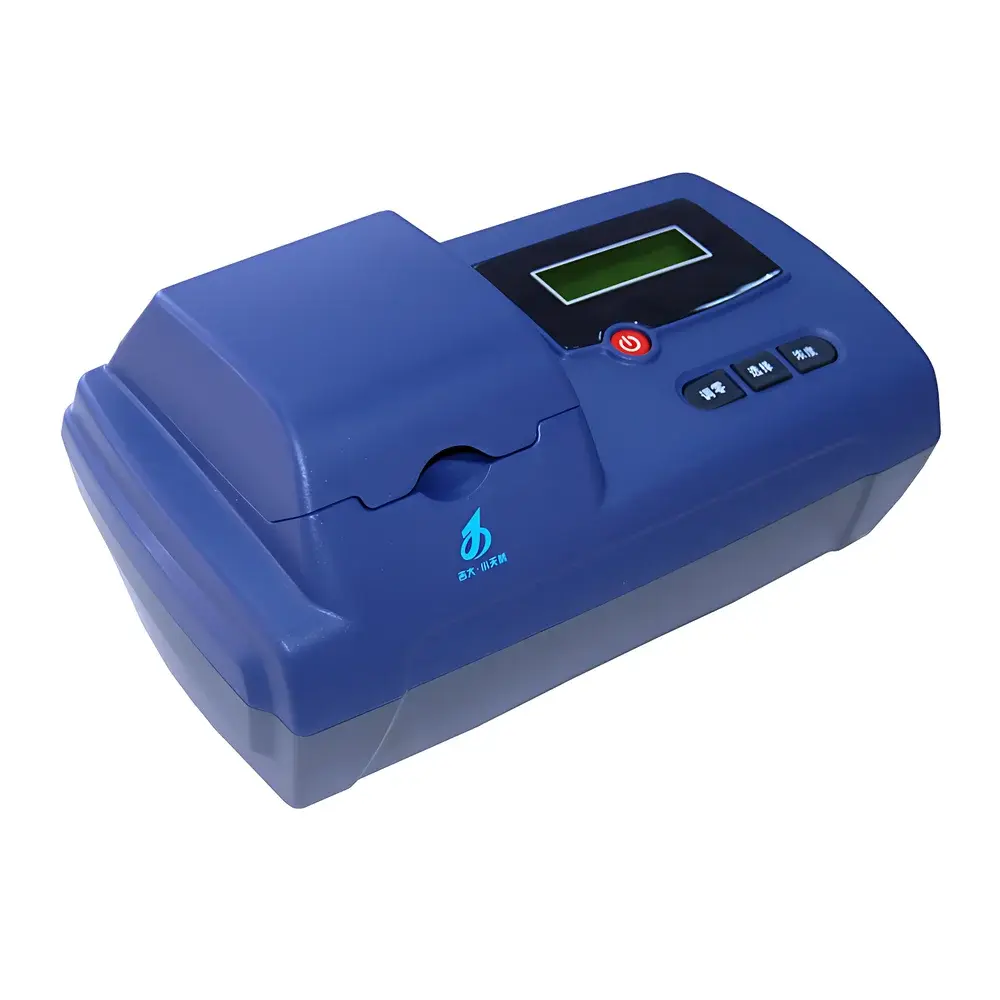
JiDa Xiaotian’e GDYS-101SE2 Chlorine Dioxide Analyzer
| Brand | JiDa Xiaotian'e |
|---|---|
| Origin | Jilin, China |
| Manufacturer Type | Direct Manufacturer |
| Origin Category | Domestic (China) |
| Model | GDYS-101SE2 |
| Instrument Type | Portable |
| Measurement Principle | DPD-based Spectrophotometry |
| Measured Parameter | Chlorine Dioxide (ClO₂) |
| Measurement Range | 0.00–3.00 mg/L |
| Accuracy | ≤5% |
| Repeatability | ±0.01 mg/L |
| Resolution | 0.01 mg/L |
| Limit of Detection (LOD) | 0.02 mg/L |
| Light Source | 520 nm LED |
| Photometric Stability | ±0.005 Abs / 20 min |
| Measurement Time | 1 minute |
| Operating Temperature | 15–40 °C |
| Power Supply | DC 9 V (battery-powered) |
| Dimensions | 170 × 90 × 35 mm |
| Weight | 300 g |
Overview
The JiDa Xiaotian’e GDYS-101SE2 Chlorine Dioxide Analyzer is a field-deployable, portable spectrophotometric instrument engineered for rapid, on-site quantification of aqueous chlorine dioxide (ClO₂) concentration in drinking water, wastewater effluents, disinfection process streams, and distribution system monitoring points. It operates on the standardized N,N-diethyl-p-phenylenediamine (DPD) colorimetric method—fully compliant with GB/T 5750.11–2006, the Chinese national standard for drinking water quality analysis. The device integrates a solid-state 520 nm light-emitting diode (LED) as both light source and optical filter, eliminating moving parts and conventional monochromators. This optomechanically robust architecture ensures high photometric stability (±0.005 Abs over 20 minutes), resistance to vibration and humidity, and extended operational lifetime (>100,000 hours for the LED source). Designed for routine compliance verification and process control, the GDYS-101SE2 delivers trace-level sensitivity with a limit of detection (LOD) of 0.02 mg/L and a linear dynamic range spanning 0.00–3.00 mg/L—covering critical regulatory thresholds for ClO₂ residual monitoring per WHO, EPA, and municipal water safety guidelines.
Key Features
- Integrated LED-based optical system: 520 nm emitter functions simultaneously as light source and spectral selector—no external filters or gratings required.
- Pre-calibrated factory-built calibration curve stored in non-volatile memory; eliminates need for manual standard solution preparation prior to field use.
- One-button zero calibration followed by single-step reagent addition (pre-packaged DPD test kits); full measurement completes within 60 seconds.
- Compact, ruggedized housing (170 × 90 × 35 mm; 300 g) optimized for handheld operation in field environments, mobile labs, and utility vehicle deployment.
- Intelligent power management: auto-shutdown after 30 minutes of inactivity; real-time battery level diagnostics with low-power alert.
- DC 9 V battery operation enables continuous field use without AC infrastructure—ideal for remote sampling stations and emergency response scenarios.
Sample Compatibility & Compliance
The GDYS-101SE2 is validated for direct analysis of clarified aqueous samples including treated drinking water, filtered surface water, chlorinated cooling tower make-up, and post-disinfection process water. Turbid or highly colored matrices require pre-filtration (≤0.45 µm membrane) to avoid scattering interference. The DPD methodology employed is chemically selective for free chlorine dioxide under neutral-to-slightly-acidic conditions (pH 6.2–7.2); interference from free chlorine, chloramines, and oxidized manganese is minimized through proprietary reagent formulation and timed reaction kinetics. Regulatory alignment includes conformance with GB/T 5750.11–2006 and technical equivalence to APHA Standard Methods 4500-ClO₂ D (2022 edition). While not FDA 21 CFR Part 11–certified out-of-the-box, the instrument supports GLP-compliant documentation when paired with laboratory-controlled sample logging and manual audit trails.
Software & Data Management
The GDYS-101SE2 operates as a standalone embedded system with no onboard data storage or USB/Bluetooth connectivity. All measurements are displayed in real time on a high-contrast LCD screen and must be manually recorded. No firmware updates, PC software, or cloud synchronization capabilities are provided. This design prioritizes operational simplicity, electromagnetic immunity, and long-term reliability in uncontrolled field settings—consistent with ISO/IEC 17025:2017 Clause 5.9.2 requirements for equipment used in accredited testing where data integrity is maintained via procedural controls rather than electronic audit trails.
Applications
- Routine residual ClO₂ verification at water treatment plant contact tanks and clearwells.
- Field validation of point-of-use (POU) and point-of-entry (POE) disinfection systems.
- Emergency response monitoring during outbreak investigations or infrastructure failure events.
- QA/QC checks for bottled water production lines and food processing rinse water.
- Educational laboratories requiring cost-effective, maintenance-free ClO₂ teaching platforms.
FAQ
Does the GDYS-101SE2 require daily recalibration?
No—zero-point calibration is performed once per session using deionized water; the built-in calibration curve remains stable across ambient temperatures (15–40 °C) and does not drift under normal field conditions.
Can it measure free chlorine and chlorine dioxide simultaneously?
No—the GDYS-101SE2 is dedicated exclusively to chlorine dioxide quantification via DPD Method 4500-ClO₂ D. Separate instrumentation is required for free chlorine or total chlorine analysis.
What reagent format is supported?
Only factory-sealed, lyophilized DPD reagent packets (designed specifically for GDYS-101SE2) are compatible; third-party or bulk reagents are not validated and may compromise accuracy.
Is the instrument suitable for wastewater with high organic load?
It is intended for clarified, low-turbidity samples. For raw or secondary effluent, centrifugation or 0.45 µm filtration is mandatory prior to analysis to prevent optical interference.
What is the expected service life of the optical module?
The integrated 520 nm LED source is rated for >100,000 hours of operation; no periodic lamp replacement or optical alignment is required during the instrument’s functional lifetime.







