
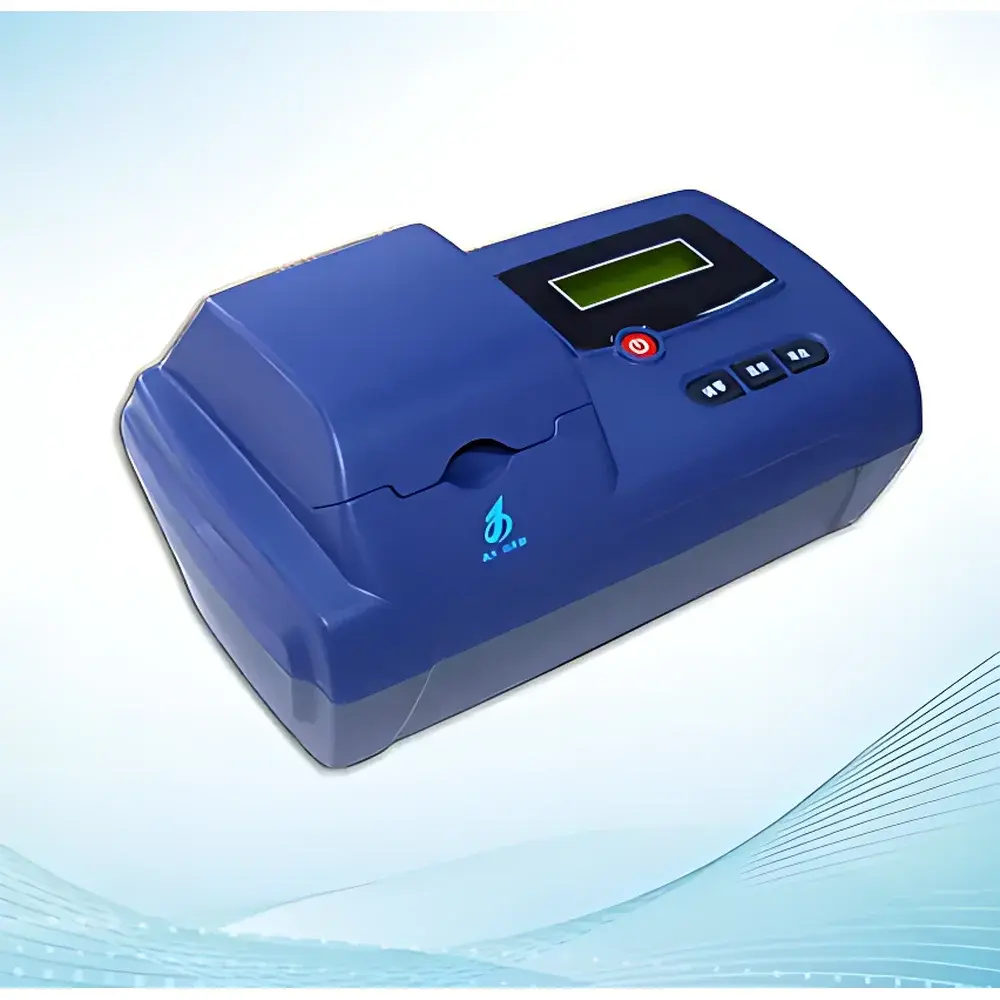
JiDa-Xiaotian’e GDYS-101SG Hexavalent Chromium Water Analyzer
| Brand | JiDa-Xiaotian'e |
|---|---|
| Origin | Jilin, China |
| Manufacturer Type | Direct Manufacturer |
| Country of Origin | China |
| Model | GDYS-101SG |
| Instrument Type | Portable/Handheld Water Quality Analyzer |
| Target Analyte | Hexavalent Chromium (Cr(VI)) |
| Detection Limit | 0.01 mg/L |
| Measurement Range | 0.00–1.00 mg/L |
| Accuracy | ±5% |
| Method Compliance | GB/T 5750.6–2006 |
| Analysis Time | ≤3 minutes per sample |
| Reagent Format | Single-use, pre-packaged test kit |
Overview
The JiDa-Xiaotian’e GDYS-101SG Hexavalent Chromium Water Analyzer is a field-deployable, colorimetric photometric instrument engineered for rapid, on-site quantification of hexavalent chromium (Cr(VI)) in aqueous matrices. It operates on the principle of diphenylcarbazide (DPC) derivatization — a well-established spectrophotometric method standardized in GB/T 5750.6–2006, China’s national standard for drinking water quality testing. In this reaction, Cr(VI) under acidic conditions oxidizes DPC to form a stable violet-colored complex with maximum absorbance at 540 nm. The analyzer integrates an embedded LED-based optical system, calibrated photodetector, and microprocessor-controlled signal processing to convert absorbance into concentration values (mg/L) directly. Designed for environmental monitoring professionals, water utility field technicians, and regulatory compliance officers, the GDYS-101SG delivers laboratory-grade repeatability in a rugged, battery-powered handheld format — eliminating the need for centralized lab analysis during routine surveillance or emergency response.
Key Features
- Field-validated compliance with GB/T 5750.6–2006 — fully traceable to China’s statutory methodology for Cr(VI) determination in drinking water and environmental waters.
- Three-minute total assay time: includes reagent addition, mixing, reaction incubation, and optical readout — enabling high-throughput screening across multiple sampling points per shift.
- Integrated single-use test kits: each sealed vial contains pre-measured, stabilized DPC reagent and buffer, minimizing operator error, cross-contamination risk, and calibration drift between batches.
- Self-contained optical path with temperature-compensated LED light source and silicon photodiode detector — optimized for stability across ambient temperatures from 5 °C to 40 °C.
- Non-volatile memory stores up to 500 measurement records with timestamp, sample ID, and operator code — supporting basic data traceability requirements under GLP-aligned workflows.
- IP65-rated enclosure with rubberized grip and shock-absorbing housing — certified for operation in humid, dusty, or intermittently wet field environments typical of wastewater outfalls, riverbanks, or industrial discharge zones.
Sample Compatibility & Compliance
The GDYS-101SG is validated for direct analysis of unfiltered, non-turbid aqueous samples including distilled water, potable water, domestic wastewater, surface water (rivers, lakes), seawater (with salinity correction applied via built-in algorithm), and industrial effluents. Samples containing suspended solids >50 NTU require optional filtration using 0.45 µm membrane filters prior to analysis to prevent optical interference. Interference assessment per GB/T 5750.6–2006 confirms minimal impact from common ions (e.g., Fe³⁺ ≤ 2 mg/L, Cu²⁺ ≤ 1 mg/L, NO₃⁻ ≤ 50 mg/L); higher concentrations necessitate matrix-matched calibration or pretreatment. While not certified to ISO/IEC 17025 or EPA Method 7196A, its performance characteristics align with the precision and detection capability thresholds required for Tier-1 screening under China’s Environmental Monitoring Technical Specifications (HJ/T 91–2002) and MoE’s Surface Water Quality Assessment Guidelines.
Software & Data Management
Data export is supported via USB-C interface to Windows-compatible desktop software (supplied on encrypted USB drive). The application enables batch download, CSV export, calibration curve review, and report generation compliant with internal QA documentation standards. Audit trail functionality logs all user-initiated actions (e.g., calibration, zero adjustment, firmware update) with timestamps — though full 21 CFR Part 11 electronic signature support is not implemented. Firmware updates are performed offline using signed binary files; no cloud connectivity or remote access capabilities are included, ensuring data sovereignty and network isolation in sensitive infrastructure settings.
Applications
- Routine monitoring of Cr(VI) at municipal water treatment plants — particularly post-coagulation and pre-distribution points.
- Regulatory inspections of electroplating, leather tanning, and pigment manufacturing facilities under China’s Discharge Permit System.
- Emergency response to suspected chromium contamination events (e.g., spillage, pipeline rupture) where real-time decision-making informs containment and remediation priorities.
- Academic and research field studies assessing Cr(VI) speciation dynamics in redox-sensitive aquifers or estuarine mixing zones.
- Third-party environmental consulting firms conducting baseline surveys for EIA (Environmental Impact Assessment) reporting.
FAQ
What is the shelf life of the reagent kits?
Each sealed DPC test kit remains stable for 18 months when stored at 2–8 °C; room-temperature storage (≤30 °C) reduces viability to 12 months.
Can the instrument measure total chromium?
No — the GDYS-101SG is analyte-specific to Cr(VI) only. Total chromium requires separate digestion (e.g., UV-peroxidation) followed by reduction to Cr(III) and subsequent Cr(VI)-equivalent measurement, which is outside the device’s operational scope.
Is calibration verification required before each use?
A blank (reagent-only) measurement is mandatory per test sequence; factory calibration is valid for 12 months or 200 tests — whichever occurs first — and may be verified using supplied 0.10 mg/L Cr(VI) reference standard solution.
Does the instrument meet international export certification requirements?
It carries CCC (China Compulsory Certification) and meets CE EMC Directive 2014/30/EU for electromagnetic compatibility; however, it lacks RoHS recertification or IEC 61000-4 series immunity testing reports required for EU market placement.
How is interference from chloride ions managed in seawater analysis?
The instrument applies an embedded correction algorithm based on conductivity input (measured separately) to compensate for chloride-induced absorbance suppression, as validated per HJ 669–2013 for marine water testing protocols.
Related Products







