
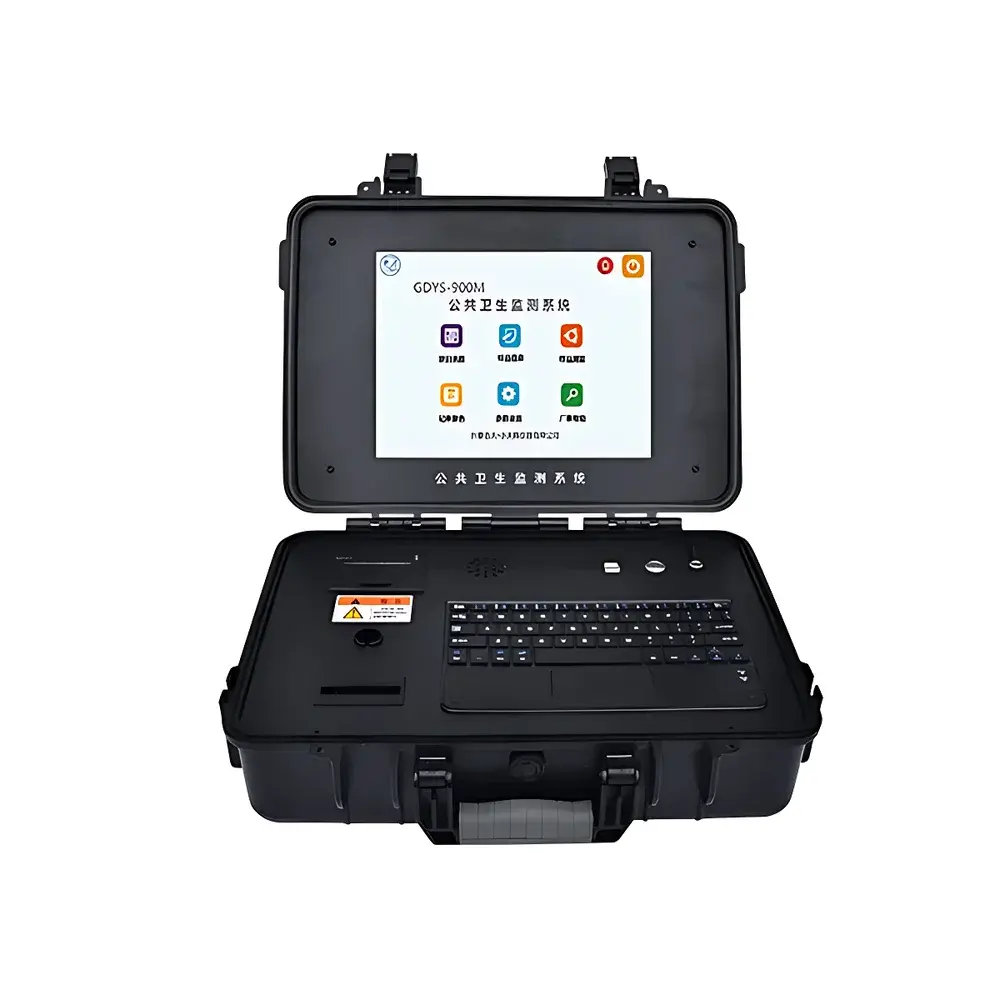
JiDa Xiaotian’e GDYS-900M Portable Multi-Parameter Public Health Monitoring System
| Brand | JiDa Xiaotian'e |
|---|---|
| Origin | Jilin, China |
| Model | GDYS-900M |
| Instrument Type | Portable/HANDHELD Water & Air Quality Analyzer |
| Detection Parameters | Residual Chlorine, Total Chlorine, Ozone, Chlorine Dioxide, Ammonia Nitrogen, Sulfide (Water) |
| Light Source | High-Brightness LED |
| Wavelengths | 380, 430, 470, 520, 538, 595, 630 nm |
| Photometric Stability | ≤0.005 Abs/h |
| Operating Temperature | 5–40 °C |
| Detector | Integrated Photodiode Sensor |
| Sample Cell | Cylindrical Glass Cuvettes & Standard Glass Cuvettes |
| Power Supply | AC/DC Dual Mode |
| Data Storage | 32 GB internal flash memory |
| Connectivity | USB 2.0, RJ45 Ethernet, Built-in Wi-Fi (IEEE 802.11 b/g/n) |
| Display | Color TFT Touchscreen |
| OS | Windows Embedded Standard 7 |
| Onboard Software | Preloaded calibration curves, sample metadata entry (sample ID, analyte, operator, lab name), audit-ready data logging |
| Printing | Integrated thermal printer + external printer support via USB/Ethernet/Wi-Fi |
Overview
The JiDa Xiaotian’e GDYS-900M Portable Multi-Parameter Public Health Monitoring System is an integrated field-deployable analyzer engineered for simultaneous quantitative determination of critical chemical contaminants in water and indoor air matrices. It operates on the principle of absorbance-based photometry—utilizing high-stability, narrow-bandwidth LEDs at seven discrete wavelengths (380–630 nm) to enable selective quantification of colorimetrically reactive analytes. The system implements standardized spectrophotometric methods aligned with common regulatory protocols—including EPA Method 334.0 (chlorine species), ISO 7890-3 (ammonia nitrogen), HJ 501–2009 (formaldehyde), and GB/T 5750.11–2023 (sulfide)—without requiring manual standard curve preparation. Its compact, ruggedized chassis and dual-mode power architecture make it suitable for unattended operation during mobile environmental surveillance, emergency response deployments, routine municipal drinking water audits, and indoor air quality (IAQ) assessments in schools, hospitals, and public buildings.
Key Features
- Windows Embedded Standard 7 operating system with intuitive touchscreen interface and physical QWERTY keyboard for reliable field data entry under variable lighting or glove-use conditions
- Pre-programmed, factory-validated calibration curves for all supported analytes—eliminating on-site standard solution preparation and reducing procedural variability
- Dual-power capability: seamless transition between AC mains and high-capacity lithium-ion battery (≥10,000 mAh), delivering ≥4 hours of continuous measurement cycles at full functionality
- Integrated thermal printer enabling immediate hardcopy generation of measurement records—including timestamp, sample ID, detected concentration, method ID, and operator signature field
- Comprehensive connectivity suite: USB 2.0 host/device mode, 10/100 Mbps Ethernet (RJ45), and IEEE 802.11 b/g/n Wi-Fi for real-time data synchronization with LIMS or cloud-based dashboards
- 32 GB onboard NAND flash storage with automatic file versioning and time-stamped audit logs compliant with GLP data integrity expectations
- Optical path optimized for low-stray-light performance: fixed-wavelength LED illumination paired with precision-matched photodiode detection ensures repeatability ≤0.005 Abs/h over extended field sessions
Sample Compatibility & Compliance
The GDYS-900M accepts standard 10 mm and 16 mm pathlength glass cuvettes and cylindrical borosilicate vials, accommodating both liquid-phase water samples (tap, surface, groundwater) and air-derived aqueous extracts (e.g., formaldehyde absorbed in DNPH cartridges or ammonia collected in dilute sulfuric acid). All analytical methods implemented are traceable to national standard reference materials (GBW series) and harmonized with ISO/IEC 17025 requirements for testing laboratories. While not certified to FDA 21 CFR Part 11 out-of-the-box, its software architecture supports configurable user access levels, electronic signature prompts, and immutable audit trails—enabling validation per GMP/GLP frameworks when deployed within regulated public health laboratories.
Software & Data Management
The embedded application provides structured data capture across three tiers: (1) pre-analysis metadata (sample location, collector ID, sampling date/time), (2) real-time instrument diagnostics (lamp intensity, dark current, temperature drift), and (3) post-processing results with uncertainty estimation based on signal-to-noise ratio and curve-fit residuals. Export formats include CSV, PDF (print-ready reports), and XML (for LIMS ingestion). Wi-Fi-enabled firmware updates ensure long-term method compliance with evolving Chinese Ministry of Ecology and Environment (MEE) and National Center for Disease Control and Prevention (China CDC) technical guidelines.
Applications
- Routine verification of residual disinfectant levels in municipal distribution systems and point-of-use devices
- Emergency screening for chlorine dioxide or ozone breakthrough following water treatment plant incidents
- Indoor air quality monitoring in newly renovated facilities to verify formaldehyde and ammonia concentrations against GB/T 18883–2022 limits
- Field assessment of sulfide contamination in anaerobic groundwater sources near agricultural or industrial zones
- Public health outbreak investigations requiring rapid triage of multiple waterborne and airborne toxicants across geographically dispersed sites
FAQ
Does the GDYS-900M support custom method development or user-defined wavelength selection?
No. The system operates exclusively with its seven factory-aligned LED wavelengths and preloaded chemometric algorithms. Modification of optical configuration or calibration logic requires authorized service intervention.
Is the device compatible with third-party LIMS platforms via HL7 or ASTM E1384?
It exports structured CSV and XML files containing analyte IDs, concentration values, units, timestamps, and QC flags—enabling integration with most modern LIMS via middleware or scripted ingestion; native HL7/ASTM E1384 drivers are not included.
What maintenance intervals are recommended for field calibration verification?
Users should perform daily zero-point verification using blank reagent and weekly span-check with NIST-traceable standards; annual optical alignment and detector linearity validation are advised per manufacturer service bulletin.
Can the internal battery be replaced in the field without tools?
No. Battery replacement requires disassembly by certified technicians to maintain IP54 ingress protection rating and optical path sealing integrity.







