
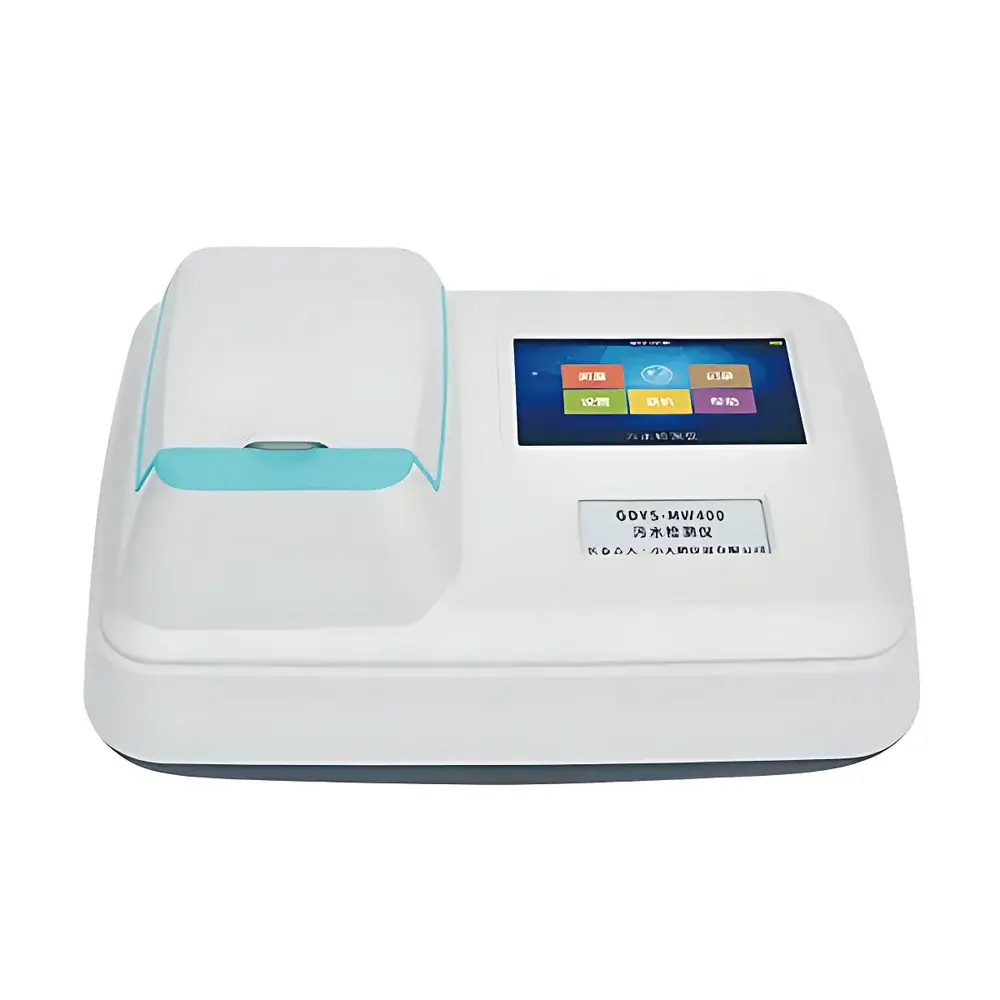
JiDa-Xiaotian’e GDYS-MW400 Portable Multi-Parameter Water Quality Analyzer
| Brand | JiDa-Xiaotian'e |
|---|---|
| Origin | Jilin, China |
| Model | GDYS-MW400 |
| Instrument Type | Portable / Handheld Water Quality Analyzer |
| Detection Parameters | Total Phosphorus, Ammonia Nitrogen, Total Nitrogen, Chemical Oxygen Demand (COD) (High-Range & Low-Range) |
| Wavelengths | 380 / 430 / 470 / 520 / 538 / 595 / 630 nm |
| Photometric Stability | ±0.005 Abs/h |
| Detector | Integrated Photodiode Sensor |
| Light Source | High-Brightness LED (100,000 h lifetime) |
| Sample Cells | 19 mm cylindrical glass cuvettes & 50 mm rectangular glass cuvettes |
| Power Supply | AC 220 V ±10 %, 50 Hz ±1 Hz / Rechargeable Li-ion battery (8.4 V, 1800 mAh) |
| Operating Temperature | 5–40 °C |
| Dimensions | 310 × 225 × 125 mm |
| Weight | 1.7 kg |
| Data Interfaces | USB 2.0, RS-232 |
| Connectivity | Bluetooth (for printer pairing), PC software for Excel export and report generation |
Overview
The JiDa-Xiaotian’e GDYS-MW400 is a field-deployable, multi-parameter photometric water quality analyzer engineered for rapid, on-site quantification of key regulatory and operational parameters in wastewater, surface water, groundwater, and drinking water sources. It operates on the principle of spectrophotometric absorption analysis—utilizing discrete, user-selectable LED light sources at seven fixed wavelengths (380, 430, 470, 520, 538, 595, and 630 nm) to excite colorimetric reactions in pre-formulated reagent vials. The instrument measures absorbance changes in accordance with Beer-Lambert law, converting optical signals into concentration values via factory-calibrated and user-expandable calibration curves. Its modular optical architecture—integrating light source, monochromator-free wavelength selection, sample chamber, and photodiode detector into a single compact module—ensures high reproducibility and minimal optical drift (< ±0.005 Abs/h), critical for compliance-driven environmental monitoring workflows.
Key Features
- Integrated optical engine with ultra-long-life LEDs (rated >100,000 hours), eliminating lamp replacement and spectral drift concerns associated with tungsten-halogen or xenon sources.
- Dual-display interface: primary 4.7-inch color TFT LCD showing real-time concentration, absorbance (Abs), and transmittance (%T); secondary customizable display for status flags, batch ID, or QC prompts.
- Pre-loaded method library supporting four core EPA- and ISO-aligned parameters: Total Phosphorus (0.02–100.00 mg/L, segmented range), Ammonia Nitrogen (0.10–200.00 mg/L), Total Nitrogen (0.50–500.0 mg/L), and COD (dual-range: 5–100 mg/L low-range; 50–20,000 mg/L high-range).
- Single-channel, multi-wavelength measurement capability—no moving parts or filter wheels—reducing mechanical failure points and enabling rapid assay switching without recalibration.
- Onboard data management: stores up to 2,000 test records with timestamp, operator ID, calibration ID, and raw absorbance values; supports user-defined project tagging and QC flagging (e.g., “Field Blank”, “Spike Recovery”).
- Flexible power architecture: AC mains operation with automatic battery charging and seamless switchover to internal 8.4 V / 1800 mAh Li-ion battery—providing ≥8 hours continuous use under typical field conditions.
Sample Compatibility & Compliance
The GDYS-MW400 accepts standard 19 mm round glass cuvettes (for routine low-volume assays) and 50 mm rectangular glass cells (for higher-volume or turbid samples requiring path-length extension). All detection protocols are compatible with EPA Method 365.4 (Total Phosphorus), EPA Method 350.1 (Ammonia Nitrogen), ISO 11908:2015 (Total Nitrogen), and ISO 6060:1989 (COD). While not certified to ISO/IEC 17025 as a standalone testing laboratory, the instrument meets functional performance criteria outlined in ASTM D5116–22 (Standard Guide for Laboratory Design for Environmental Analysis) and supports GLP-compliant data integrity when used with traceable reagents and documented calibration procedures. Built-in stability verification routines align with US EPA’s recommended daily photometric verification protocol for field instruments.
Software & Data Management
The embedded firmware includes full-featured single-unit operation: method selection, zeroing, calibration, measurement, and result review—all navigable via intuitive icon-based menu system. Optional PC software (Windows-compatible, no admin rights required) enables bidirectional data synchronization, batch report generation (PDF/Excel), audit trail export (including calibration history, firmware version, and operator log), and method import/export via CSV. Bluetooth 4.2 connectivity allows direct thermal printing of results using certified portable printers (e.g., Zebra ZQ520); RS-232 and USB interfaces support integration with LIMS or SCADA systems via Modbus RTU or ASCII command sets. All exported Excel files retain metadata columns: date/time, parameter name, measured value, unit, detection limit, calibration curve ID, and instrument serial number.
Applications
This analyzer serves municipal wastewater treatment plants for process control (e.g., nitrification/denitrification monitoring, phosphorus removal optimization), environmental consulting firms conducting ambient surface water surveys, rural water supply operators performing routine compliance checks per national drinking water standards (e.g., China’s GB 5749–2022), and academic field research teams studying nutrient loading in watersheds. Its ruggedized housing (IP54-rated against dust and splashing water), lightweight form factor (1.7 kg), and battery autonomy make it suitable for unattended deployment in remote sampling stations or mobile lab vans. The dual-range COD capability eliminates the need for manual dilution in highly contaminated industrial effluents—a frequent pain point in textile, food processing, and pharmaceutical discharge monitoring.
FAQ
Does the GDYS-MW400 comply with ISO/IEC 17025 requirements for accredited testing laboratories?
No—the instrument itself is not accredited, but its measurement performance, documentation features (audit trail, calibration logs), and compatibility with traceable reference materials enable laboratories to meet ISO/IEC 17025 clause 6.4.10 (Equipment Verification) when incorporated into a validated analytical procedure.
Can custom calibration curves be uploaded from external sources?
Yes—via USB drive in CSV format, provided curve format matches the onboard schema (wavelength, concentration, absorbance pairs) and passes internal validation checksum.
Is reagent lot traceability supported?
Yes—each test record stores reagent lot number (manually entered or auto-scanned via optional barcode reader), expiration date, and preparation date.
What is the warm-up time before first measurement?
Less than 60 seconds after power-on; photometric stabilization is confirmed automatically before allowing measurement initiation.
Are there firmware update mechanisms?
Yes—updates are delivered via encrypted USB stick with digital signature verification; version history and changelog are accessible within system settings.







