
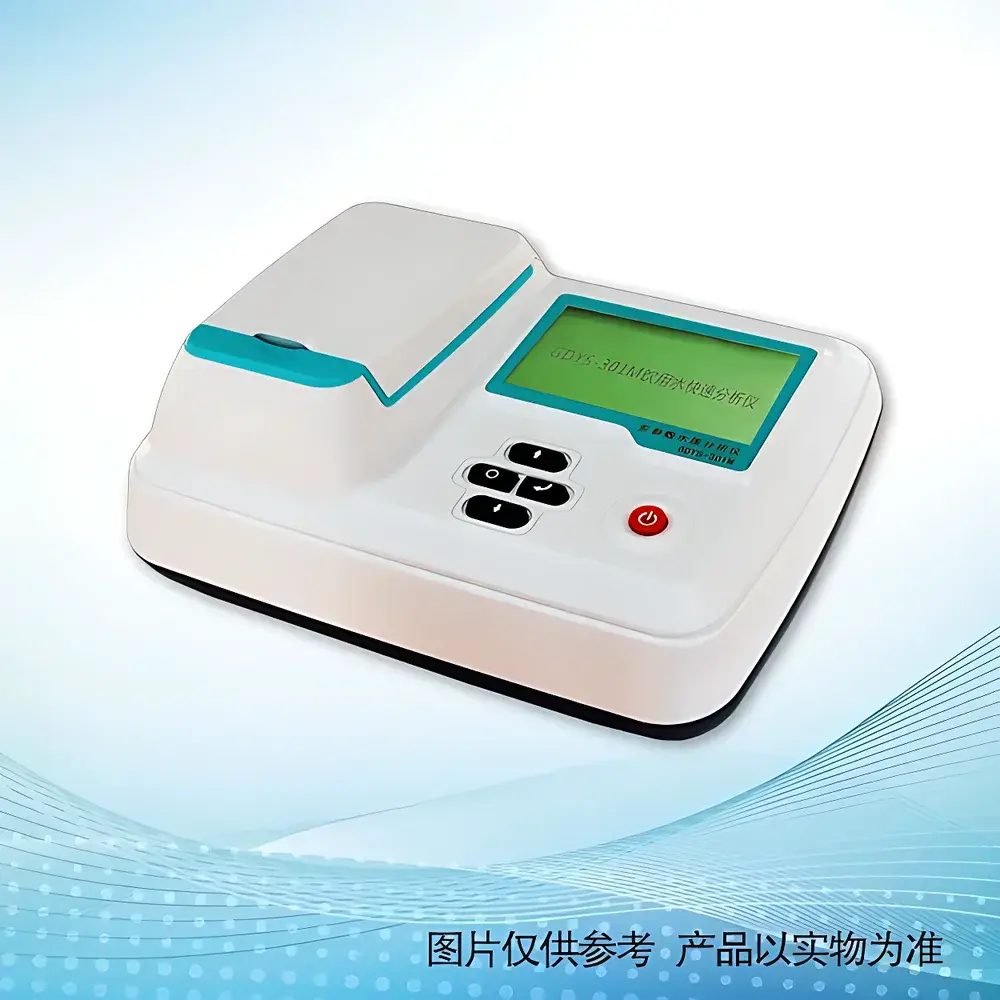
JiDa-Xiaotianshen GDYS-301M Portable Drinking Water Quality Analyzer
| Brand | JiDa-Xiaotianshen |
|---|---|
| Origin | Jilin, China |
| Manufacturer Type | OEM Manufacturer |
| Region of Manufacture | Domestic (China) |
| Model | GDYS-301M |
| Price Range | USD 1,400–4,200 |
| Instrument Type | Benchtop Water Quality Analyzer |
| Test Parameters | Free Chlorine, Total Chlorine, Chlorine Dioxide, Nitrate Nitrogen, Ozone, Ammonia Nitrogen, and 35 Total Parameters |
Overview
The JiDa-Xiaotianshen GDYS-301M Portable Drinking Water Quality Analyzer is a microprocessor-controlled, multi-wavelength photometric analyzer engineered for rapid, on-site and laboratory-based assessment of critical drinking water quality parameters. Based on standardized colorimetric reaction principles compliant with ISO 7890-2 (chlorine), ISO 6777 (ammonia nitrogen), ISO 8576 (nitrate), and EPA Method 334.0 (free/total chlorine), the instrument employs fixed-wavelength LED optical architecture to quantify analyte concentrations via absorbance measurement across 10 discrete wavelengths (380 nm, 400 nm, 410 nm, 470 nm, 520 nm, 538 nm, 595 nm, 610 nm, 630 nm, and 650 nm). Its solid-state optical path—comprising high-stability LEDs and integrated photodiode detectors—eliminates moving parts, ensuring long-term repeatability (<0.005 Abs/h drift) and resistance to mechanical shock, humidity, and thermal fluctuation in field-deployed environments. Designed specifically for regulatory compliance workflows in municipal water utilities, public health laboratories, and emergency response units, the GDYS-301M delivers quantitative results without requiring user-prepared calibration standards.
Key Features
- Multi-parameter capability covering 35 regulated drinking water indicators—including free chlorine, total chlorine, chlorine dioxide, ozone, ammonia nitrogen, nitrate nitrogen, fluoride, cyanide, heavy metals (Pb, Hg, As, Cr⁶⁺, Cd), and organic surrogates (phenol, surfactants, formaldehyde)
- Fixed-wavelength LED photometry system with automatic wavelength selection based on selected test protocol; no manual filter changes or grating alignment required
- Dual sample format support: 30 mm round glass vials and 50 mm rectangular cuvettes—enabling flexibility for both reagent kit compatibility and standard method adherence
- Integrated calibration curves stored in non-volatile memory; zero-point calibration only required using supplied blank reagents—no daily standard curve generation needed
- 4.7-inch high-contrast LCD with native Chinese interface; displays real-time absorbance values and concentration results with unit annotation (e.g., mg/L Cl₂, µg/L Pb)
- Dual power architecture: AC mains (220 V ±10%, 50 Hz) + rechargeable Li-ion battery (7.4 V, 900 mAh) supporting >6 hours continuous operation for mobile deployment
- Robust environmental rating: operational range 5–40 °C, suitable for indoor labs and outdoor field use under ambient conditions
Sample Compatibility & Compliance
The GDYS-301M is validated for use with standardized colorimetric reagent kits conforming to national and international methods, including GB/T 5750 series (China Standard Methods for Examination of Drinking Water), ISO 7027 (turbidity), ISO 10530 (pH), and APHA Standard Methods 4500-Cl G (DPD method for chlorine). Sample matrices include tap water, groundwater, treated distribution system water, and emergency source water (pre-filtered if turbidity exceeds 5 NTU). The instrument meets GLP documentation requirements through timestamped data logging and supports audit-ready reporting when paired with certified reagent lots. While not FDA 21 CFR Part 11–certified out-of-the-box, its data export functionality (CSV/Excel) and metadata tagging (operator ID, sample ID, location, date/time) enable integration into validated LIMS environments under client-defined SOPs.
Software & Data Management
The GDYS-301M includes embedded firmware supporting storage of ≥2,000 measurement records, each containing sample ID, test parameter, concentration value, unit, absorbance reading, measurement timestamp, and operator code. USB 2.0 and RS-232 interfaces allow bidirectional communication with Windows-based desktop software for advanced data management. The PC application enables custom report templates compliant with local regulatory formats (e.g., China CDC reporting forms), batch export to Excel, PDF report generation, and direct upload to provincial water safety monitoring platforms via HTTP/HTTPS APIs. All exported files retain full traceability metadata, satisfying minimum ALCOA+ principles (Attributable, Legible, Contemporaneous, Original, Accurate) for routine QA/QC documentation.
Applications
- Routine compliance monitoring of drinking water at water treatment plants and distribution network sampling points
- Emergency response screening during contamination events (e.g., chlorine depletion, heavy metal leaching, algal toxin precursors)
- Field verification of point-of-use (POU) device performance and disinfection residual maintenance
- Public health surveillance programs targeting endemic contaminants (e.g., arsenic in rural wells, nitrate in agricultural zones)
- Educational use in environmental science curricula for hands-on water chemistry methodology training
- Contract laboratory support for third-party certification under CNAS accreditation (ISO/IEC 17025)
FAQ
Does the GDYS-301M require daily recalibration with standard solutions?
No—built-in factory-calibrated curves eliminate the need for daily standard preparation. Only a reagent blank zeroing step is required before each test batch.
Can the instrument be used for wastewater or seawater analysis?
It is optimized for drinking water matrices per GB/T 5750 and ISO standards. High-salinity or highly turbid samples require dilution or pretreatment to avoid interferences.
Is remote firmware update supported?
Firmware updates are performed locally via USB drive using manufacturer-provided binaries; over-the-air (OTA) updates are not implemented.
What reagent compatibility does the GDYS-301M support?
It is designed for use with JiDa-Xiaotianshen’s proprietary GDYS-series colorimetric reagent kits, which include stabilized DPD, Nessler, cadmium reduction, and phenol red formulations traceable to NIST SRMs.
How is measurement uncertainty addressed in regulatory submissions?
Instrument-specific uncertainty budgets (based on photometric noise, reagent lot variability, and operator technique) are documented in the user manual and can be incorporated into laboratory uncertainty calculations per ISO/IEC 17025 Clause 7.6.
Related Products







