
Jihengpin HP307 Vertical Through-Plane Resistivity Tester for Fuel Cell Bipolar Plates
| Brand | Jihengpin |
|---|---|
| Origin | Shandong, China |
| Manufacturer Type | Direct Manufacturer |
| Region Classification | Domestic (China) |
| Model | HP307 |
| Force Range | 30–5000 N (0.05–4.0 MPa) |
| Force Resolution | 0.1 N |
| Force Accuracy | ±0.5% FS |
| Test Speed | 1–300 mm/min |
| Parallelism of Upper/Lower Platen | <0.025 mm |
| Platen Diameter | 120 mm |
| Dimensions (W×D×H) | 430×350×710 mm |
| Weight | 45 kg |
| Power Supply | 220 V, 50 Hz |
Overview
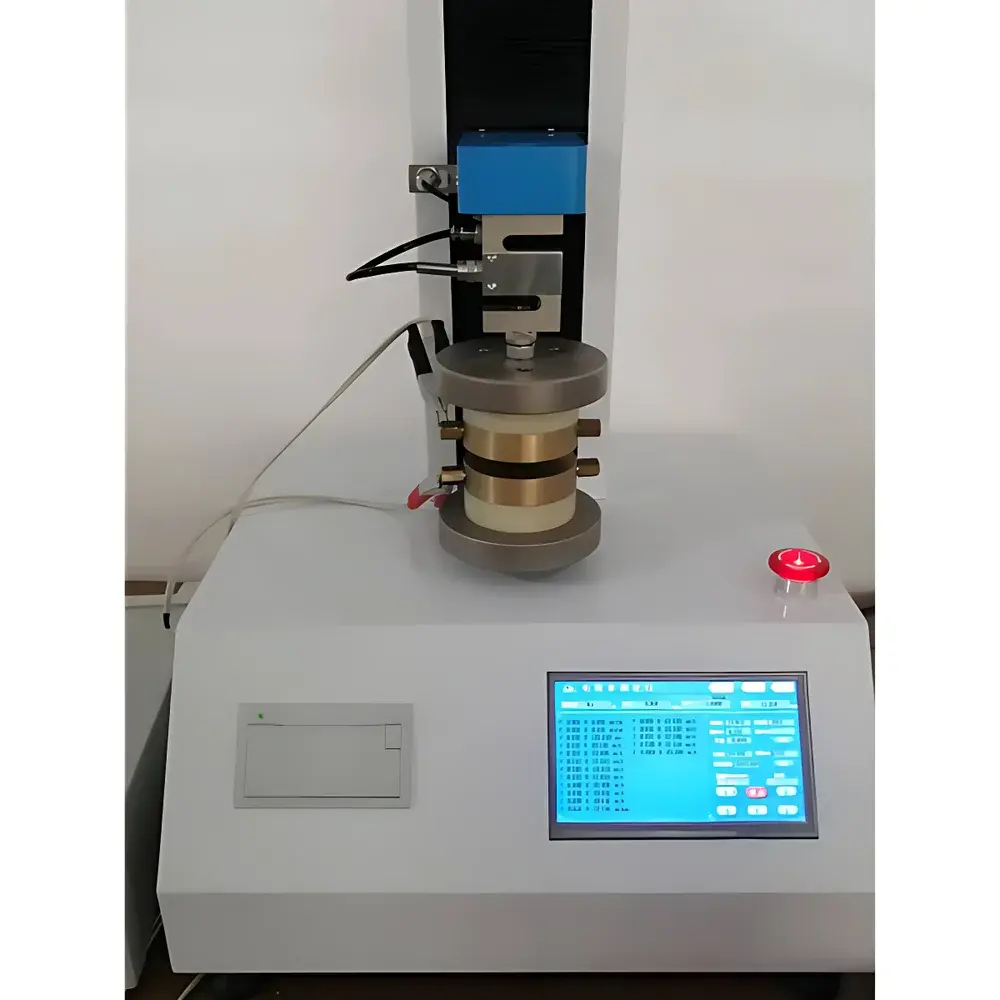
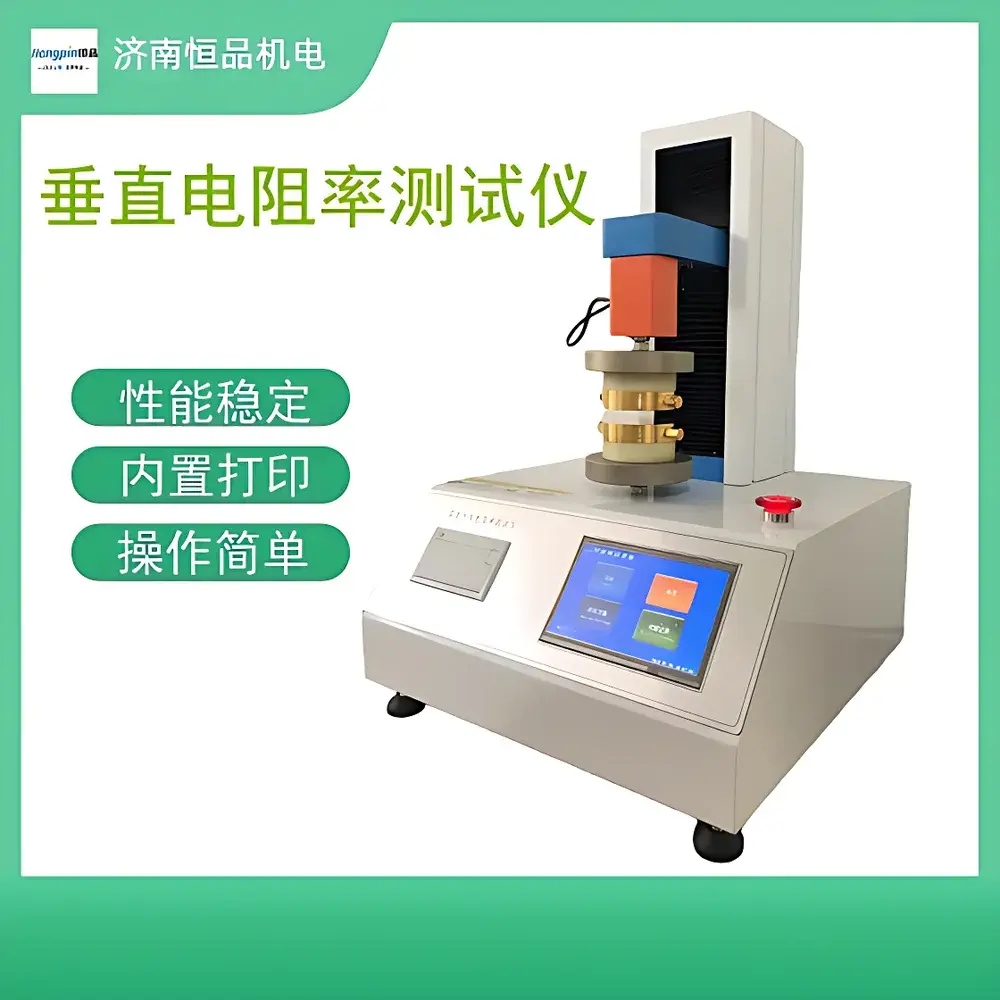
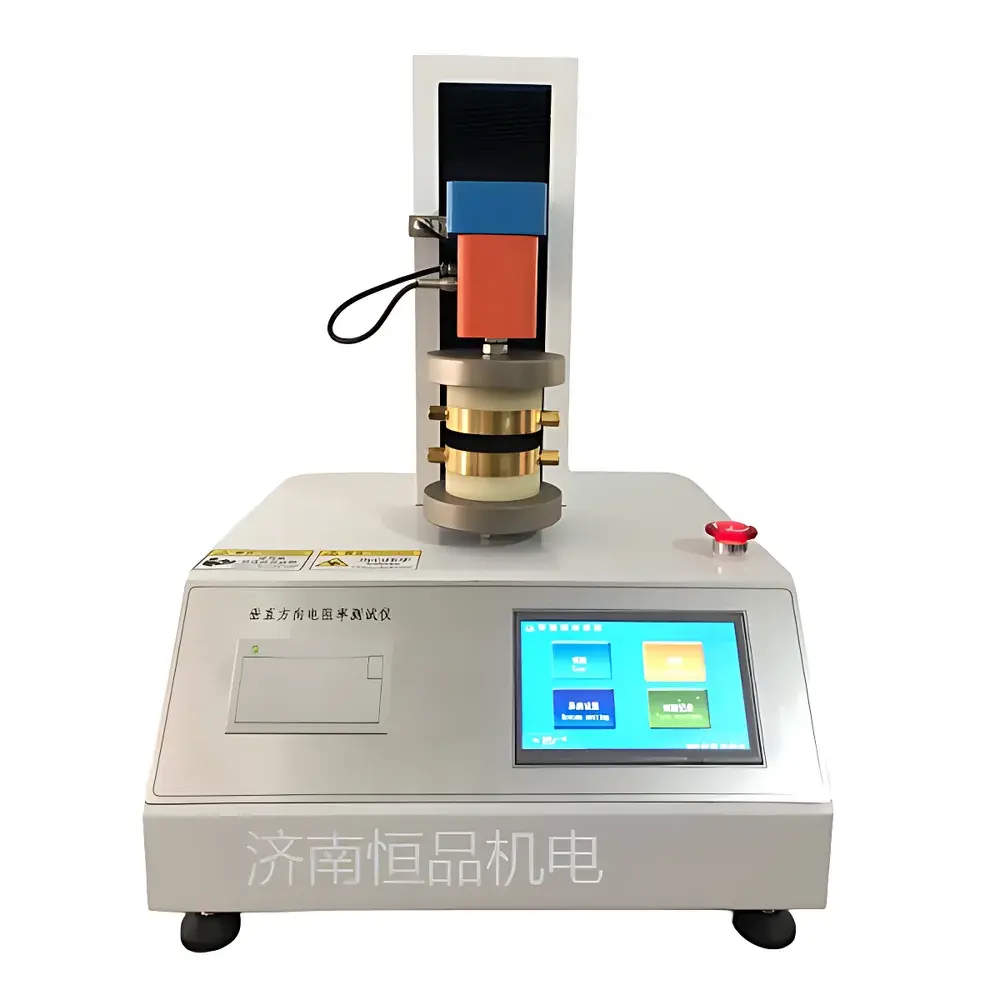
The Jihengpin HP307 Vertical Through-Plane Resistivity Tester is a dedicated mechanical-electrical characterization system engineered for precise measurement of through-plane electrical resistivity in proton exchange membrane fuel cell (PEMFC) bipolar plates and gas diffusion layers (GDLs), particularly carbon paper substrates. It operates on the principle of controlled uniaxial compression combined with four-terminal (Kelvin) resistance measurement, ensuring elimination of contact resistance errors during vertical conductivity assessment. Designed in strict accordance with GB/T 20042.7—2018 “Proton Exchange Membrane Fuel Cells — Part 7: Test Methods for Carbon Paper Characteristics”, the HP307 provides metrologically traceable, repeatable data essential for R&D validation, incoming material inspection, and quality assurance in fuel cell stack manufacturing. Its rigid frame, high-precision load cell, and parallel platen geometry collectively ensure uniform stress distribution across the sample surface—critical for minimizing measurement artifacts arising from non-uniform contact pressure.
Key Features
- Integrated 7-inch industrial touchscreen HMI with real-time display of compressive force, displacement, deformation rate, and dynamic resistance curve—enabling immediate visual verification of test integrity.
- Full-digital servo-controlled speed regulation system with precision planetary gearbox and ball-screw actuation, delivering stable, low-noise motion across the full 1–300 mm/min range without step loss or velocity drift.
- High-stability S-type load cell (±0.5% FS accuracy, 0.1 N resolution) calibrated per ISO 376 requirements; platen parallelism maintained at <0.025 mm over 120 mm diameter to guarantee homogeneous pressure application.
- Automated test sequence execution: pre-load stabilization, ramped compression to target pressure, dwell, resistance acquisition, and auto-return to initial position—all programmable via intuitive GUI.
- Built-in thermal-stable four-wire resistance measurement module compliant with IEC 60584 and ASTM D257 standards, supporting direct mΩ–kΩ range output synchronized with mechanical loading events.
- Onboard micro-printer for immediate hardcopy reporting; internal memory stores ≥1000 test records with timestamp, operator ID, and environmental metadata (optional external temperature/humidity sensor integration).
Sample Compatibility & Compliance
The HP307 accommodates standard GDL specimens (e.g., Toray TGP-H series, SGL SIGRACET® GDLs) and machined graphite/composite bipolar plate coupons up to 120 mm in diameter and 5 mm thick. Sample mounting uses non-conductive ceramic alignment fixtures to prevent lateral current leakage. All test protocols align with GB/T 20042.7–2018, which specifies conditioning (23 °C/50% RH, 24 h), electrode configuration (circular Ag paste electrodes, Ø10 mm), and pressure ramping profiles (e.g., 0.5 MPa → 2.0 MPa at 0.1 MPa/s). The system supports audit-ready documentation per GLP and ISO/IEC 17025 requirements, including electronic signature fields, change history logs, and calibration certificate traceability to CNAS-accredited labs.
Software & Data Management
The embedded firmware supports CSV export of raw time-series data (force, displacement, voltage, current) via USB port. Optional PC-based analysis software (HP-DataSuite v3.2) enables statistical process control (SPC) charting, Weibull failure modeling, pressure-resistivity hysteresis loop analysis, and automated report generation compliant with FDA 21 CFR Part 11 (electronic signatures, audit trails, role-based access control). Data encryption (AES-256) and secure network deployment (TLS 1.2) are available for enterprise integration with LIMS or MES platforms.
Applications
- Quantitative evaluation of carbon paper anisotropy: comparison of in-plane vs. through-plane resistivity under variable compaction pressures.
- Correlation studies between GDL microstructure (porosity, fiber orientation, PTFE loading) and interfacial contact resistance (ICR) at cathode-side operating conditions.
- Accelerated durability testing: cyclic compression-resistance mapping to assess degradation mechanisms in coated graphite bipolar plates.
- Supplier qualification: batch-to-batch consistency verification against OEM technical specifications (e.g., Toyota Mirai GDL ICR < 10 mΩ·cm² @ 1.4 MPa).
- Academic research: fundamental investigation of electron transport pathways in hierarchical porous carbons under constrained mechanical boundary conditions.
FAQ
What standards does the HP307 explicitly support?
GB/T 20042.7–2018 is fully implemented; optional firmware modules add ASTM F2739 (fuel cell component compression testing) and ISO 10545-11 (ceramic tile resistivity) compliance.
Can the system measure both resistivity and contact resistance independently?
Yes—the four-terminal method isolates bulk material resistivity, while two-terminal mode (with defined electrode geometry) yields total interfacial contact resistance (ICR), as required by USCAR-27.
Is calibration certification included with delivery?
Each unit ships with a factory calibration certificate traceable to NIM (National Institute of Metrology, China), valid for 12 months; annual recalibration services are available under ISO/IEC 17025 scope.
How is data integrity ensured during long-duration tests?
Non-volatile flash memory retains all data during power interruption; checksum validation and cyclic redundancy checks (CRC-32) are applied to every data packet.
Does the HP307 support custom test sequences for R&D applications?
Yes—via scriptable test profiles (.xml format) allowing multi-step pressure ramps, dwell periods, and conditional branching based on real-time resistance thresholds.



