
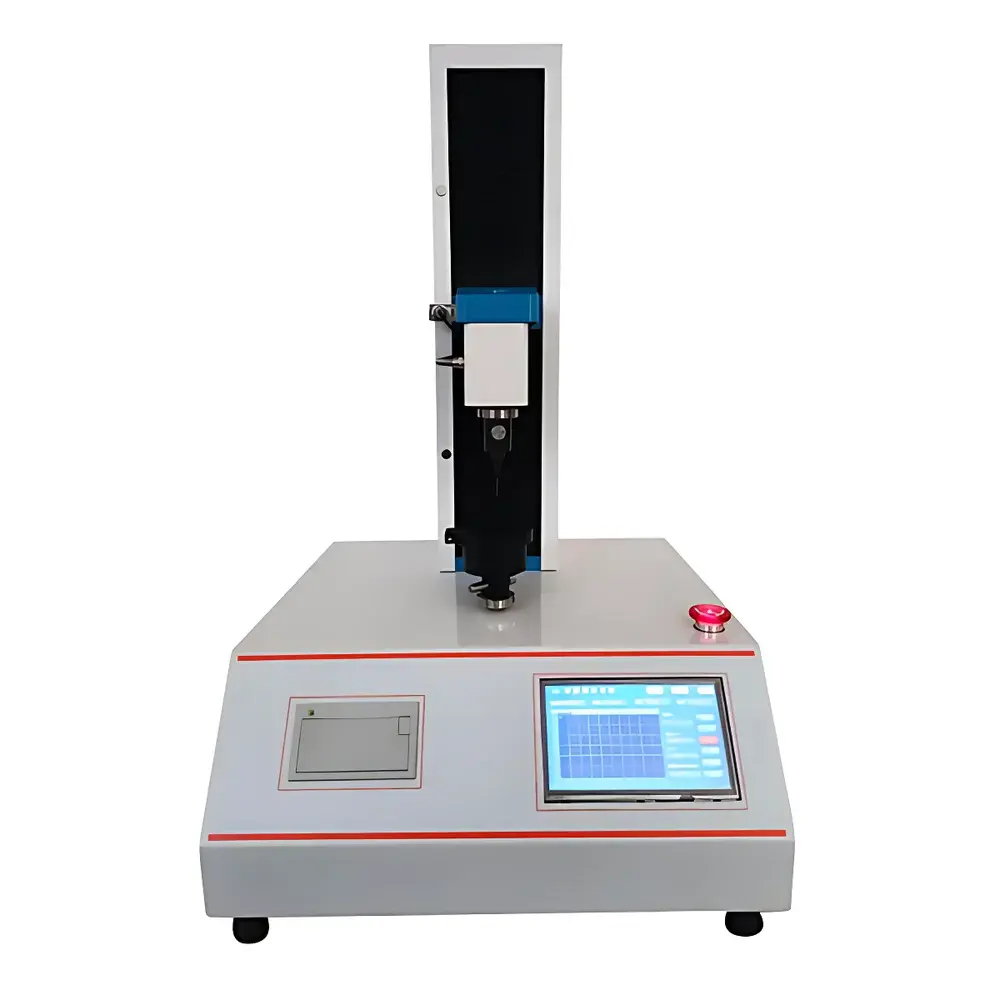
Jihengpin HP622 Slow Puncture Resistance Tester for Flexible Packaging Materials
| Brand | Jihengpin |
|---|---|
| Origin | Shandong, China |
| Manufacturer Type | Direct Manufacturer |
| Model | HP622 |
| Key Specifications | Load Range 0–50 N |
| Resolution | 0.1 N |
| Accuracy | ±1% FS |
| Test Speed | 25 mm/min (adjustable 0–300 mm/min) |
| Sample Size | 75 mm × 75 mm |
| Clamp Aperture | Ø35 mm |
| Probe | Hemispherical, compliant with YY/T 0681.13–2014 |
| Dimensions | 330 × 335 × 550 mm |
| Weight | ~55 kg |
| Power Supply | 220 V, 50 Hz |
Overview
The Jihengpin HP622 Slow Puncture Resistance Tester is an electromechanical testing instrument engineered for quantifying the resistance of flexible packaging materials to quasi-static mechanical puncture under controlled displacement conditions. It operates on the principle of force-displacement transduction: a hemispherical probe (Ø3.2 mm radius, per YY/T 0681.13–2014) advances at a precisely regulated linear velocity into a clamped specimen, capturing real-time load and displacement data throughout the entire penetration event. Unlike high-speed impact or drop-weight tests, this system emulates low-velocity, sustained mechanical challenges—such as those encountered during manual handling, stacking pressure, or sterilization tray insertion—where material deformation, viscoelastic recovery, and localized yielding govern failure behavior. The instrument outputs three primary metrics: peak puncture force (N), total puncture energy (N·mm), and probe penetration depth (mm), enabling rigorous assessment of barrier integrity, structural resilience, and functional reliability in sterile medical packaging and pharmaceutical secondary containment.
Key Features
- Integrated 7-inch capacitive touchscreen interface with bilingual (English/Chinese) firmware, supporting intuitive test setup, real-time force–displacement curve visualization, and on-device statistical analysis (mean, SD, CV%)
- High-fidelity load cell with ±1% full-scale accuracy and 0.1 N resolution, calibrated traceable to national metrological standards
- Precision ball-screw actuation driven by servo-controlled stepper motor, ensuring smooth, backlash-free motion across the full speed range (0–300 mm/min)
- Dedicated 35 mm internal-diameter clamping fixture with uniform radial pressure distribution, minimizing edge slippage and ensuring ASTM F1306-compliant specimen constraint
- Onboard thermal-stabilized electronics and low-drift signal conditioning circuitry for enhanced repeatability across ambient temperature fluctuations (15–30 °C)
- Embedded thermal printer for immediate hard-copy output of test reports—including timestamp, operator ID, sample ID, and all three primary parameters
Sample Compatibility & Compliance
The HP622 is validated for use with thin-gauge flexible barrier structures including Tyvek®-polyethylene laminates, PET/Alu/PE coextrusions, medical-grade polyolefin films, and sterilizable pouch sealants. Its mechanical configuration adheres strictly to the dimensional and procedural requirements of YY/T 0681.13–2014 (Chinese standard for slow puncture resistance of sterile medical packaging) and ASTM F1306–2016 (Standard Test Method for Slow Rate Penetration Resistance of Flexible Barrier Films and Laminates). While not certified to ISO 11607–2 or EN 868–5 out-of-the-box, its measurement methodology aligns with the fundamental physical principles underlying those standards. Users performing GLP/GMP-regulated testing may configure audit trails and user-level access controls via optional firmware upgrades compliant with FDA 21 CFR Part 11 requirements.
Software & Data Management
The embedded firmware supports CSV export via USB port for post-test analysis in Excel, MATLAB, or statistical process control (SPC) platforms. Raw time-series data (force vs. displacement, sampled at 100 Hz) is stored with metadata including environmental conditions (if external hygrometer/thermometer inputs are enabled), operator credentials, and calibration certificate expiry dates. Optional PC-based software (sold separately) provides advanced features: batch report generation, trend charting across production lots, comparative overlay of multiple curves, and automated pass/fail evaluation against user-defined specification limits. All digital records maintain immutable timestamps and support electronic signature workflows for regulatory submissions.
Applications
- Validation of sterile barrier system (SBS) integrity for Class II and III medical devices prior to ethylene oxide or gamma sterilization
- Quality control of pouch seal strength and film toughness during roll-to-roll converting and pouch-form-fill-seal (PFFS) manufacturing
- Comparative evaluation of alternative barrier materials during packaging design qualification (e.g., transitioning from PVC to recyclable mono-material structures)
- Root-cause analysis of field failures involving package perforation during transport or clinical handling
- Supporting accelerated aging studies by correlating puncture resistance degradation with time/temperature/humidity exposure
FAQ
What is the difference between “slow puncture” and “impact puncture” testing?
Slow puncture applies force at ≤300 mm/min to assess viscoelastic deformation and yield behavior; impact puncture uses free-fall or pneumatic methods (>1 m/s) to evaluate brittle fracture thresholds.
Can the HP622 be used for non-medical packaging applications?
Yes—it is routinely applied to food-grade laminates, e-commerce mailer envelopes, and agricultural mulch films where controlled puncture resistance correlates with shelf-life performance.
Is probe geometry customizable beyond the YY/T 0681.13–2014 hemispherical tip?
Standard configuration uses a 3.2 mm radius stainless steel hemisphere; custom probes (e.g., conical, flat-ended) are available upon request with recalibration documentation.
Does the instrument meet ISO/IEC 17025 calibration requirements?
The base unit includes factory calibration certificates; accredited third-party calibration (to ISO/IEC 17025) is available through authorized service centers with documented uncertainty budgets.
How frequently should the load cell be recalibrated?
Annual recalibration is recommended for routine QC use; biannual verification is advised in high-throughput GMP environments or after any mechanical shock event.





