
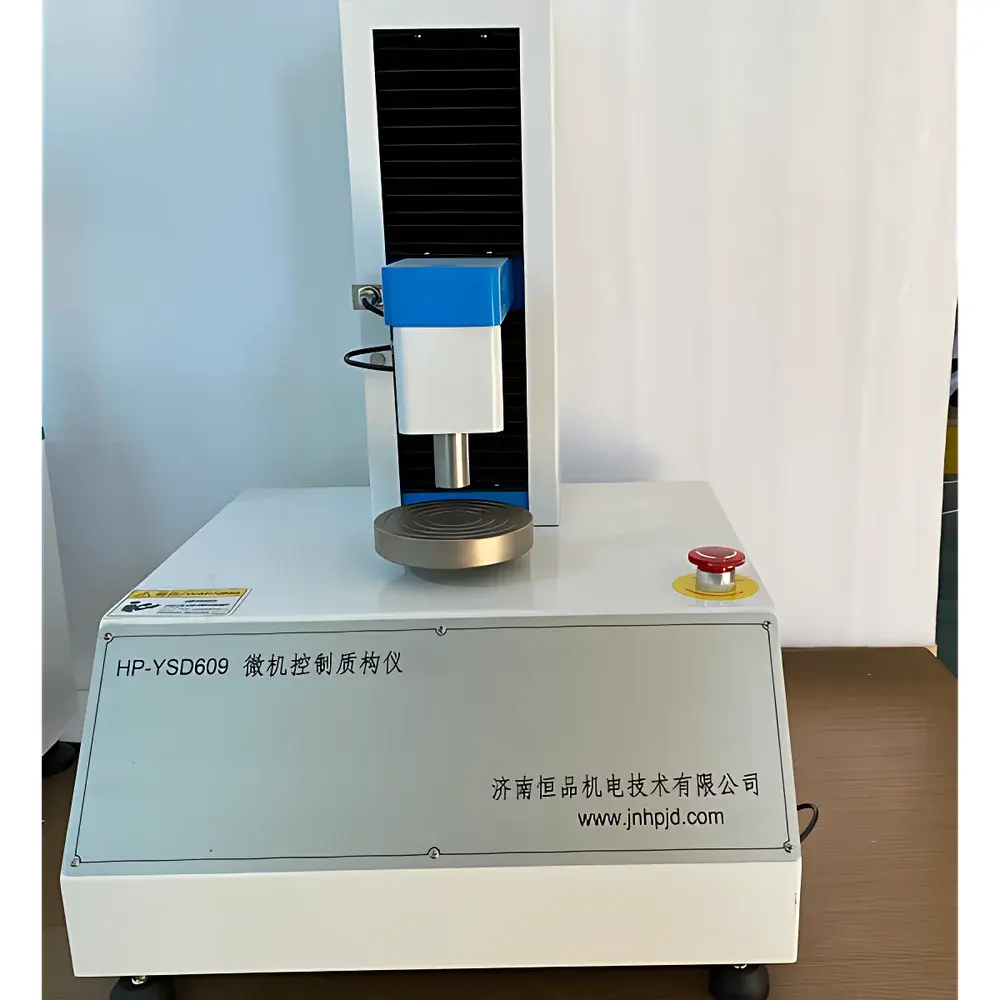
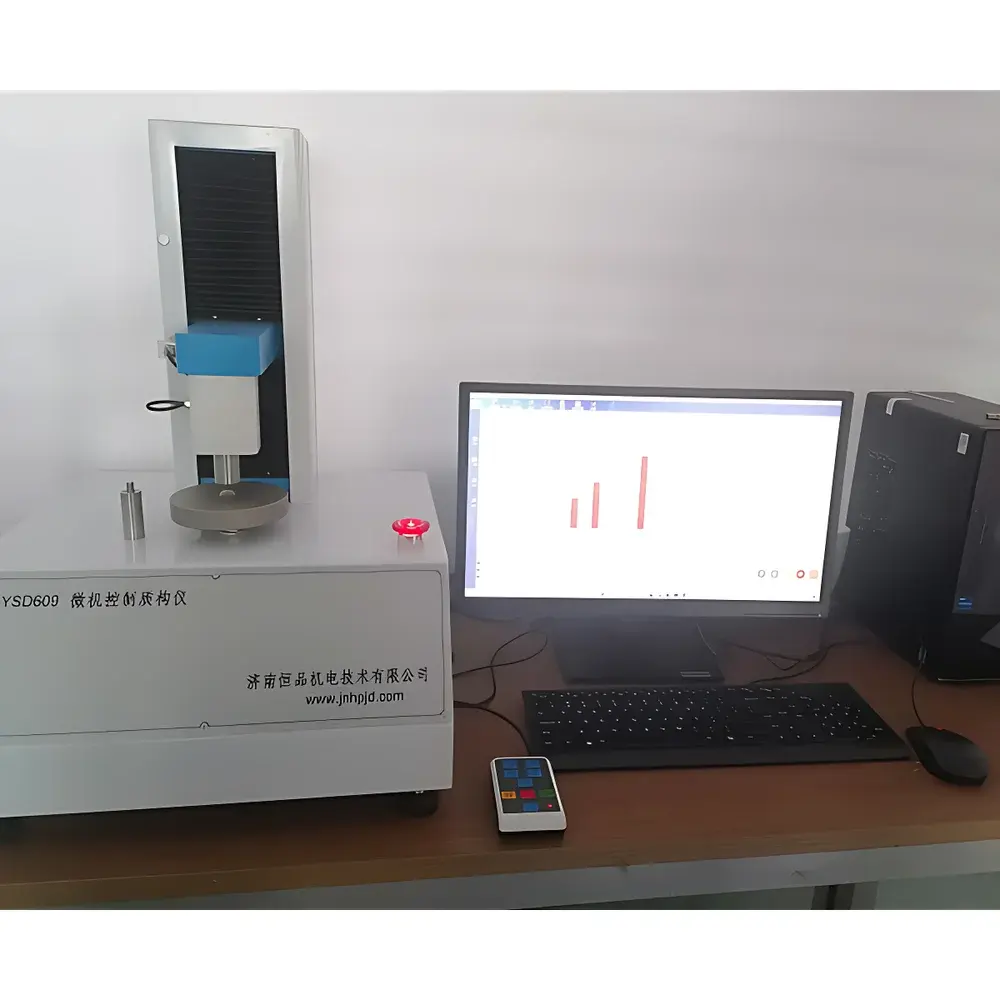
Jihengpin ZGY-TA Texture Analyzer (TPA Universal Texture Analyzer)
| Brand | Jihengpin |
|---|---|
| Origin | Shandong, China |
| Manufacturer Type | Direct Manufacturer |
| Product Category | Domestic |
| Model | ZGY-TA TPA Universal Texture Analyzer |
| Force Range | 1–50 kg (standard configuration: 20 kg) |
| Force Resolution | 0.01 kg |
| Force Accuracy | ±0.5% of full scale |
| Test Speed Range | 0.1–10 mm/s (software-adjustable) |
| Speed Resolution | 0.1 mm/s (accuracy >99%) |
| Maximum Travel Distance | 320 mm |
| Displacement Resolution | 0.01 mm |
| Dimensions (W×D×H) | 500 × 500 × 1200 mm |
| Weight | 85 kg |
| Power Supply | 220 V, 50 Hz |
Overview
The Jihengpin ZGY-TA Texture Analyzer is a universal, microprocessor-controlled mechanical testing system engineered for precise quantification of textural and mechanical properties in soft solids, semi-solids, and viscoelastic materials. Based on the principle of uniaxial compression, tension, penetration, and extrusion—under controlled displacement or force modes—the instrument delivers high-reproducibility measurements aligned with standardized texture profile analysis (TPA) methodology. It operates according to fundamental biomechanical testing principles used in food science, pharmaceutical development, cosmetic formulation, and biomaterial evaluation. The system integrates a high-precision load cell, precision-ground ball screw drive, and programmable stepper motor to ensure stable, low-noise actuation across its full 320 mm vertical stroke. Designed for laboratory environments requiring GLP-compliant data integrity, the ZGY-TA supports traceable test execution, audit-ready parameter logging, and repeatable probe alignment—making it suitable for routine QC, R&D validation, and regulatory submission support.
Key Features
- High-fidelity force measurement using calibrated load cells with 0.01 kg resolution and ±0.5% full-scale accuracy.
- Programmable test speed from 0.1 to 10 mm/s, adjustable in 0.1 mm/s increments, with real-time velocity feedback and <1% deviation tolerance.
- Dual electromagnetic limit switches enable precise, non-contact upper/lower travel termination—critical for consistent probe-sample interaction depth control.
- Integrated industrial-grade control unit with embedded chip architecture ensures deterministic timing, minimal latency, and immunity to PC-side software instability.
- Modular probe interface compatible with ISO/ASTM-standardized fixtures—including cylindrical probes (5 mm, 20 mm, 25.4 mm), Kramer shear cells, Warner-Bratzler blades, and custom-designed attachments.
- Robust mechanical architecture: 25 mm-thick monolithic worktable, reinforced crosshead, and synchronous belt-driven ball screw transmission for zero backlash and acoustic noise <55 dB(A) at 1 m.
- Emergency stop circuitry, hardware-based overload cutoff, and software-enforced safety interlocks meet IEC 61000-6-2 EMC and IEC 61000-6-4 emission standards.
Sample Compatibility & Compliance
The ZGY-TA accommodates heterogeneous sample geometries and rheological classes without modification: solid foods (cheese, meat, bread), gels (agar, pectin, carrageenan), pastes (toothpaste, ointments), foams (shaving cream, whipped toppings), elastomers (rubber seals, packaging films), and pharmaceutical dosage forms (tablets, capsules, hydrogels). All standard test protocols align with ASTM STP 1377 (Standard Guide for Instrumental Texture Measurement), ISO 11357-3 (Plastics – DSC – Part 3: Determination of melting and crystallization temperatures), and USP <1043> (Viscosity and Consistency of Semisolid Dosage Forms). Data acquisition complies with ALCOA+ principles; raw force-displacement time-series files are saved in ASCII (.txt) format with metadata headers (timestamp, operator ID, method name, calibration ID), enabling retrospective reprocessing and third-party statistical validation. Optional 21 CFR Part 11-compliant software modules provide electronic signatures, audit trails, and role-based access control for regulated environments.
Software & Data Management
The proprietary Win-based control software provides real-time dual-axis plotting (force vs. displacement, force vs. time), automated TPA parameter extraction (hardness, cohesiveness, springiness, chewiness, adhesiveness, resilience), and batch statistical reporting (mean, SD, CV%, min/max, confidence intervals). Raw data export supports .csv, .xlsx, and .txt formats; curve overlay functionality enables comparative analysis across formulations or processing conditions. The software architecture permits concurrent connection to multiple calibrated load cells (up to four), facilitating parallel method development. Firmware updates are delivered via secure HTTPS endpoint with SHA-256 signature verification. All test methods are stored as encrypted XML templates—editable only by authorized users—and include configurable pass/fail thresholds linked to LIMS integration APIs.
Applications
- Food Science: Quantitative assessment of TPA parameters in baked goods, dairy analogs, plant-based meats, confectionery gummies, and infant formula powders; compliance testing per ISO 11357, AOAC 987.02, and AACC 74-09.
- Pharmaceuticals: Tablet hardness, capsule shell rupture force, gel strength of topical bases, and viscosity profiling of mucoadhesive polymers per USP <1043>, <701>, and <724>.
- Cosmetics & Personal Care: Emulsion stability indexing, lipstick break resistance, mascara film flexibility, and foundation spreadability under standardized compression cycles.
- Materials Engineering: Compression set analysis of polyurethane foams, peel strength of laminated films, puncture resistance of blister packaging, and tack measurement of pressure-sensitive adhesives.
- Academic Research: Mechanobiological characterization of hydrogels, tissue-engineered scaffolds, and edible films under dynamic loading regimes mimicking oral processing or gastric transit.
FAQ
What force ranges are available, and how is calibration maintained?
The ZGY-TA supports interchangeable load cells from 1 kg to 50 kg full scale. Each sensor is factory-calibrated against NIST-traceable deadweight standards and includes a unique calibration certificate. Users may perform two-point verification at any time using certified reference weights.
Is the system compliant with FDA 21 CFR Part 11 requirements?
Yes—optional Part 11 add-on module provides electronic signatures, immutable audit trails, automatic backup logging, and user authentication via Windows Active Directory integration.
Can custom probes be integrated without mechanical modification?
Yes—the universal mounting interface accepts ISO-standard threaded probes (M6 × 1.0) and features tool-less quick-release clamping. Third-party probes require only mechanical compatibility verification—not firmware reconfiguration.
How is thermal drift compensated during extended testing sessions?
The load cell incorporates temperature-compensated strain gauge bridges and auto-zeroing routines executed before each test cycle. Ambient temperature monitoring is logged alongside force data to support post-hoc thermal correction if required.
What operating systems are supported?
Native support for Windows 10/11 (64-bit); virtualized operation on Windows Server 2019/2022 is validated. No macOS or Linux native drivers are provided.





