
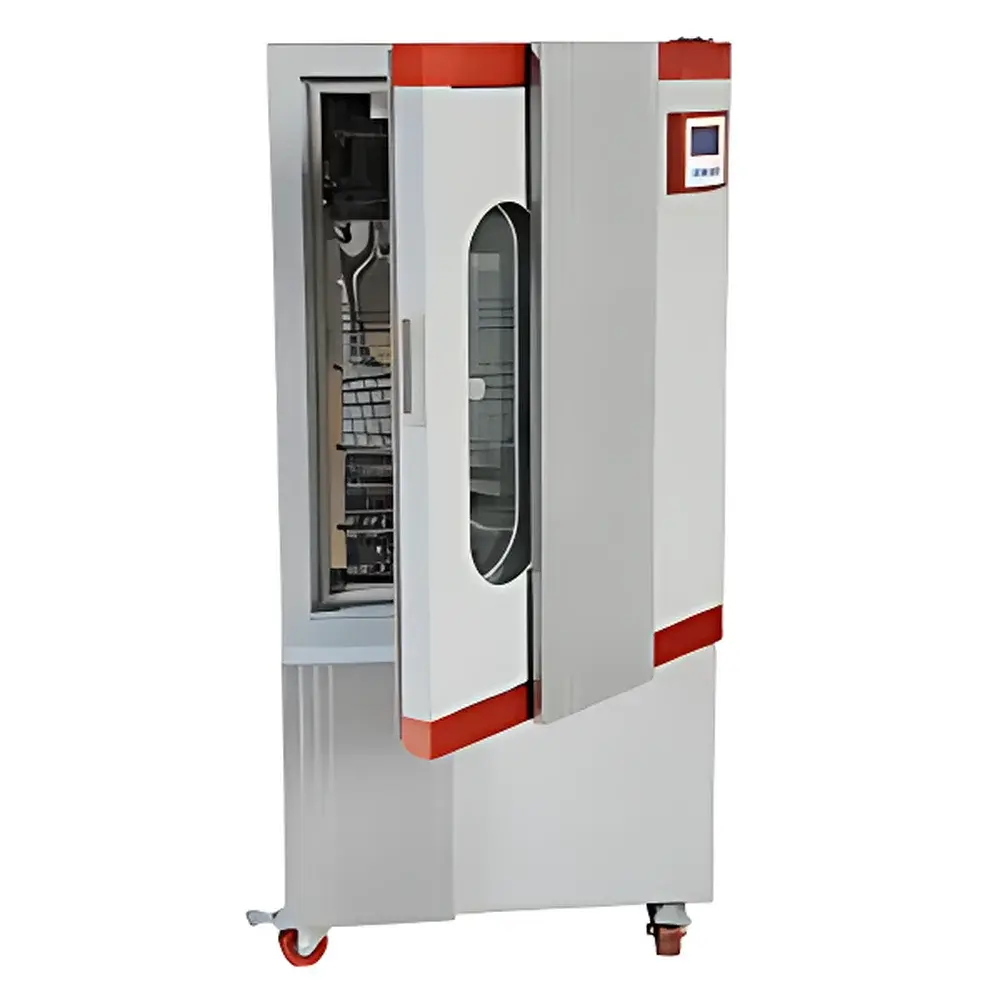
Jihepu BSP-400 Biochemical Incubator
| Brand | Jihepu |
|---|---|
| Origin | Shandong, China |
| Model | BSP-400 |
| Temperature Range | 0°C to 60°C |
| Temperature Resolution | 0.1°C |
| Temperature Uniformity | ±1°C |
| Temperature Fluctuation | ±0.5°C |
| Input Power | 1350 W |
| Timer Range | 0–9999 minutes |
| Interior Dimensions (W×D×H) | 600 × 640 × 1050 mm |
| Exterior Dimensions (W×D×H) | 745 × 930 × 1695 mm |
| Shelf Capacity | 4 adjustable stainless steel shelves |
| Refrigerant | Eco-friendly non-CFC refrigerant |
| Compressor | Internationally certified hermetic compressor |
| Communication Interface | RS-485 port for external data logging or PC integration |
Overview
The Jihepu BSP-400 Biochemical Incubator is a precision-engineered, microprocessor-controlled environmental chamber designed for stable, long-term temperature maintenance in life science laboratories. It operates on a forced-air convection principle with an optimized dual-path airflow system—featuring a centrifugal blower and proprietary duct architecture—to ensure uniform thermal distribution across the entire working chamber. Unlike basic static incubators, the BSP-400 integrates active air exchange via an independent fresh-air inlet valve, enabling controlled ventilation without compromising temperature stability. Its operational range spans 0°C to 60°C with a resolution of 0.1°C and maintains ±0.5°C temperature fluctuation and ±1°C spatial uniformity—performance metrics aligned with ISO 15197 and ASTM E2875 requirements for laboratory incubation systems. The unit is engineered for continuous unattended operation in BOD analysis, microbial culture preservation, fungal propagation, plant tissue culture, and biochemical assay development under GLP-compliant workflows.
Key Features
- Intelligent microcomputer controller with backlit LCD interface displaying real-time temperature, setpoint, elapsed time, and programmable cycle status
- Patented integrated refrigeration system with multi-layer safety protection, automatic defrosting via non-energy-consuming thermal cycling—eliminating frost-induced thermal disturbance during extended runs
- Double-door observation window design: outer tempered glass + inner insulated acrylic layer minimizes heat loss while permitting visual monitoring without internal environment disruption
- Four independently adjustable mirror-finish stainless steel shelves; load capacity up to 25 kg per shelf
- Dual-mode ventilation control: manual or programmable fresh-air intake (30 mm inner / 60 mm outer diameter access ports on lateral panels)
- Power failure recovery function with non-volatile memory retention for all user-defined parameters including setpoints, timers, and program sequences
- RS-485 serial interface compliant with Modbus RTU protocol for integration into centralized lab monitoring networks or third-party data acquisition software
Sample Compatibility & Compliance
The BSP-400 accommodates standard microbiological vessels—including Petri dishes, test tubes, flasks, and multi-well plates—as well as larger botanical specimens and liquid culture media containers. Its interior chamber (600 × 640 × 1050 mm) supports simultaneous incubation of up to 120 Petri dishes (90 mm) or 48 T-flasks (225 cm²). All wetted surfaces are electropolished 304 stainless steel, resistant to corrosion from common disinfectants (e.g., 70% ethanol, 0.5% sodium hypochlorite) and compatible with ISO 13485-certified cleanroom maintenance protocols. The unit complies with IEC 61010-1:2010 for electrical safety and meets EMC requirements per EN 61326-1:2013. Optional GPRS alarm modules support remote notification of out-of-spec conditions per FDA 21 CFR Part 11 audit trail readiness when paired with validated data logging software.
Software & Data Management
The BSP-400 supports configurable 10-segment, 99-cycle programming for complex thermal ramp-and-hold protocols—ideal for simulating diurnal cycles in plant physiology studies or staged microbial growth curves. When connected via RS-485, it interfaces seamlessly with industry-standard platforms such as LabVIEW, MATLAB Data Acquisition Toolbox, or custom Python-based SCADA applications using open Modbus register mapping. Optional accessories include a thermal printer module (supporting time-stamped trend curve output), GPRS-enabled SMS alert system (configurable thresholds for temperature deviation, door-open duration, or power interruption), and Ethernet-to-RS485 gateway for TCP/IP network integration. All firmware updates are performed via secure UART bootloader—no proprietary vendor software required.
Applications
- Biochemical Oxygen Demand (BOD5) testing per APHA Standard Methods 5210B and ISO 5815-1
- Cultivation and maintenance of mesophilic bacteria (e.g., E. coli, Bacillus subtilis), yeasts (Saccharomyces cerevisiae), and filamentous fungi (Aspergillus niger)
- Short-term storage of clinical isolates and reference strains at defined temperatures prior to identification or antimicrobial susceptibility testing
- Seed germination assays and in vitro plant tissue culture under controlled photoperiod-independent conditions
- Stability testing of diagnostic reagents and enzyme-based assay kits per ICH Q1A(R2) guidelines
- Environmental simulation for aquatic toxicology studies involving freshwater and marine microorganisms
FAQ
What is the maximum ambient operating temperature for the BSP-400?
The unit is rated for continuous operation in ambient environments up to 32°C with ≤70% relative humidity (non-condensing). Performance validation data is available upon request.
Can the BSP-400 maintain temperatures below 5°C reliably?
Yes—the refrigeration system achieves stable operation down to 0°C with full-load thermal uniformity verified per ISO 15197 Annex C methodology.
Is the RS-485 interface galvanically isolated?
Yes, the communication port includes opto-isolation rated to 1500 VDC for noise immunity in electrically noisy laboratory environments.
Does the incubator support validation documentation packages (IQ/OQ/PQ)?
Factory-installed calibration certificates traceable to NIM (China National Institute of Metrology) are provided; full validation support kits—including probe placement templates and protocol templates aligned with ASTM E2875—are available as optional add-ons.
How often does the automatic defrost cycle activate?
Defrosting occurs only when frost accumulation exceeds sensor threshold—typically every 72–120 hours under continuous 4°C operation—minimizing thermal perturbation and energy use.




