
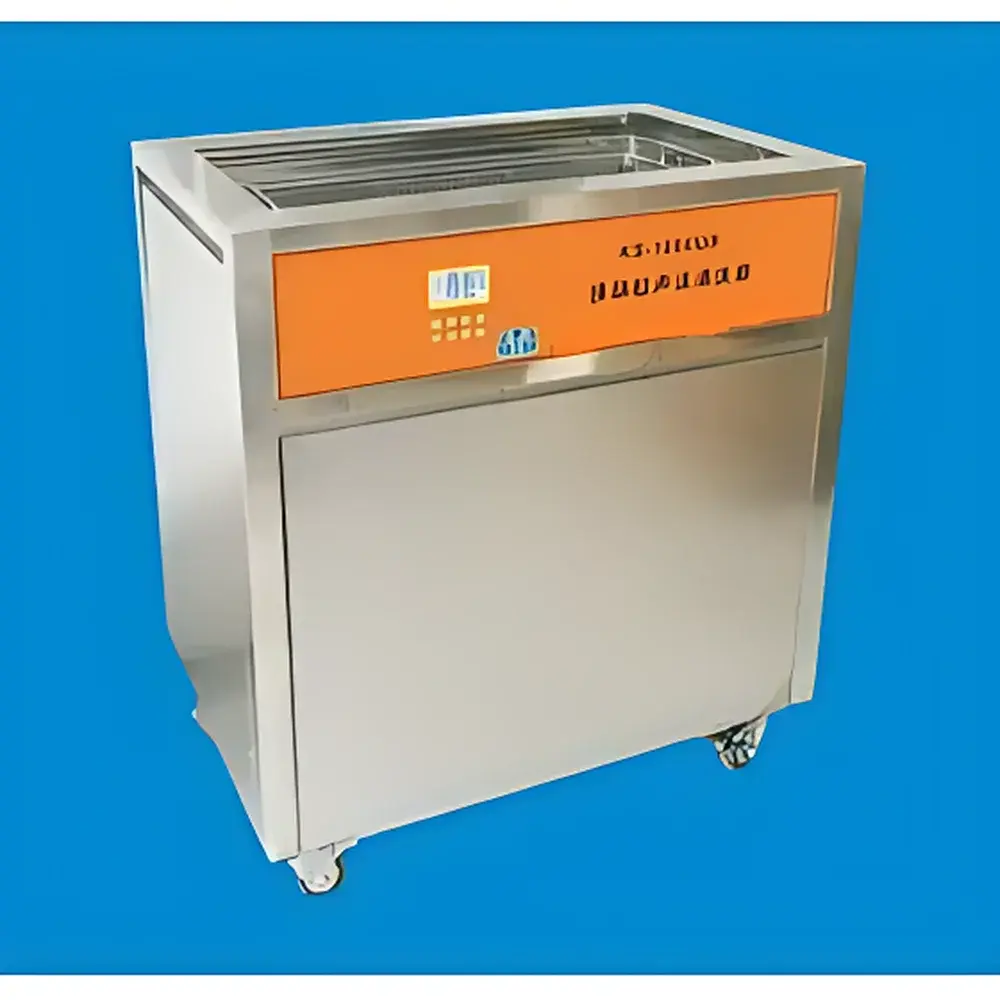
Jihepu KS-1000E Single-Tank Rotary-Knob Ultrasonic Cleaner
| Brand | Jihepu |
|---|---|
| Model | KS-1000E |
| Tank Capacity | 72 L |
| Ultrasonic Frequency | 40 kHz |
| Ultrasonic Power Output | 1000 W |
| Power Adjustment | Continuously Variable |
| Temperature Control Range | 0–80 °C |
| Timer Range | 1–30 min, Adjustable |
| Sound-Dampening Lid | Included |
| Drain Valve | Stainless Steel Ball Valve |
| Construction Material | 304 Stainless Steel (Tank, Lid, Housing, Basket) |
| Heating System | Integrated Immersion Heater |
| Optional Features | Steam Recovery and Thermal Insulation Assembly |
| Compliance | Designed for General Laboratory Use per ISO 13485-aligned manufacturing practices |
Overview
The Jihepu KS-1000E Single-Tank Rotary-Knob Ultrasonic Cleaner is an integrated benchtop or floor-standing cleaning system engineered for reproducible, high-efficiency ultrasonic cavitation in laboratory, academic, and industrial quality control environments. It operates on the principle of piezoelectric transduction at a fixed nominal frequency of 40 kHz—optimized for balanced penetration depth and micro-cavitation intensity across aqueous and mild solvent-based cleaning media. Unlike multi-frequency systems requiring software switching, the KS-1000E delivers stable, harmonically tuned output ideal for routine removal of particulate contaminants, organic residues, biofilms, and machining oils from precision components, glassware, surgical instruments, semiconductor wafers, and analytical sample preparation vessels. Its monolithic design integrates the ultrasonic generator, transducer array, and stainless steel tank into a single thermally insulated chassis, minimizing energy loss and ensuring mechanical stability during extended operation cycles.
Key Features
- Continuously adjustable ultrasonic power output (0–100% of 1000 W nominal), enabling optimization for delicate substrates or heavily soiled loads without acoustic erosion.
- Precise digital temperature control (0–80 °C) via PID-regulated immersion heater, supporting temperature-dependent cleaning protocols such as enzymatic decontamination or low-surface-tension solvent activation.
- Rotary-knob interface for intuitive, tactile adjustment of time (1–30 min), temperature, and power—designed for glove-compatible operation in controlled environments and compliant with ergonomic standards for repetitive-use workflows.
- Sound-dampening lid constructed from double-walled 304 stainless steel with thermal insulation, reducing ambient noise to ≤55 dB(A) at 1 m and preventing vapor loss during heated cycles.
- Integrated steam recovery channel within the lid assembly minimizes condensate drip onto adjacent equipment and improves workplace safety in enclosed fume hood installations.
- Drain system featuring a front-mounted 304 stainless steel ball valve with Teflon-sealed actuation—compatible with gravity drainage or connection to centralized lab waste lines.
- All wetted surfaces—including tank interior, basket, lid sealing surface, and overflow channels—fabricated from electropolished 304 stainless steel (ASTM A240/A480), ensuring corrosion resistance and compatibility with common alkaline, acidic, and neutral cleaning chemistries.
Sample Compatibility & Compliance
The KS-1000E accommodates a wide range of sample geometries and materials, including but not limited to: borosilicate glassware (vials, cuvettes, chromatography columns), metal tools (tweezers, forceps, endoscopes), ceramic substrates, polymer molds, and printed circuit boards. Its 72 L working volume supports batch processing of up to 12 standard 1-L Erlenmeyer flasks or 48 × 15-mL centrifuge tubes simultaneously. The unit is manufactured under quality management systems aligned with ISO 13485 principles and conforms to IEC 61000-6-3 (EMC emissions) and IEC 61000-6-2 (immunity). While not certified for medical device reprocessing per ISO 15883 or EN 285, it meets general laboratory equipment requirements referenced in CLSI GP26-A4 and ASTM D4292 for ultrasonic cleaning validation support.
Software & Data Management
The KS-1000E is a hardware-controlled instrument with no embedded firmware or network connectivity. All operational parameters are set locally via analog rotary controls and displayed on a high-contrast LCD screen. This architecture eliminates cybersecurity risks associated with IoT-enabled devices and ensures long-term operational continuity without software updates or license dependencies. For regulated environments requiring audit trails (e.g., GLP or GMP laboratories), users may document settings manually or integrate the unit into validated process records using external time-stamped loggers. The absence of digital storage or remote access complies with FDA 21 CFR Part 11 requirements for non-electronic record systems.
Applications
- Routine cleaning and decontamination of analytical glassware prior to trace-metal analysis (ICP-MS, AAS) and HPLC system maintenance.
- Removal of polishing compounds and oxide layers from optical lenses and metrology standards.
- Extraction of phytochemicals and nucleic acids from plant tissues and microbial pellets in life science research.
- De-gassing of solvents and resin mixtures prior to casting or coating applications.
- Disruption of cell aggregates and homogenization of viscous suspensions in pharmaceutical formulation development.
- Preparation of calibration standards and reference materials requiring particle-free surfaces.
FAQ
Is the KS-1000E suitable for cleaning delicate MEMS devices or microfluidic chips?
Yes—when operated at reduced power (≤30%) and lower temperatures (25–40 °C) with low-surface-tension, non-ionic detergents, it has been validated for cleaning silicon-based microstructures without feature damage.
Can the unit be operated continuously for more than 30 minutes?
The timer is capped at 30 minutes for safety and transducer longevity; however, manual restart is supported. Continuous operation beyond 60 minutes requires periodic 10-minute cooldown intervals to maintain thermal stability of the transducer stack.
Does the drain valve meet VDI 2083 Class 5 cleanroom compatibility requirements?
The valve’s 304 stainless steel construction and smooth internal finish comply with VDI 2083 Section 5.3 for non-critical cleanroom ancillary equipment; full certification requires third-party particle shedding testing under user-specific conditions.
What cleaning solutions are chemically compatible with the 304 stainless steel tank?
The tank is resistant to pH 2–12 aqueous solutions at ≤80 °C. Avoid halide-rich media (e.g., concentrated NaCl >5%), hypochlorite above 200 ppm, and strong oxidizers like nitric acid unless passivated per ASTM A967.



