
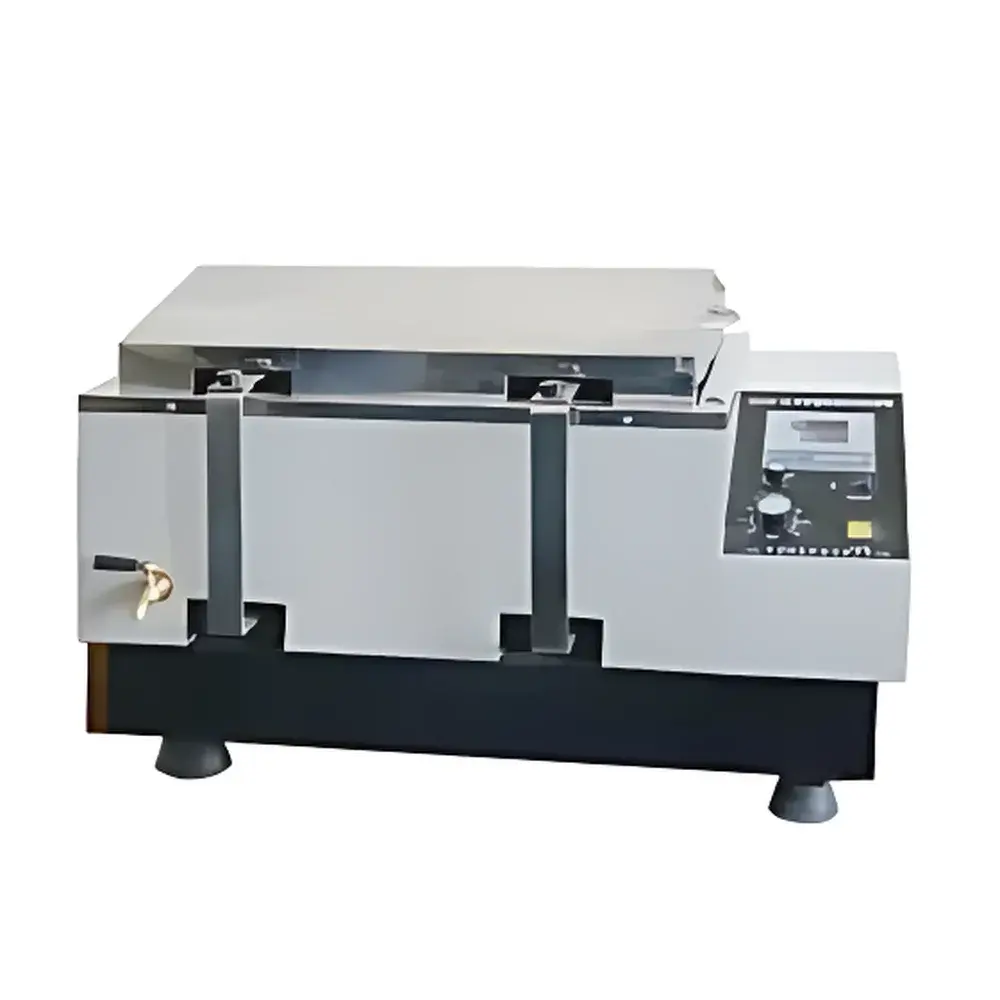
Jihepu SHA-B Water Bath Incubator Shaker
| Brand | Jihepu |
|---|---|
| Origin | Shandong, China |
| Manufacturer Type | Authorized Distributor |
| Product Category | Domestic |
| Model | SHA-B |
| Instrument Type | Water Bath Incubator Shaker / Orbital & Reciprocal Shaker |
| Timer Range | 0–120 min (or continuous operation) |
| Oscillation Frequency | 0–300 rpm, continuously adjustable |
| Oscillation Amplitude | 20 mm |
| Temperature Control Range | Ambient to 100 °C |
| Temperature Accuracy | ±0.5 °C |
| Heating Power | 1800 W |
| Power Supply | 220 V, 50 Hz |
| Bath Chamber Dimensions | 490 × 390 × 170 mm (L×W×H) |
| Overall Dimensions | 700 × 550 × 490 mm (L×W×H) |
| Tray Quantity | 1 stainless steel platform |
| Oscillation Modes | Orbital and Reciprocal (dual-mode) |
| Chamber Material | Stainless steel (304 grade) |
Overview
The Jihepu SHA-B Water Bath Incubator Shaker is an integrated laboratory instrument combining precise temperature-controlled water bath functionality with dual-mode mechanical oscillation—orbital and reciprocal motion—in a single compact unit. Engineered for reproducible cultivation and suspension-based incubation of biological samples, it operates on the principle of convective thermal equilibrium within a thermostatically regulated water medium, coupled with controlled mechanical agitation to ensure homogeneous mixing, enhanced oxygen transfer, and uniform cell or microbial growth conditions. This design is particularly suited for applications requiring both thermal stability and dynamic suspension—such as bacterial culture expansion, enzyme reaction kinetics, solubility studies, and sample homogenization under physiological or elevated temperatures. Its stainless-steel water chamber ensures long-term corrosion resistance in aqueous environments, while its dual oscillation capability allows users to select the most appropriate motion profile depending on culture vessel geometry and biological sensitivity.
Key Features
- Dual oscillation mode: switchable orbital (circular) and reciprocal (back-and-forth) motion—optimized for Erlenmeyer flasks, test tubes, and multi-well plates.
- Precise digital PID temperature control with ±0.5 °C accuracy across a wide range from ambient to 100 °C, ensuring minimal thermal drift during extended incubations.
- Continuously adjustable speed control (0–300 rpm) with smooth startup and stable rotational output, minimizing shear stress on sensitive cultures.
- Mechanical timer with 0–120 minute range or continuous operation setting—no battery dependency or software initialization required.
- Stainless steel (AISI 304) water bath chamber and platform—resistant to oxidation, chemical degradation, and repeated sterilization cycles.
- Included universal spring clamp rack accommodates varied vessel diameters (10–50 mm), supporting parallel comparative experiments without adapter reconfiguration.
- Low-splash oscillation design: optimized fluid dynamics prevent droplet ejection while maintaining sufficient surface agitation for gas exchange.
Sample Compatibility & Compliance
The SHA-B supports standard microbiological and biochemical containers—including glass and polypropylene flasks (50–2000 mL), centrifuge tubes, and sealed vials—when placed on the single stainless-steel tray. Its water bath configuration enables direct thermal coupling to sample vessels, eliminating air-gap insulating effects common in dry-block shakers. The unit complies with general electrical safety requirements per IEC 61010-1 for laboratory equipment. While not certified to ISO/IEC 17025 or GLP-specific validation protocols out-of-the-box, its stable thermal and mechanical performance supports user-defined qualification procedures (IQ/OQ/PQ) aligned with GMP-relevant workflows in QC laboratories. Temperature uniformity mapping and speed calibration can be performed using traceable NIST-certified thermometers and tachometers.
Software & Data Management
The SHA-B operates via analog-digital hybrid controls—featuring a digital LED display for real-time temperature and timer readouts, and manual rotary dials for speed and time adjustment. It does not include embedded microprocessor logging, USB connectivity, or remote monitoring capabilities. As such, it aligns with environments prioritizing operational simplicity, audit-trail minimalism, and reduced firmware maintenance overhead. All parameter settings are manually recorded by the user; no electronic data storage or FDA 21 CFR Part 11-compliant audit trails are generated. For laboratories requiring digital documentation, external data loggers (e.g., calibrated thermocouple-based recorders) may be deployed alongside the unit to capture time-stamped temperature and runtime profiles.
Applications
- Bacterial and yeast culture propagation in liquid media under controlled thermal and agitation conditions.
- Enzyme activity assays requiring consistent temperature and mixing throughout kinetic measurements.
- Solubility and dissolution testing of pharmaceutical compounds in aqueous buffers at elevated temperatures.
- Extraction efficiency optimization for plant metabolites or nucleic acids using heated agitation.
- Cell detachment and suspension preparation prior to flow cytometry or viability assays.
- Environmental sample processing—including waterborne pathogen enrichment and sediment resuspension protocols.
- Teaching laboratory use in undergraduate biochemistry and microbiology courses, where reliability, ease of operation, and cost-effectiveness are critical.
FAQ
What is the maximum load capacity of the shaking platform?
The single stainless-steel tray is rated for uniform loads up to 15 kg, assuming balanced vessel distribution and operation below 250 rpm.
Can the unit maintain 100 °C with full water bath volume and continuous shaking?
Yes—the 1800 W heating element sustains 100 °C at full bath volume (approx. 25 L) under continuous 200 rpm oscillation, though stabilization time increases by ~12–15 minutes compared to static mode.
Is the water bath depth sufficient for submerging 1-L Erlenmeyer flasks?
With a bath depth of 170 mm and standard flask geometry, 1-L flasks sit partially submerged; optimal immersion depth is achieved using 500-mL or smaller vessels.
Does the SHA-B support external temperature probe input for chamber monitoring?
No—temperature sensing is internal only, via a fixed PT100 sensor embedded in the water bath wall.
What maintenance is recommended for long-term reliability?
Monthly descaling with 5% acetic acid solution is advised for hard-water regions; annual inspection of heater terminals and seal integrity around the bath lid is recommended.



