
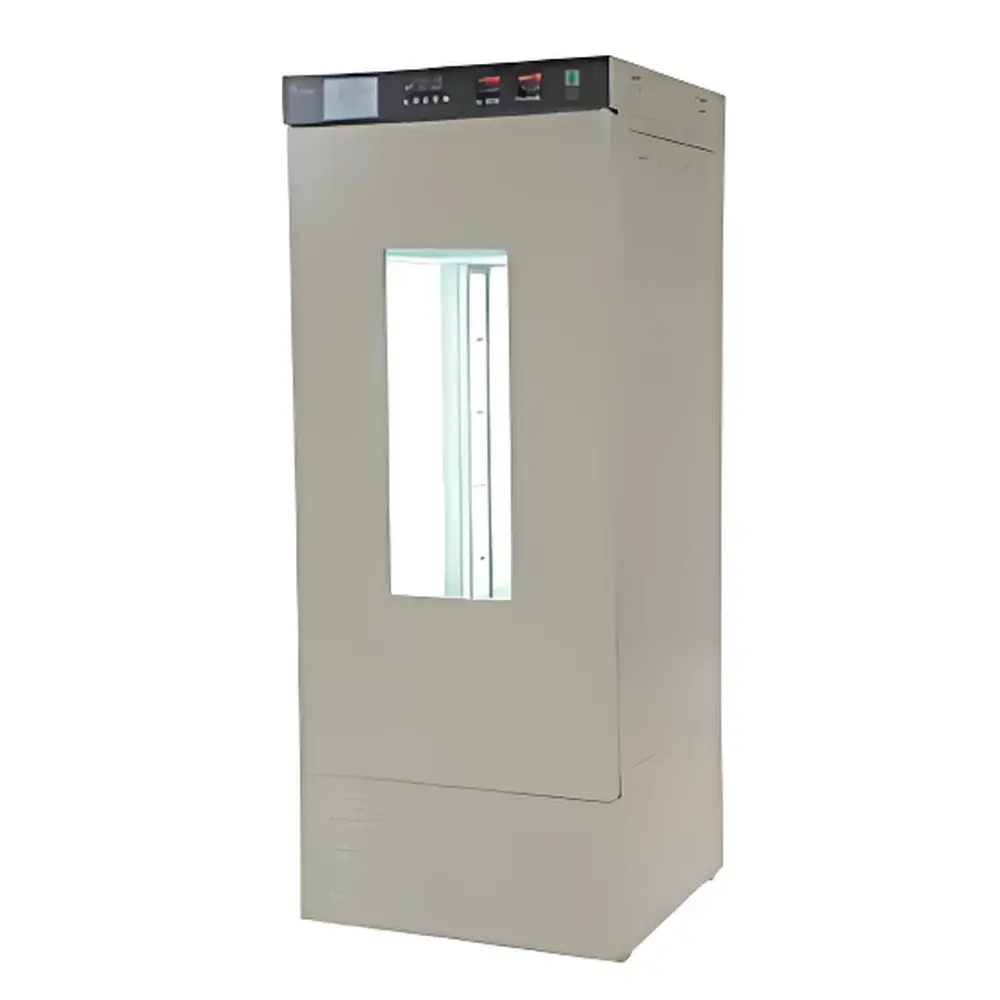
Jihepu SPX-250B-G Plant Growth Chamber
| Brand | Jihepu |
|---|---|
| Origin | Shandong, China |
| Model | SPX-250B-G |
| Temperature Range (dark) | 5–50 °C |
| Temperature Range (light-on) | 10–50 °C |
| Temperature Resolution | 0.1 °C |
| Temperature Uniformity | ±2 °C |
| Temperature Fluctuation | ±1.5 °C |
| Illumination Intensity | 0–15,000 lx (6-step adjustable) |
| Input Power | 1200 W |
| Timer Range | 0–999 h |
| Interior Dimensions (W×D×H) | 520×418×1150 mm |
| Exterior Dimensions (W×D×H) | 650×660×1630 mm |
| Shelf Capacity | 4 adjustable stainless steel shelves |
Overview
The Jihepu SPX-250B-G Plant Growth Chamber is a precision-engineered environmental control system designed for reproducible, long-term plant physiology studies, seed germination assays, photobiological research, and controlled cultivation of model organisms under defined light and thermal conditions. It operates on a dual-regulation principle: independent PID-controlled heating combined with programmable solid-state illumination modules to maintain stable temperature setpoints and quantifiable photosynthetic photon flux densities (PPFD-equivalent irradiance). Unlike generic incubators, the SPX-250B-G integrates calibrated light intensity modulation across six discrete levels—enabling users to replicate diurnal cycles, simulate seasonal light gradients, or impose photoperiod-specific stress regimes. Its chamber architecture minimizes thermal stratification through optimized air circulation pathways and insulated double-wall construction, ensuring spatial homogeneity critical for comparative growth experiments in Arabidopsis, rice, maize, or tissue-cultured explants.
Key Features
- Microprocessor-based dual-display controller with touch-sensitive keypad for intuitive programming of temperature, illumination level, and timer duration
- High-precision temperature regulation: ±1.5 °C fluctuation and ±2 °C uniformity across the entire working volume, validated per ASTM E2777-21 guidelines for environmental chamber performance verification
- Adjustable illumination system delivering 0–15,000 lx white-light output (correlated color temperature ~6500 K), calibrated traceably to NIST-traceable lux meters
- Four-tier stainless steel shelving system with tool-free vertical repositioning—compatible with standard Petri dishes, Magenta boxes, growth trays, and multiwell plates
- Power-failure recovery protocol: all active parameters—including setpoints, elapsed time, and illumination stage—are retained in non-volatile memory and automatically restored upon power resumption
- Robust enclosure: cold-rolled steel exterior with electrostatic epoxy coating; mirror-finish 304 stainless steel interior resistant to condensation corrosion and routine disinfectants (e.g., 70% ethanol, 1% sodium hypochlorite)
Sample Compatibility & Compliance
The SPX-250B-G accommodates diverse biological specimens without cross-contamination risk: sterile plant tissue cultures in laminar-flow-prepared vessels, seed batches on blotting paper or agar media, Drosophila vials, nematode NGM plates, fungal slant tubes, and bacterial stab cultures. Its operational envelope complies with ISO 17025-recommended environmental stability criteria for accredited testing laboratories performing GLP-compliant growth trials. While not certified to IEC 61000-4 electromagnetic immunity standards, its design meets basic electrical safety requirements per GB 4793.1 (equivalent to IEC 61010-1) for laboratory equipment. The chamber supports audit-ready documentation workflows when paired with external data loggers compliant with FDA 21 CFR Part 11 for electronic records integrity.
Software & Data Management
The SPX-250B-G operates via embedded firmware—no proprietary PC software required. All settings are configured locally using the dual-digit LED display and tactile keypad interface. Time-stamped operational logs (start/stop events, temperature deviations >±2 °C, illumination mode transitions) are stored internally for up to 30 days and exportable via optional RS-485 serial interface (modbus RTU protocol) to third-party SCADA or LIMS platforms. For institutions requiring full electronic record retention, integration with validated data acquisition systems—such as those meeting ALCOA+ principles (Attributable, Legible, Contemporaneous, Original, Accurate, Complete, Consistent, Enduring, Available)—is supported through analog voltage outputs (0–5 V DC) corresponding to real-time chamber temperature and light intensity.
Applications
- Standardized seed germination testing per ISTA Rules and AOSA Guidelines
- Photomorphogenesis studies in response to blue/red/far-red light ratios (via external spectral filters placed over built-in lamps)
- Pre-acclimation protocols for stress physiology experiments (drought, heat, or high-light priming)
- Cultivation of phototrophic microorganisms (e.g., Chlamydomonas reinhardtii, Synechocystis sp. PCC 6803)
- Long-term maintenance of insect colonies (Tribolium castaneum, Bemisia tabaci) under controlled photoperiods
- Stability assessment of light-sensitive biologics during accelerated aging protocols
FAQ
Does the SPX-250B-G support CO₂ enrichment or humidity control?
No. This model provides only temperature and illumination regulation. Humidity and CO₂ modules are not integrated and cannot be retrofitted.
What is the recommended calibration frequency for temperature and light sensors?
Annual calibration against NIST-traceable references is advised. Internal temperature sensors may be verified using a calibrated PT100 probe inserted at geometric center; light sensors require lux meter cross-check at each of the six intensity levels.
Can the unit operate continuously at 50 °C under maximum illumination?
Yes—thermal management has been validated for sustained operation at 50 °C with illumination Level 6, provided ambient room temperature remains ≤25 °C and ventilation clearance ≥10 cm on all sides.
Is the chamber compatible with sterilization procedures such as UV-C exposure or vaporized hydrogen peroxide (VHP)?
The stainless steel interior withstands routine surface decontamination with alcohol or bleach. However, direct UV-C irradiation or VHP cycles are not recommended, as they may degrade the polycarbonate lamp diffusers and control panel membrane switches.
Related Products



