
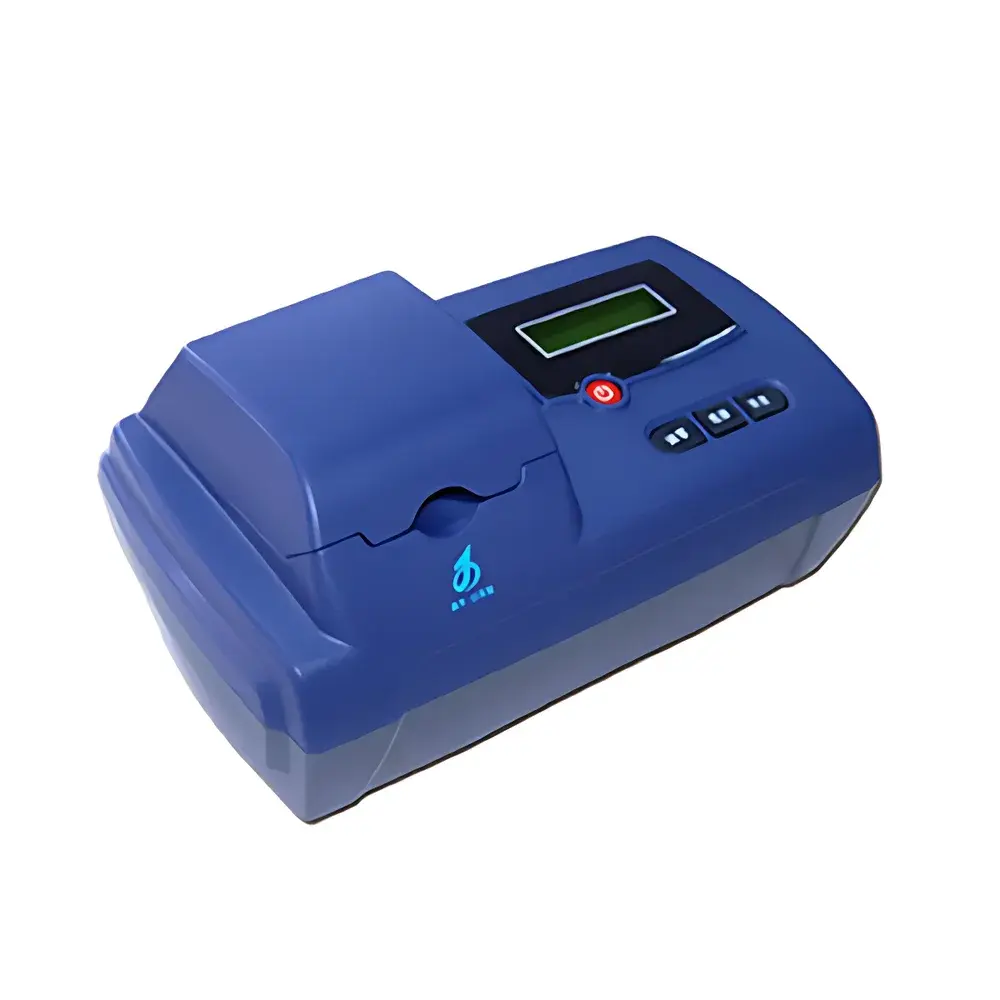
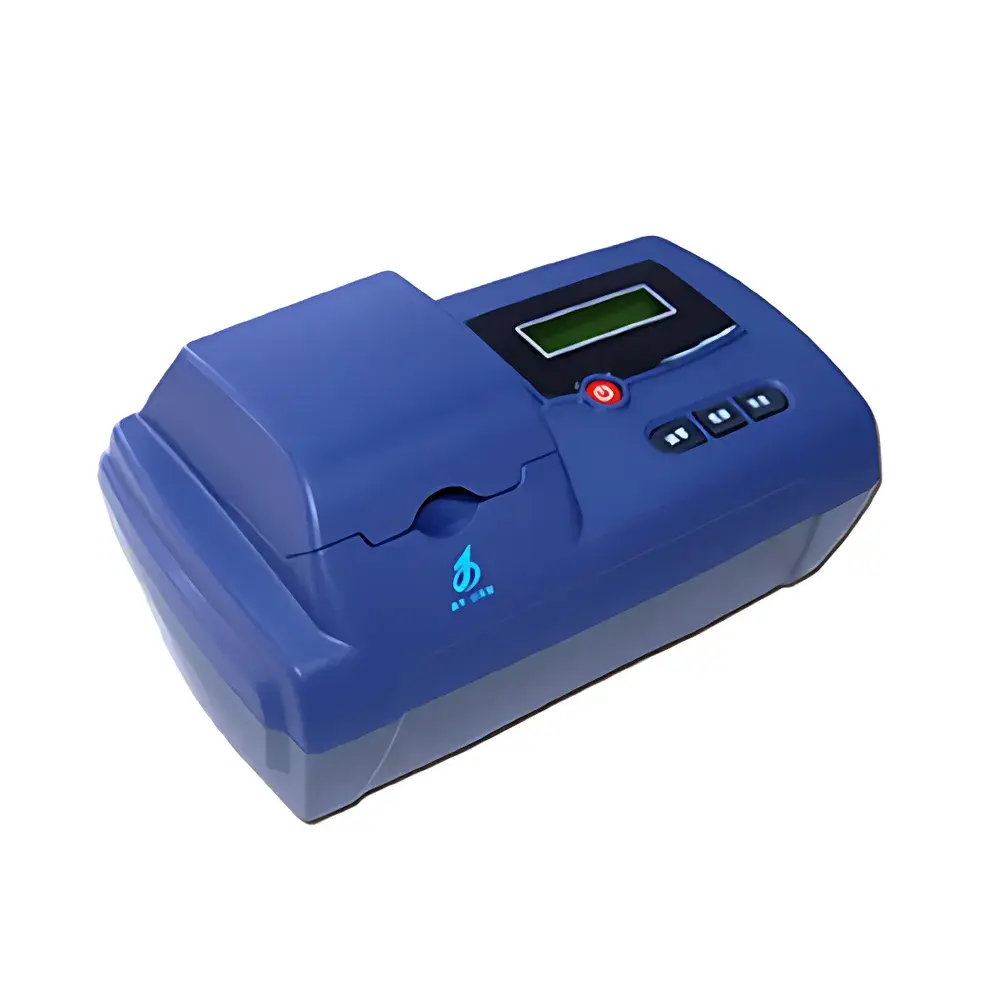
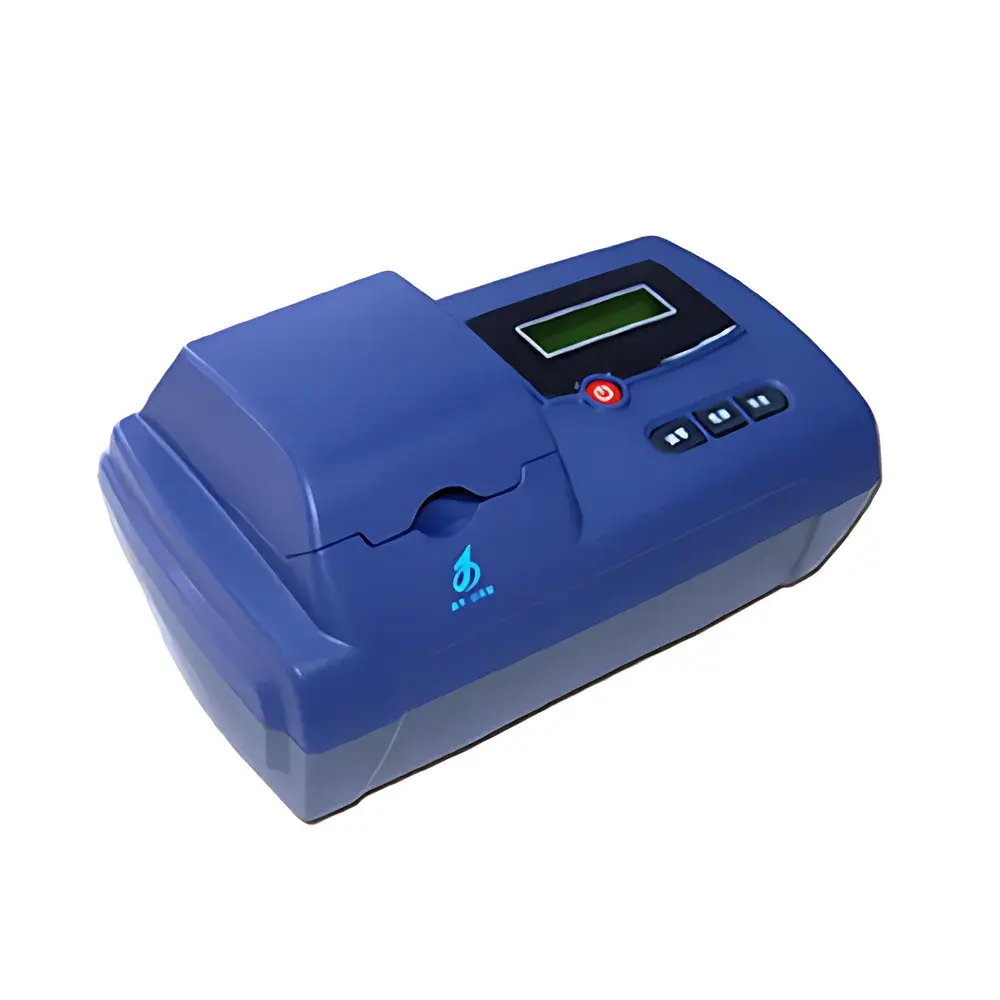
Jilin University & Little Swan GDYS-601SB Portable Disinfection By-Product Analyzer
| Brand | Jilin University & Little Swan |
|---|---|
| Origin | Shanghai, China |
| Manufacturer Type | Authorized Distributor |
| Country of Origin | China |
| Model | GDYS-601SB |
| Quotation | Upon Request |
| Operating Temperature | 0 °C to 40 °C |
| Power Supply | 9 V DC (rechargeable Li-ion battery included) |
| Response Time | 1 s |
| Photometric Stability | ±0.005 Abs/h |
| Optical Wavelengths | 520 nm and 538 nm |
| Absorbance Range | 0.000–2.000 Abs |
| Light Source | High-brightness LED (rated lifetime >100,000 h) |
| Measurement Chamber | Integrated cylindrical sealed cuvette |
| Calibration | Factory-preloaded calibration curves for all target analytes |
Overview
The Jilin University & Little Swan GDYS-601SB Portable Disinfection By-Product Analyzer is a dedicated photometric field instrument engineered for rapid, on-site quantification of residual disinfectants and their regulated by-products in drinking water and source water matrices. It operates on the principle of fixed-wavelength absorbance spectroscopy, utilizing dual-wavelength LED illumination (520 nm and 538 nm) to selectively detect colorimetric reactions generated by standardized reagent chemistry. Designed in accordance with common methodological frameworks referenced in ISO 7890-3 (chlorine species), ISO 10593-1 (ozone), and EPA Method 334.0 (chlorite), the GDYS-601SB supports compliance-driven monitoring workflows in municipal water utilities, environmental health laboratories, and emergency response units. Its compact, handheld architecture—combined with sealed-cuvette measurement geometry and pulse-driven optical excitation—minimizes path-length variability and stray-light interference, ensuring high reproducibility under variable ambient conditions.
Key Features
- Integrated optical module: Fixed-wavelength LEDs, precision-machined sample chamber, and silicon photodiode detector are co-aligned and mechanically stabilized—no moving parts or manual alignment required.
- Pre-programmed analytical curves: Contains factory-calibrated, matrix-matched calibration functions for chlorine dioxide, free chlorine, total chlorine, chlorite, ozone, and formaldehyde—eliminating daily standard preparation and reducing operator dependency.
- Sealed-cuvette methodology: Sample derivatization and photometric readout occur within the same disposable cylindrical reaction vessel, preventing cross-contamination, minimizing handling error, and improving inter-operator consistency.
- Dual-power operation: Equipped with an internal rechargeable lithium-ion battery (9 V nominal) and compatible with external DC input; includes real-time battery diagnostics with low-voltage alert and auto-shutdown to preserve data integrity.
- Ruggedized field design: IP65-rated enclosure, shock-absorbing casing, and operating temperature tolerance from 0 °C to 40 °C support deployment in mobile labs, distribution system monitoring points, and post-disaster assessment scenarios.
- Modular consumables system: Compatible with proprietary lyophilized reagent kits, pre-measured solid-phase extraction cartridges, and calibrated pipetting tools—all traceable to NIST-traceable reference materials.
Sample Compatibility & Compliance
The GDYS-601SB is validated for use with clarified, non-turbid aqueous samples meeting turbidity <5 NTU (per ISO 7027). It accommodates raw surface water (post-filtration), finished drinking water, and treated groundwater without dilution across defined concentration ranges: chlorine dioxide (0.02–5.00 mg/L), free chlorine (0.01–3.00 mg/L), total chlorine (0.01–5.00 mg/L), chlorite (0.05–2.00 mg/L), ozone (0.02–2.00 mg/L), and formaldehyde (0.05–1.00 mg/L). All assay chemistries conform to APHA Standard Methods 4500-Cl G, 4500-O3 B, and 4500-CH2O D. Instrument firmware supports audit-ready data logging compliant with GLP documentation requirements, including timestamped measurements, operator ID entry, and batch-specific reagent lot tracking.
Software & Data Management
Data acquisition and reporting are managed via embedded firmware with 2000-entry non-volatile memory. Each record stores absorbance values at both wavelengths, calculated concentration, measurement time/date, battery status, and reagent lot identifier. USB-C interface enables secure export of CSV-formatted datasets to LIMS or QA/QC review platforms. Firmware supports optional PC-based configuration utility for curve update (via encrypted firmware patch), language localization, and report template customization—fully compatible with Windows 10/11 and macOS 12+. No cloud connectivity or remote telemetry is implemented, preserving data sovereignty per ISO/IEC 27001-aligned operational protocols.
Applications
- Routine verification of disinfectant residual decay profiles across distribution networks
- Emergency response screening for chlorine dioxide breakthrough during alternative disinfectant switching
- Validation of membrane filtration efficiency via chlorite removal quantification
- Source water quality triage following algal bloom events or industrial spill incidents
- Field validation of laboratory-generated chlorine demand curves
- Regulatory compliance sampling per China’s GB 5749-2022 and WHO Guidelines for Drinking-water Quality (4th ed., Annex 2)
FAQ
Does the GDYS-601SB require daily recalibration with standard solutions?
No. The instrument uses factory-loaded, multi-point calibration curves verified against NIST SRM 1699 (chlorine) and USP Reference Standards. Recalibration is only necessary after firmware updates or if QC checks exceed ±0.01 Abs deviation over 24 h.
Can the device measure samples with high turbidity or suspended solids?
Not directly. Samples must be filtered through 0.45 µm membrane prior to analysis to avoid scattering artifacts. Turbidity >5 NTU invalidates photometric linearity per ISO 7027.
Is the battery replaceable by the end user?
Yes. The Li-ion pack is user-serviceable using Torx T5 driver; replacement batteries are supplied with CE/UL certification and include integrated fuel gauge IC.
Are reagent kits certified for shelf life and stability?
All reagent kits carry printed expiration dates and are validated for 18 months unopened at 4–25 °C per ICH Q5C guidelines. Lyophilized formulations retain activity ±3% over shelf life when stored desiccated.
Does the instrument meet FDA 21 CFR Part 11 requirements?
It supports Part 11-aligned data integrity practices—including electronic signatures, audit trails, and role-based access control—when used with the optional PC configuration software and validated LIMS integration. Standalone mode provides ALCOA+ compliant records but lacks electronic signature capability.







