
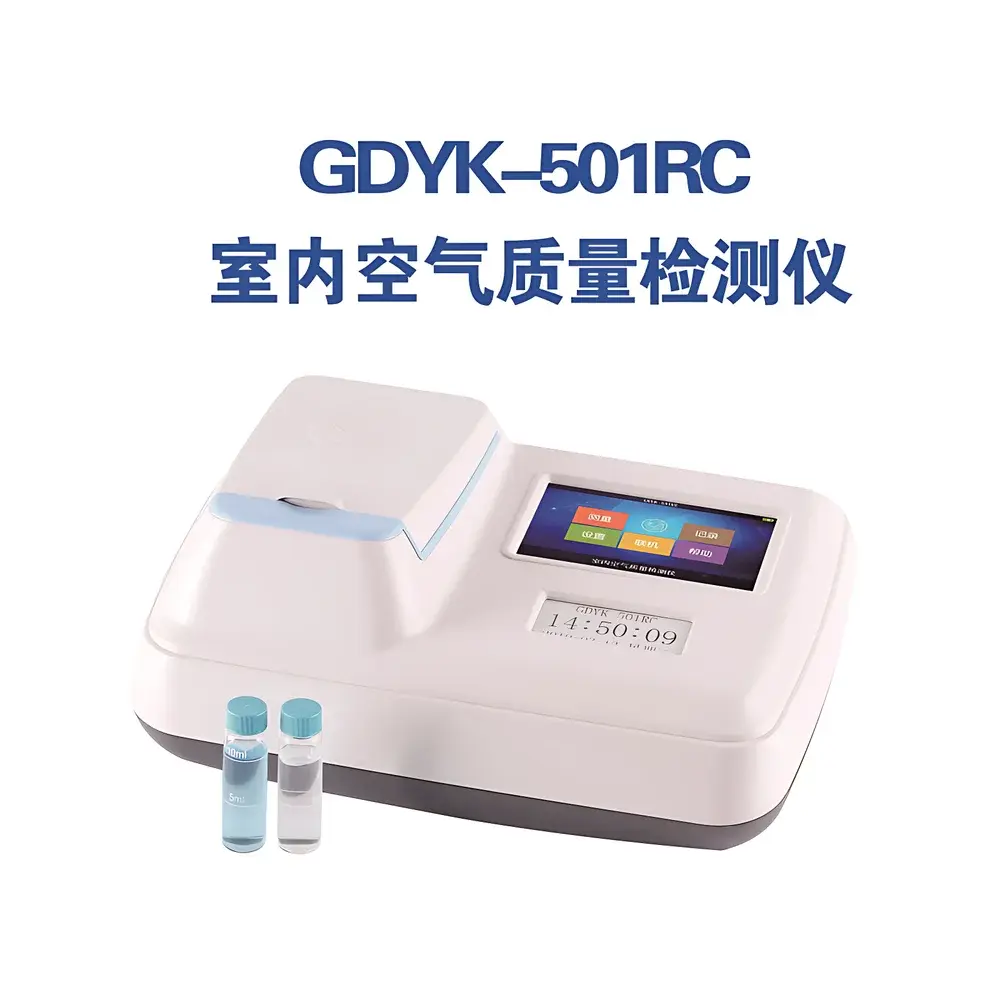
Jilin University-Xiaotianshe GDYK-501RC Indoor Air Quality Analyzer
| Brand | Jilin University-Xiaotianshe |
|---|---|
| Origin | Jilin, China |
| Manufacturer Type | Direct Manufacturer |
| Region of Manufacture | Domestic (China) |
| Model | GDYK-501RC |
| Instrument Type | Portable |
| Operating Principle | Spectrophotometry |
| Detection Parameters | Formaldehyde (HCHO), Benzene Homologues, Total Volatile Organic Compounds (TVOC), Ammonia (NH₃) |
| Detection Limits (mg/m³) | 0.01 (HCHO), 0.05 (Benzene Homologues), 0.05 (TVOC), 0.10 (NH₃) |
| Measurement Ranges (mg/m³) | 0.00–2.00 (HCHO), 0.00–1.00 (Benzene Homologues), 0.00–4.00 (TVOC), 0.00–5.00 (NH₃) |
| Light Sources | 630 nm (HCHO), 465 nm (Benzene/TVOC), 430 nm (NH₃) |
| Analytical Methods | National Standard Phenol Reagent Method (HCHO), Colorimetric Methods (Benzene/TVOC), National Standard Nessler’s Reagent Method (NH₃) |
| Accuracy | ±5% FS |
| Display | 5-inch TFT color touchscreen + 2.9-inch e-ink auxiliary display |
| Connectivity | USB, RS232, RS485 (optional), Bluetooth (for wireless printing) |
| Power Supply | Rechargeable Li-ion battery + AC/DC adapter |
| Data Storage | Internal non-volatile memory with conditional search capability |
Overview
The Jilin University-Xiaotianshe GDYK-501RC Indoor Air Quality Analyzer is a field-deployable, multi-analyte spectrophotometric instrument engineered for quantitative assessment of four critical indoor air contaminants: formaldehyde (HCHO), benzene homologues (e.g., benzene, toluene, xylene), total volatile organic compounds (TVOC), and ammonia (NH₃). It operates on the principle of absorbance-based colorimetric analysis—where analyte-specific chemical reactions generate chromophores whose optical density is measured at precisely defined wavelengths (430 nm, 465 nm, and 630 nm) using stable, temperature-compensated light-emitting diodes. Designed in accordance with Chinese national standards—including GB/T 18204.2–2014 (formaldehyde), GB/T 18204.2–2014 (ammonia), and GB 50325–2020 (TVOC)—the GDYK-501RC delivers trace-level detection sensitivity and high reproducibility under variable ambient conditions. Its dual-display architecture and embedded microcontroller enable real-time calibration verification, automatic blank correction, and on-device data validation—critical for compliance-driven environments such as school classrooms, hospital waiting areas, residential inspections, and post-renovation occupancy assessments.
Key Features
- Dual-display interface: 5-inch high-resolution TFT color touchscreen for intuitive menu navigation, real-time graphing, and method selection; complemented by a 2.9-inch bistable e-ink auxiliary display for low-power status monitoring and battery life extension.
- Modular optical design: Independently optimized LED light sources (430 nm, 465 nm, 630 nm) with precision current-regulated drivers ensure spectral stability and minimal drift over extended operation cycles.
- Multi-parameter flexibility: Four pre-programmed analytical methods allow user-selectable combinations—enabling simultaneous or sequential measurement of any subset of HCHO, benzene homologues, TVOC, and NH₃ without hardware reconfiguration.
- Robust connectivity suite: Native support for USB mass storage mode, RS232 serial communication, optional RS485 Modbus RTU protocol, and Bluetooth 4.2 for secure pairing with certified thermal printers—facilitating audit-ready report generation.
- Field-sustained power architecture: Integrated rechargeable lithium-ion battery (rated ≥8 h continuous operation) with intelligent charge management; compatible with universal AC/DC adapters (100–240 VAC input).
- Comprehensive data governance: Internal flash memory stores ≥10,000 test records with timestamp, operator ID, location tag (manual entry), and raw absorbance values—each record checksum-verified for integrity.
Sample Compatibility & Compliance
The GDYK-501RC is validated for use with standard 10 mL absorption solution sampling kits (e.g., DNPH-coated silica cartridges for TVOC, phenol reagent impingers for HCHO, Nessler’s reagent bubbler systems for NH₃). Sample introduction follows passive or active air sampling protocols compliant with GB/T 18204.2–2014 and HJ 583–2010. All onboard analytical methods are aligned with Chinese national environmental monitoring standards and referenced against ISO 16000-23 (indoor air—determination of formaldehyde) and ISO 16017-1 (VOCs by sorbent tube/thermal desorption/GC–MS) for methodological equivalence. While not certified to EU CE or US EPA Tier 1 requirements, its performance characteristics meet GLP-aligned documentation needs for internal quality assurance, third-party certification bodies, and municipal health department field surveys.
Software & Data Management
Instrument firmware supports full audit trail functionality: every calibration event, parameter modification, and measurement execution is time-stamped and logged with operator credentials (user-defined login). Data export is available in CSV format via USB stick or serial transfer, preserving raw absorbance readings, calculated concentrations, confidence flags (e.g., “out-of-range”, “low signal-to-noise”), and method version identifiers. Optional PC software (GDYK-PC Suite v3.2) provides trend analysis, batch reporting, and PDF certificate generation with digital signature fields—designed to satisfy basic 21 CFR Part 11 readiness for non-GMP laboratory applications. All stored records include CRC-16 error checking and write-protection for archival integrity.
Applications
- Post-construction indoor air clearance testing in residential and commercial buildings per GB 50325–2020 Class I/II limits.
- Occupational hygiene screening in office environments, kindergartens, and elderly care facilities.
- Verification of HVAC system efficacy during commissioning and seasonal maintenance cycles.
- Educational laboratories conducting environmental chemistry experiments on pollutant kinetics and adsorption efficiency.
- Municipal public health departments performing routine ambient air quality surveillance in densely populated urban interiors.
- Third-party inspection agencies delivering ISO/IEC 17025-compliant test reports (when used within validated SOPs and traceable calibration workflows).
FAQ
What sample volume is required for each analyte?
Standard sampling uses 10 mL absorbing solution per test; airflow rate and duration are method-dependent—typically 0.5 L/min for 20 min (10 L total) for formaldehyde and ammonia, and 0.2 L/min for 30 min (6 L) for benzene/TVOC.
Is external calibration gas required?
No—calibration is performed using liquid standard solutions traceable to NIM (National Institute of Metrology, China); no gas cylinders or permeation tubes are needed.
Can the instrument be used outdoors?
It is designed for indoor environments (operating range: 5–40 °C, RH ≤85% non-condensing); outdoor deployment is not recommended due to uncontrolled particulate interference and thermal instability.
How often must the optical path be cleaned?
The cuvette chamber requires manual cleaning with ethanol-dampened lint-free wipes after every 50 measurements or when visible residue accumulates—no ultrasonic or solvent immersion permitted.
Does the device support remote firmware updates?
Firmware updates are delivered via USB stick only; network connectivity (Wi-Fi/Ethernet) is not implemented for security and regulatory consistency.
Related Products







