
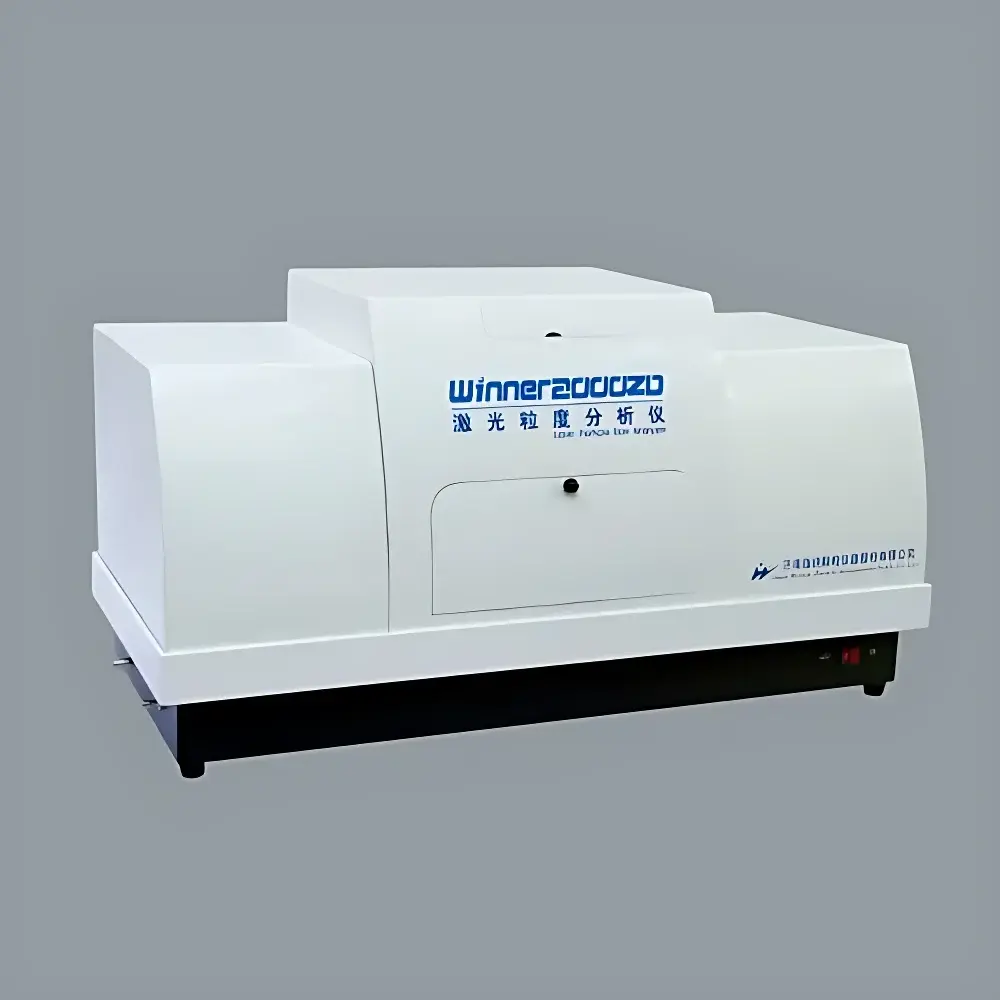
Jinan Winner Winner2000ZD Series Intelligent Laser Particle Size Analyzer
| Brand | Jinan Winner |
|---|---|
| Origin | Shandong, China |
| Manufacturer Type | Direct Manufacturer |
| Instrument Type | Laboratory Wet-Dispersion Laser Particle Size Analyzer |
| Measurement Range | 0.1–300 µm |
| Repeatability | <0.5% (D50 of NIST-traceable standard reference material) |
| Measurement Time | <120 s per run |
| Dispersion Method | Wet dispersion with integrated ultrasonication, stirring, and circulation |
| Laser Source | λ = 639 nm, P > 2 mW |
| Ultrasonic Frequency | 40 kHz, Power: 60 W (adjustable duration) |
| Stirring Speed | 0–3000 rpm (adjustable) |
| Circulation Flow Rate | 8 L/min |
| Sample Cell Volume | 350 mL (optional 10 mL micro-cell) |
| Compliance | GB/T 19077–2016, ISO 13320:2009, Q/0100JWN001–2013 |
Overview
The Jinan Winner Winner2000ZD Series Intelligent Laser Particle Size Analyzer is a high-precision, laboratory-grade instrument engineered for reliable and reproducible particle size distribution (PSD) analysis of solid particulates suspended in liquid media. It operates on the principle of laser diffraction—measuring angular intensity distribution of light scattered by particles in a collimated laser beam—and applies Mie or Fraunhofer optical models depending on particle refractive index and size regime. The system features a convergent-beam Fourier transform optical design that eliminates aperture-induced angular truncation, significantly enhancing sensitivity to submicron particles (down to 0.1 µm). Its fully automated alignment mechanism—driven by a high-resolution four-phase hybrid stepper motor—maintains optical centering at the micron level, eliminating manual calibration drift and ensuring long-term measurement stability across repeated analyses.
Key Features
- Full-range scattering detection using an annular photodiode array with 76–78 independent detection channels, optimized for high signal-to-noise ratio and angular resolution.
- Unconstrained free-fitting algorithm: PSD reconstruction is not bound to log-normal or other parametric assumptions, enabling faithful representation of multimodal, skewed, or irregular distributions.
- Integrated wet dispersion module (patented: ZL.2010 1 0533181.6) combining ultrasonication (40 kHz, 60 W), variable-speed mechanical stirring (0–3000 rpm), and controlled recirculation (8 L/min) to prevent sedimentation and ensure homogeneous sample presentation.
- Automated workflow: One-click “Auto Test” mode initiates alignment, dispersion, measurement, and data reporting without operator intervention beyond sample introduction.
- Modular optical architecture with thermally stabilized laser diode and sealed optical path, minimizing environmental influence on beam quality and detector response.
Sample Compatibility & Compliance
The Winner2000ZD supports aqueous and organic suspensions of insoluble solids—including metal and non-metal powders, ceramics, pharmaceutical excipients, agrochemicals, carbon black, graphite, kaolin, calcium carbonate, catalysts, and battery electrode materials. It accommodates both standard (350 mL) and low-volume (10 mL) sample cells, facilitating analysis of precious or limited-quantity samples. All measurement protocols comply with ISO 13320:2009 (particle size analysis — laser diffraction methods), GB/T 19077–2016 (Chinese national standard equivalent), and internal quality control specifications (Q/0100JWN001–2013). The instrument meets foundational requirements for GLP-compliant laboratories, including traceable calibration using NIST-traceable reference materials (e.g., NIST SRM 1963) and documented repeatability (<0.5% RSD on D50).
Software & Data Management
The proprietary WinPAS software provides intuitive graphical interface navigation, real-time scatter pattern visualization, and customizable report generation (PDF, CSV, Excel). It supports audit-trail logging for critical operations—including parameter changes, calibration events, and result exports—aligning with basic FDA 21 CFR Part 11 readiness for electronic records. Data processing includes automatic background subtraction, multiple refractive index selection, and optional density-based mass/volume distribution conversion. Raw scattering patterns and intermediate fitting residuals are exportable for third-party validation or advanced modeling (e.g., regularization inversion, constrained least-squares optimization). Software updates are delivered via secure HTTPS channel with version-controlled release notes.
Applications
This analyzer serves as a primary characterization tool in R&D, QC, and process development environments across diverse sectors:
- Materials science: Sintering behavior prediction for ceramic and metal powders; slurry stability assessment in additive manufacturing feedstocks.
- Pharmaceuticals: API particle sizing for dissolution rate correlation; granule and blend uniformity evaluation per USP <788> and <724> guidance.
- Chemicals & coatings: Pigment dispersion quality control; emulsion droplet size monitoring in latex synthesis.
- Environmental & energy: Catalyst support particle integrity testing; cathode/anode powder batch consistency verification for Li-ion batteries.
- Geosciences & construction: Clay mineral grading; cement fineness classification per ASTM C114 and EN 196-6.
FAQ
What standards does the Winner2000ZD conform to for regulatory reporting?
It complies with ISO 13320:2009 and GB/T 19077–2016 for method validation, and its performance metrics (repeatability, accuracy against certified standards) satisfy internal QC and GLP documentation requirements.
Can the instrument analyze dry powders directly?
No—the Winner2000ZD is configured exclusively for wet dispersion. Dry powder analysis requires optional pneumatic dispersion accessories, which are not included in this base configuration.
Is the software compatible with LIMS integration?
Yes—WinPAS supports ODBC-compliant database export and structured CSV output, enabling seamless ingestion into most laboratory information management systems (LIMS) for automated data archival and trending.
How is optical alignment verified during routine operation?
The system performs self-diagnostic alignment checks before each measurement cycle using position-encoded stepper motor feedback and real-time centroid tracking of the primary laser beam on the central detector element.
What maintenance is required for long-term operational reliability?
Routine cleaning of the flow cell and ultrasonic bath chamber is recommended after every 50–100 runs; annual verification of laser power output and detector linearity using factory-calibrated reference kits is advised for ISO-compliant environments.



