
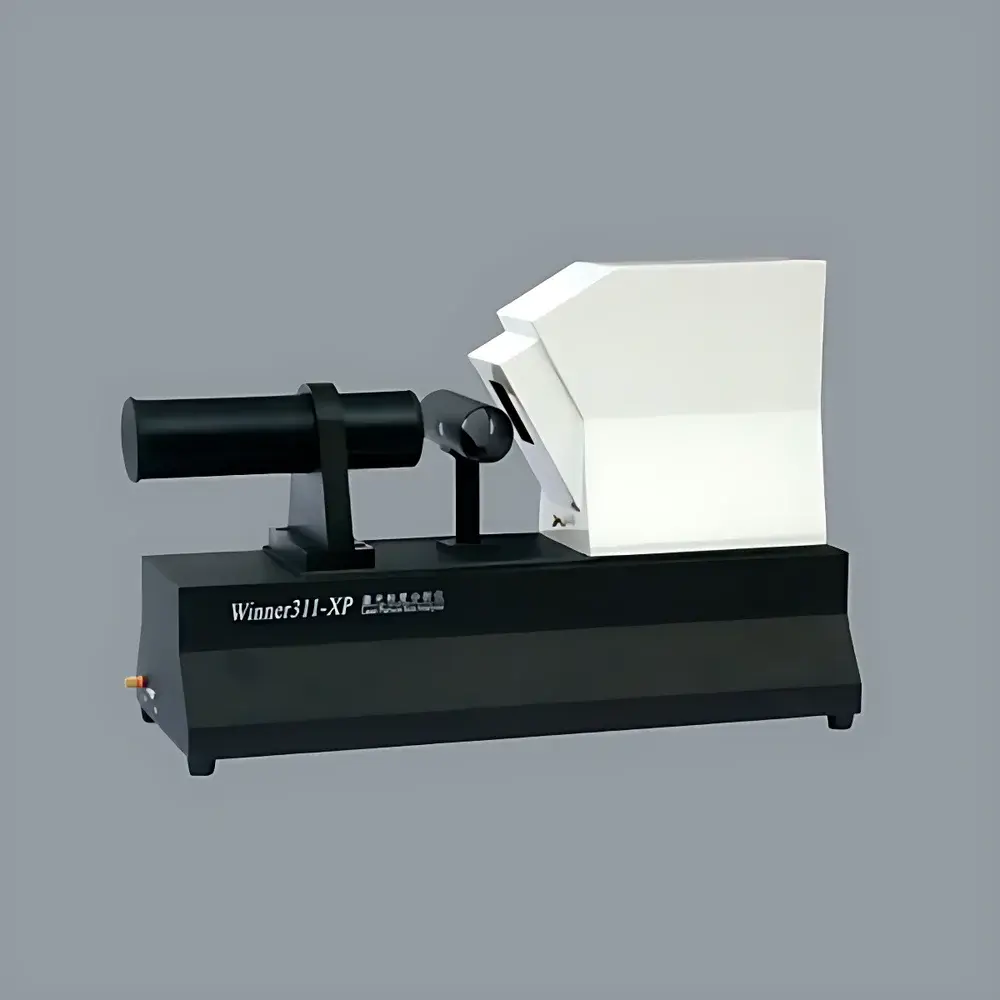
Jinan Winner Winner311XPPLUS Desktop Spray Droplet Size Analyzer
| Brand | Jinan Winner |
|---|---|
| Origin | Shandong, China |
| Manufacturer Type | Direct Manufacturer |
| Origin Category | Domestic |
| Model | Winner311XPPLUS |
| Price Range | USD 14,000–21,500 |
| Dispersion Method | Dry & Wet Dispersion |
| Instrument Type | Laboratory Laser Diffraction Particle Size Analyzer |
| Measurement Range | 0.1–100 µm |
| Repeatability | >99% |
| Measurement Time | 10–120 s |
Overview
The Jinan Winner Winner311XPPLUS Desktop Spray Droplet Size Analyzer is a purpose-built laser diffraction instrument engineered for non-contact, real-time measurement of droplet size distributions in airborne aerosols—specifically optimized for small-scale nebulizers, medical inhalers, nasal sprays, and other precision atomization devices. Unlike conventional wet-dispersion laser particle analyzers, the Winner311XPPLUS employs an open-tube optical configuration that enables direct interrogation of freely suspended droplets, mists, fogs, and respirable powders without physical sampling or carrier fluid interference. Its core measurement principle follows ISO 13320:2009 and GB/T 19077–2016 standards for laser diffraction, relying on angular analysis of Mie-scattered light from a collimated 650 nm semiconductor laser (P > 1 mW) to reconstruct volumetric particle size distribution (PSD) across the full 0.1–100 µm range. This architecture eliminates sedimentation bias, minimizes evaporation artifacts, and supports dynamic measurement of transient spray plumes under ambient or controlled airflow conditions.
Key Features
- Open-tube optical design with 60 mm measurement zone length—enables flexible integration into lab-scale spray test benches and compatibility with low-flow nebulizer outputs.
- Dual-lens, dual-array detector system: A primary forward-scatter lens coupled with a high-density multi-angle backscatter array ensures comprehensive angular coverage (up to 150°), enhancing resolution at sub-micron diameters and improving D10/D50/D90 reproducibility.
- Integrated laminar air curtain system: Patented gas sheath flow protects the front optical window from deposition during extended operation, eliminating manual cleaning cycles and sustaining optical throughput stability over >8-hour continuous testing sessions.
- Single-beam collimated illumination path: Reduces alignment sensitivity and thermal drift; supports long-term calibration retention verified per ISO 13320 Annex B protocols.
- Modular firmware architecture: Supports user-defined trigger logic (e.g., TTL pulse sync with pump activation), time-resolved sequential acquisition (frame rates up to 10 Hz), and automatic baseline correction for background aerosol subtraction.
Sample Compatibility & Compliance
The Winner311XPPLUS is validated for regulatory-compliant testing of pharmaceutical aerosol products, including metered-dose inhalers (MDIs), soft-mist inhalers (SMIs), dry powder inhalers (DPIs), and nasal sprays—as referenced in USP , Ph. Eur. 2.9.31, and Chinese Pharmacopoeia Volume IV (2020 Edition) Chapter 0902. It meets the essential performance criteria outlined in ASTM F2147–22 (Standard Practice for Measuring Aerosol Particle Size Distribution from Nebulizers) and supports GLP documentation workflows through audit-trail-enabled software logging. Sample introduction requires no dilution, filtration, or surfactant addition—making it suitable for volatile formulations, ethanol-based propellants, and hygroscopic excipients where wet dispersion would induce coalescence or phase separation.
Software & Data Management
The bundled WinPAS v4.2 software provides ISO/IEC 17025-aligned data processing with NIST-traceable reference material validation (e.g., NIST SRM 1963). Key capabilities include: real-time PSD visualization with cumulative/differential plots; automated calculation of FDA-recommended metrics (e.g., mass median aerodynamic diameter [MMAD], geometric standard deviation [GSD], fine particle fraction [FPF < 5 µm]); batch-mode statistical comparison (ANOVA, t-test); export to CSV, PDF, and XML formats compliant with 21 CFR Part 11 electronic record requirements; and configurable report templates aligned with ICH Q5A and Q5C stability study reporting conventions. All raw scattering intensity matrices are retained for retrospective reprocessing.
Applications
- Pharmaceutical development: Quantitative characterization of emitted dose uniformity, actuation-to-actuation variability, and formulation-dependent droplet shrinkage during flight.
- Medical device QA/QC: Verification of nebulizer performance per ISO 27427 and EN 13544–1; validation of ultrasonic mesh and piezoelectric vibration plate雾化片 output consistency.
- Cosmetic & wellness R&D: Particle sizing of aromatherapy misters, facial steamers, and cold-fog humidifiers to ensure skin penetration depth and respiratory safety.
- Electronics: Characterization of e-liquid droplets in vaping devices for nicotine delivery modeling and thermal degradation product correlation studies.
- Academic aerosol physics: Investigation of breakup mechanisms, ligament formation, and secondary atomization in low-Weber-number sprays.
FAQ
Does the Winner311XPPLUS require sample dilution or carrier gas conditioning?
No—its open-path design measures native aerosols directly; optional compressed air or nitrogen purge can be used for inerting but is not mandatory.
Can it measure polydisperse sprays with bimodal distributions?
Yes—the 60-channel detection array and Mie inversion algorithm resolve distinct modes down to a 1.5:1 size ratio with <±1.2% D50 uncertainty (per NIST SRM 1963 verification).
Is the instrument compatible with GMP-regulated environments?
Yes—WinPAS v4.2 includes 21 CFR Part 11-compliant user access controls, electronic signatures, and immutable audit trails for all acquisition and analysis events.
What maintenance intervals are recommended for the optical system?
Lens protection via air curtain reduces cleaning frequency to once per 200 operational hours; annual factory recalibration is advised using certified reference standards.
How is particle refractive index handled in data processing?
Users input real and imaginary components (e.g., 1.45 + 0.0i for water-based droplets, 1.52 + 0.01i for propellant-laden aerosols); the software applies rigorous Mie theory with iterative convergence control.



