
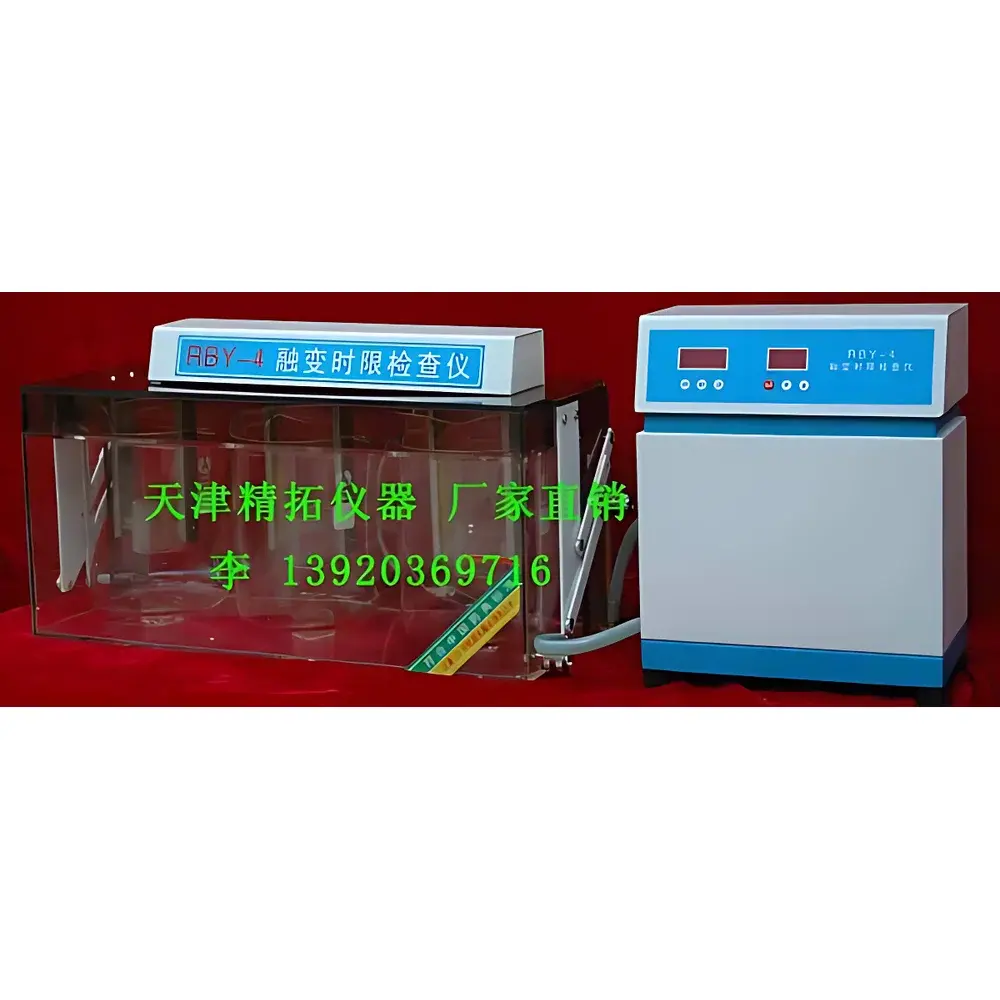
Jing Tuo Instrument RBY-4 Automatic Disintegration Tester for Suppositories and Vaginal Tablets
| Brand | Jing Tuo Instrument |
|---|---|
| Origin | Tianjin, China |
| Manufacturer Type | Direct Manufacturer |
| Country of Origin | China |
| Model | RBY-4 |
| Pricing | Upon Request |
| Temperature Control Accuracy | 37 °C ± 0.3 °C |
| Temperature Set Range | 30–40 °C |
| Cylinder Dimensions | Ø52 mm × 60 mm |
| Metal Rack Dimensions | Ø50 mm, Aperture Ø4 mm, Plate Spacing 30 mm |
| Disintegration Time Programs | P1 (30 min, rack inversion every 10 min), P2 (60 min, rack inversion every 10 min), P3 (30 min, no inversion) |
| Beaker Capacity | 5 L (3 standard beakers included) |
| Heating Power | 1300 W |
| Power Supply | 220 V ± 10 %, 50 Hz |
Overview
The Jing Tuo Instrument RBY-4 Automatic Disintegration Tester is a purpose-built pharmaceutical testing system engineered to perform standardized disintegration testing of solid dosage forms—including suppositories, vaginal tablets, and similar thermosensitive formulations—under precisely controlled aqueous conditions. Designed in strict accordance with the Chinese Pharmacopoeia (ChP) Volume IV, General Chapter 0921 “Disintegration Time Limit Test”, the RBY-4 implements a validated thermal-mechanical protocol that simulates physiological temperature and mechanical agitation to assess the time required for complete disintegration or structural breakdown of dosage units. Its core operational principle relies on immersion in a thermostatically regulated water bath maintained at 37 °C ± 0.3 °C, coupled with programmable mechanical inversion of the sample-holding metal rack to replicate gentle hydrodynamic perturbation. This methodology ensures high reproducibility across repeated assays and aligns with internationally recognized disintegration assessment paradigms used in QC laboratories supporting GLP-compliant stability and release testing.
Key Features
- Microcontroller-based temperature regulation with PID feedback loop ensures stable bath temperature at 37 °C ± 0.3 °C over extended operation cycles.
- Three preconfigured disintegration programs (P1, P2, P3) support flexible test durations (30 or 60 minutes) and variable rack inversion intervals (every 10 minutes or none), enabling compliance with multiple ChP monograph requirements.
- Stainless steel sample rack with precise geometry (Ø50 mm outer diameter, 4 mm aperture, 30 mm vertical plate spacing) ensures uniform sample positioning and unrestricted fluid access per unit.
- Dedicated cylindrical test tubes (Ø52 mm × 60 mm) conform to ChP dimensional specifications for suppository testing, minimizing edge effects and ensuring consistent immersion depth.
- Integrated timing and audible/visual alarm system provides unambiguous endpoint indication; all timing events—including rack actuation—are logged via internal microcontroller timestamps.
- High-efficiency 1300 W heating element enables rapid bath temperature recovery after sample insertion, reducing inter-test downtime without compromising thermal stability.
Sample Compatibility & Compliance
The RBY-4 is validated for use with suppositories (fatty and water-soluble bases), vaginal tablets, and other solid rectal/vaginal dosage forms specified in ChP monographs. It accommodates up to three simultaneous test units per run using standard 5 L glass beakers (supplied). The instrument’s mechanical and thermal parameters meet the dimensional and operational criteria defined in ChP 0921, including bath volume, tube dimensions, rack geometry, temperature tolerance, and agitation frequency. While primarily aligned with ChP requirements, its operational envelope overlaps with relevant sections of USP <701> Disintegration and Ph. Eur. 2.9.1, facilitating cross-referenced method transfer in multi-regional development workflows. No modifications are required to satisfy routine audit readiness under GMP Annex 15 and WHO TRS 986 validation principles.
Software & Data Management
The RBY-4 operates via embedded firmware without external PC dependency, ensuring deterministic real-time control and eliminating software compatibility risks. All operational parameters—including selected program, start time, bath temperature setpoint, and rack inversion timestamps—are retained in non-volatile memory. While the device does not feature network connectivity or electronic data capture (EDC), its design supports manual audit trail generation through printed or handwritten test records referencing instrument ID, operator, date, batch number, and observed disintegration endpoints. For laboratories implementing 21 CFR Part 11 compliance, the RBY-4 may be integrated into broader electronic quality management systems (eQMS) via documented procedural controls governing calibration logs, maintenance history, and user training verification.
Applications
- QC release testing of suppositories and vaginal tablets per ChP, USP, or Ph. Eur. specifications.
- Comparative disintegration profiling during formulation development and excipient screening.
- Stability study support—monitoring changes in disintegration behavior across storage conditions (e.g., accelerated aging at 40 °C/75% RH).
- Process validation activities where disintegration time serves as a critical quality attribute (CQA) linked to dissolution performance.
- Educational use in pharmaceutical sciences curricula for teaching pharmacopeial testing methodology and solid dosage form behavior.
FAQ
What pharmacopeial standards does the RBY-4 comply with?
The RBY-4 is designed and verified to meet the technical requirements of the Chinese Pharmacopoeia (ChP) General Chapter 0921, with functional alignment to USP <701> and Ph. Eur. 2.9.1 disintegration test apparatus specifications.
Can the RBY-4 be used for oral tablets?
No—the RBY-4 is specifically configured for thermosensitive vaginal and rectal dosage forms requiring 37 °C testing; oral tablet disintegration (typically at 37 °C but with different rack geometry and fluid volume) requires a dedicated apparatus compliant with USP <701> Type A or B.
Is calibration documentation provided with the instrument?
Yes—each unit ships with a factory calibration certificate covering temperature sensor accuracy (traceable to national standards) and timer functionality, along with instructions for periodic user verification per ISO/IEC 17025 guidelines.
What maintenance is required to ensure long-term accuracy?
Routine maintenance includes quarterly verification of bath temperature uniformity using calibrated NIST-traceable thermometers, annual inspection of heater element integrity, and biannual cleaning of rack and cylinder surfaces to prevent mineral deposit accumulation.
Does the RBY-4 support custom timing protocols beyond P1–P3?
No—the firmware implements only the three predefined programs mandated by ChP 0921; modification of timing logic or inversion sequences would require hardware-level reconfiguration and is not supported under standard warranty or regulatory validation scope.



