
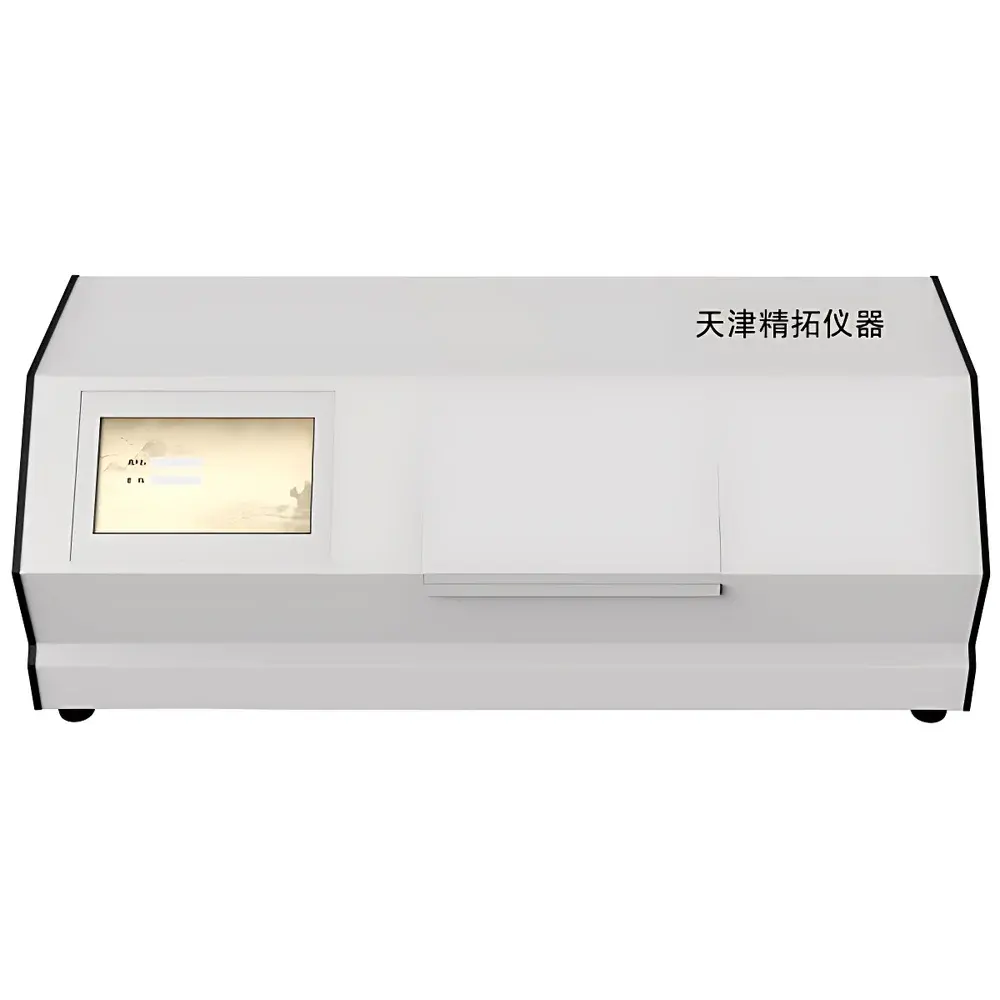
Jing Tuo JH-P100 Automated Temperature-Controlled Polarimeter
| Brand | Jing Tuo Instrument |
|---|---|
| Origin | Tianjin, China |
| Manufacturer Type | Direct Manufacturer |
| Product Category | Domestic |
| Model | JH-P100 |
| Price Range | USD 700–1,400 (FOB) |
| Type | Automated Polarimeter |
| Temperature Control | Integrated Peltier Element |
| Display | Digital LCD |
| Light Source | High-Stability LED (λ ≈ 589.3 nm equivalent) |
| Measurement Range | ±45° optical rotation |
| Angular Resolution | 0.01° |
| Accuracy | ±0.002° |
| Compliance | Meets ISO 11987:2016 (Polarimetric Determination of Optical Rotation) |
Overview
The Jing Tuo JH-P100 Automated Temperature-Controlled Polarimeter is a precision optical instrument engineered for the quantitative measurement of optical rotation—defined as the angular deflection of plane-polarized light as it passes through an optically active medium. Based on the fundamental principle of polarimetry, the JH-P100 employs a stable, monochromatic LED light source calibrated to emit at a wavelength functionally equivalent to the sodium D-line (589.3 nm), ensuring compatibility with established pharmacopoeial and industrial reference methods. Unlike legacy instruments relying on sodium vapor or tungsten-halogen lamps, the JH-P100 integrates a solid-state LED with an operational lifetime exceeding 100,000 hours—eliminating spectral drift, warm-up delays, and frequent lamp replacement. Its core optical path incorporates a high-precision half-shade field analyzer and a motorized rotatable analyzer assembly, enabling fully automated null-point detection with closed-loop feedback control. The system is designed for routine use in quality control laboratories where reproducibility, traceability, and regulatory alignment are critical.
Key Features
- Integrated Peltier-based temperature regulation (±0.1 °C stability) directly coupled to the sample cell compartment—ensuring thermal equilibrium without external water baths or circulation systems.
- Digital angular readout with 0.01° resolution and certified accuracy of ±0.002° across the full ±45° range, validated per ISO 11987 Annex B protocols.
- Automated zero calibration and auto-ranging measurement sequence initiated via front-panel interface or optional PC command.
- Robust aluminum alloy chassis with anti-vibration damping feet and EMI-shielded electronics housing for stable operation in shared lab environments.
- LED light source with narrow spectral bandwidth (<2 nm FWHM) and intensity stabilization circuitry—maintaining photometric consistency over time and ambient temperature fluctuations.
Sample Compatibility & Compliance
The JH-P100 accommodates standard 100 mm and 200 mm path-length glass cells (supplied with O-ring seals and precision-ground end faces) and supports optional quartz cells for UV-transparent applications. It complies with key international standards governing polarimetric analysis, including ISO 11987:2016 (determination of specific optical rotation), USP <781> (Optical Rotation), and EP 2.2.7. The instrument’s temperature-controlled design enables direct correlation of measured rotation values to standardized conditions (e.g., 20 °C or 25 °C), satisfying requirements for pharmaceutical assay validation under ICH Q2(R2). Full audit trail capability—including operator ID, timestamp, cell ID, temperature log, and raw angle data—is supported when connected to compliant LIMS or ELN platforms.
Software & Data Management
While the JH-P100 operates autonomously via its embedded microcontroller and LCD interface, it includes an RS-232 serial port (with optional USB-to-serial adapter) for bidirectional communication. The standard protocol supports SCPI-like commands for integration into automated workflows. Exported data includes: measurement timestamp, sample ID, temperature reading, observed rotation (°), calculated specific rotation [α], and pass/fail status relative to user-defined tolerance bands. All exported datasets conform to CSV format with UTF-8 encoding and include metadata headers compliant with ASTM E1469-21 (Standard Practice for Electronic Data Exchange in Laboratory Information Management Systems). No proprietary software installation is required; data capture may be achieved using generic terminal emulators or custom Python/Node.js scripts.
Applications
- Pharmaceutical QC: Quantification of enantiomeric purity in chiral APIs (e.g., levofloxacin, ibuprofen, L-DOPA) per USP monographs.
- Sugar industry: Sucrose concentration determination in cane and beet syrup processing, aligned with ICUMSA Methods GS7-12 and GS8-12.
- Food & beverage: Verification of honey adulteration via anomalous optical rotation profiles and fructose/glucose ratio estimation.
- Chemical synthesis: Real-time monitoring of asymmetric reaction progress in catalytic hydrogenation or enzymatic resolution processes.
- Academic research: Teaching of molecular chirality concepts, solvent effect studies, and temperature-dependent rotatory dispersion experiments.
FAQ
Does the JH-P100 meet FDA 21 CFR Part 11 requirements for electronic records?
The instrument itself does not provide built-in electronic signature or role-based access control. However, when interfaced with a validated LIMS or ELN system that implements Part 11 controls (audit trail, electronic signatures, secure login), raw data from the JH-P100 satisfies predicate rule requirements.
Can the JH-P100 measure samples below 0 °C or above 40 °C?
The integrated Peltier module maintains temperature control between 10 °C and 40 °C. Operation outside this range requires external thermal management and is not covered by factory calibration or warranty.
Is calibration verification traceable to NIST or other national metrology institutes?
Yes—each unit ships with a calibration certificate referencing traceable quartz control plates calibrated against NIST SRM 8501 (sucrose solution) and NIST SRM 8502 (quartz rotator), with uncertainty budgets reported per ISO/IEC 17025.
What is the minimum sample volume required for accurate measurement?
For 100 mm cells, the recommended fill volume is ≥3.5 mL; for 200 mm cells, ≥6.0 mL. Underfilling may introduce meniscus-related refraction errors and reduce measurement repeatability.
How frequently should the instrument be recalibrated?
Annual recalibration is recommended for GMP environments. In non-regulated labs, verification using certified control plates before each analytical batch satisfies GLP best practices.





