
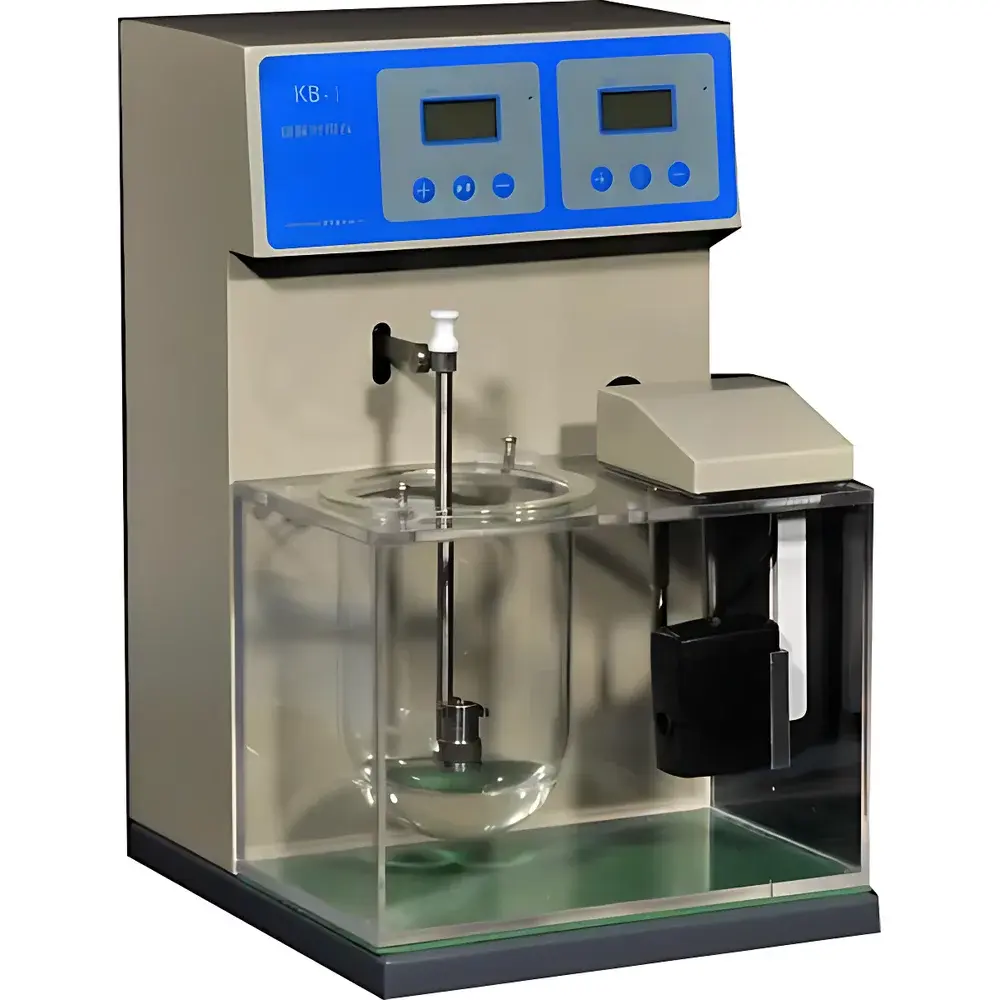
Jing Tuo KB-1 Oral Disintegrating Tablet (ODT) Disintegration Tester
| Brand | Jing Tuo Instrument |
|---|---|
| Origin | Tianjin, China |
| Manufacturer Type | Direct Manufacturer |
| Product Origin | Domestic (China) |
| Model | KB-1 |
| Price Range | USD 495 – 705 |
| Disintegration Basket | Stainless Steel, 30 mm Length, 13 mm Inner Diameter, 710 µm Aperture |
| Stroke Frequency | 30 cycles/min |
| Vertical Travel Distance | 10 mm ± 1 mm |
| Water Bath Temperature Range | Ambient to 45 °C |
| Temperature Control Accuracy | < ±0.5 °C |
Overview
The Jing Tuo KB-1 Oral Disintegrating Tablet (ODT) Disintegration Tester is a purpose-built laboratory instrument engineered for precise, pharmacopeia-compliant assessment of disintegration time in orally disintegrating tablet formulations. Designed in direct alignment with the draft amendment to the Chinese Pharmacopoeia (2015 Edition) — specifically the newly introduced monograph for ODT disintegration testing — the KB-1 implements a single-basket, single-vessel configuration optimized for visual clarity, operational reproducibility, and regulatory traceability. Unlike conventional disintegration testers used for standard compressed tablets, the KB-1 integrates design elements mandated for ODT evaluation: a geometrically defined stainless-steel basket with strict dimensional tolerances, a dedicated cylindrical test vessel replacing flat-bottomed beakers, and tightly regulated mechanical motion parameters. Its operating principle follows the immersion-and-lift cycle method, where the basket containing the ODT is vertically reciprocated through a thermostatically controlled aqueous medium at physiologically relevant temperatures (up to 45 °C), simulating oral cavity conditions. The instrument’s architecture prioritizes mechanical stability, thermal uniformity, and operator visibility — critical factors in subjective endpoint determination during manual observation.
Key Features
- Single-basket, single-vessel configuration ensures unobstructed optical access for real-time visual assessment of disintegration endpoints — essential for ODTs where partial disintegration or residue persistence must be accurately judged.
- Pharmacopeia-compliant disintegration basket fabricated from medical-grade stainless steel: precisely 30 mm in length, 13 mm inner diameter, and laser-drilled apertures of 710 µm nominal diameter — fully aligned with the dimensional specifications outlined in the draft ODT monograph.
- Dedicated cylindrical test vessel replaces generic beakers; engineered with standardized geometry and secure mounting interface to eliminate positional drift and ensure consistent immersion depth across repeated runs.
- Controlled vertical reciprocation mechanism delivers stable 30 cycles per minute with stroke amplitude maintained at 10 mm ± 1 mm — calibrated and verified per internal quality protocol to meet pharmacopeial repeatability requirements.
- Integrated water bath system offers programmable temperature control from ambient up to 45 °C, with digital PID regulation achieving thermal stability within ±0.5 °C across the entire test volume — critical for evaluating thermosensitive ODT formulations.
- Compact benchtop footprint and simplified user interface reduce training burden while supporting GLP-aligned documentation practices via timestamped operation logs.
Sample Compatibility & Compliance
The KB-1 is validated exclusively for oral disintegrating tablets as defined in the draft Chinese Pharmacopoeia (2015 Ed.) Chapter 0921. It supports all common ODT excipient systems, including mannitol-, sorbitol-, and microcrystalline cellulose-based matrices, and accommodates standard tablet diameters up to 13 mm. While not intended for enteric-coated or delayed-release dosage forms, its mechanical and thermal parameters are compatible with supplementary studies under ICH Q5C (stability testing) and USP General Chapter <701> Disintegration when adapted per validated protocols. The instrument’s construction materials comply with ISO 13485–aligned corrosion resistance standards, and its temperature calibration traceability aligns with ISO/IEC 17025 requirements for in-house verification.
Software & Data Management
The KB-1 operates via embedded microcontroller logic without external PC dependency. All operational parameters — start time, target temperature, duration, and cycle count — are set via intuitive front-panel controls and retained in non-volatile memory. Timestamped run records (date, time, temperature setpoint, actual bath temperature average, total cycles completed) are stored onboard for ≥100 tests and exportable via USB-C interface in CSV format. Audit trail functionality meets basic GLP data integrity expectations: each record includes operator ID field entry, immutable timestamps, and no post-hoc edit capability. While not 21 CFR Part 11 compliant out-of-the-box, the device supports integration into validated LIMS environments through standardized data output structure and optional firmware upgrade path.
Applications
- Regulatory submission support for ODT product registration in China, ASEAN, and other jurisdictions referencing the Chinese Pharmacopoeia.
- In-process quality control during ODT formulation development and scale-up, enabling rapid iteration of disintegrant type, concentration, and compression force.
- Stability-indicating disintegration profiling under accelerated and long-term storage conditions (e.g., 40 °C/75% RH).
- Comparative evaluation of generic ODT bioequivalence candidates against reference listed drugs.
- Method validation exercises per ICH Q2(R2), including specificity, repeatability, and intermediate precision assessments.
FAQ
Does the KB-1 comply with USP <701> or EP 2.9.1?
The KB-1 is designed to the Chinese Pharmacopoeia draft ODT specification. While its mechanical parameters fall within the broader ranges permitted by USP <701> and Ph. Eur. 2.9.1, formal compliance requires site-specific qualification per those chapters’ apparatus verification protocols.
Can the KB-1 accommodate multiple samples simultaneously?
No — it is a single-basket system optimized for focused observation and pharmacopeial alignment. Parallel testing requires multiple units or alternative multi-position platforms.
Is calibration certification included with shipment?
Each unit ships with a factory-issued calibration report covering temperature accuracy and stroke frequency, traceable to national metrology standards. On-site IQ/OQ documentation templates are provided upon request.
What maintenance is required?
Routine cleaning of the basket and vessel with deionized water after each use; annual verification of thermal uniformity and mechanical stroke using NIST-traceable tools is recommended.
Related Products





