
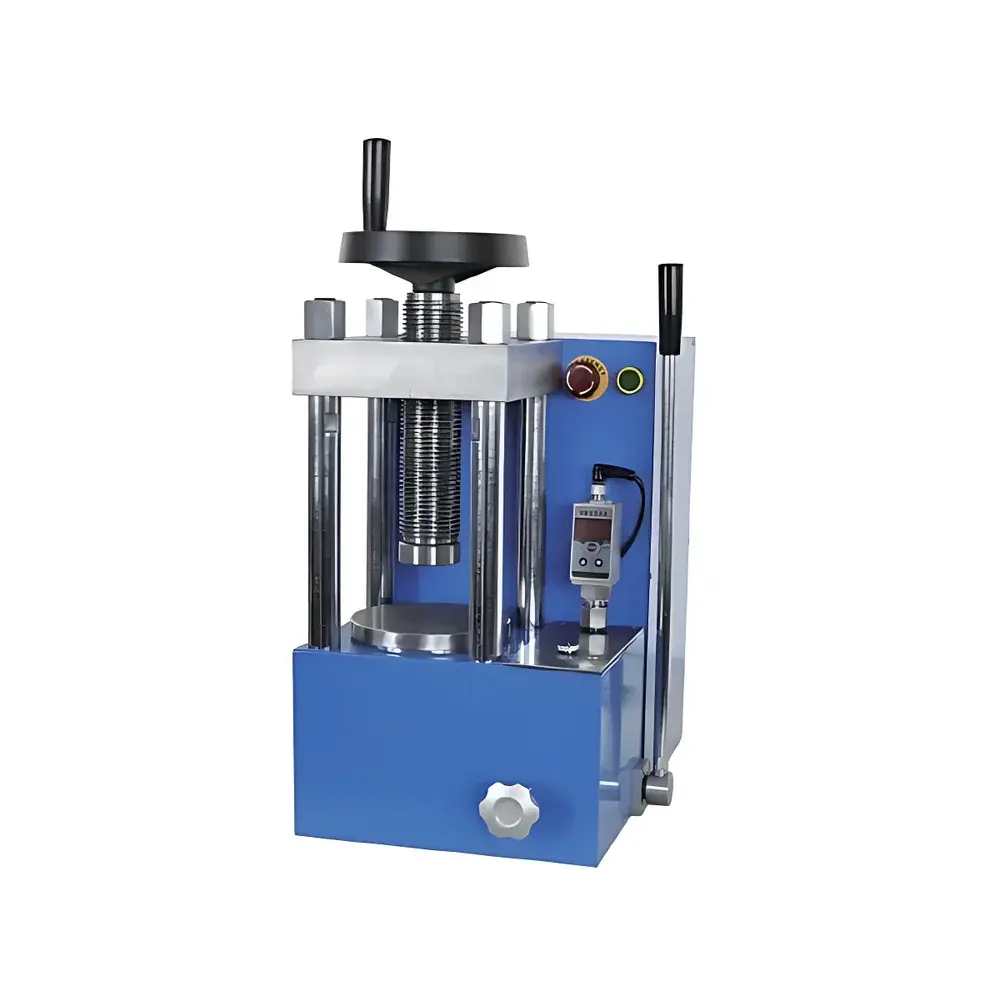
Jing Tuo PCD-40S 40-Ton Electric Powder Pellet Press
| Brand | Jing Tuo Instrument |
|---|---|
| Origin | Tianjin, China |
| Manufacturer Type | Direct Manufacturer |
| Country of Origin | China |
| Model | PCD-40S |
| Instrument Type | Semi-Automatic Pellet Press |
| Force Capacity | 40 Ton (392 kN) |
| Drive Method | Electric Motor with Hydraulic Amplification |
| Control Mode | Digital Panel with Preset Pressure & Hold Time |
Overview
The Jing Tuo PCD-40S is a semi-automatic electric powder pellet press engineered for reproducible, high-force consolidation of dry or binder-assisted powdered samples into mechanically stable discs suitable for spectroscopic, X-ray diffraction (XRD), and elemental analysis applications. It operates on a hybrid electromechanical–hydraulic principle: an electric motor drives a precision gear pump to generate hydraulic pressure, which is transmitted via a dual-cylinder system to the upper platen. This architecture delivers precise force control (±1.5% full scale) and stable dwell under load—critical for minimizing inter-sample density variation in quantitative analytical workflows. Designed for routine laboratory use, the PCD-40S complies with mechanical safety standards aligned with ISO 12100 and incorporates overload protection, emergency stop circuitry, and a guarded pressing chamber to meet general lab equipment risk assessment requirements.
Key Features
- Semi-automatic operation with programmable pressure setpoint (0–40 ton / 0–392 kN) and dwell time (0–999 s), enabling repeatable compression cycles without manual lever actuation.
- Digital LED control panel with real-time force display (kN) and elapsed hold time, supporting immediate verification of process parameters prior to ejection.
- Robust C-frame structural design fabricated from high-tensile steel, minimizing frame deflection during peak load and ensuring long-term calibration stability.
- Interchangeable die sets (standard Ø13 mm, Ø25 mm, and Ø32 mm; custom diameters available) with hardened stainless-steel construction (HRC ≥58) for resistance to abrasive powders including oxides, carbonates, and metal alloys.
- Integrated sample ejection mechanism with adjustable stroke depth, facilitating clean pellet release without manual tapping or secondary tooling.
- Low-noise electric drive system (<65 dB(A) at 1 m), eliminating hydraulic oil maintenance, leakage risks, and ambient temperature sensitivity associated with fully hydraulic units.
Sample Compatibility & Compliance
The PCD-40S accommodates a broad range of inorganic and organic powders—including geological sediments, pharmaceutical excipients, catalyst precursors, and ceramic green bodies—provided particle size distribution falls within typical analytical prep limits (D90 < 150 µm). For XRF and XRD pellet preparation, users commonly apply cellulose, boric acid, or wax binders at 5–10 wt% to enhance green strength. The instrument supports ASTM E1777 (Standard Practice for Preparation of Solid Samples for Spectrochemical Analysis) and ISO 12851 (X-ray fluorescence spectrometry — Sample preparation procedures). While not certified for GMP production environments, its documented operating parameters, repeatable force delivery, and absence of consumable fluids make it suitable for GLP-aligned QA/QC labs conducting method validation per ICH Q2(R2).
Software & Data Management
The PCD-40S operates as a standalone unit with no embedded software or network interface. All operational data—including target pressure, actual achieved force (recorded at peak), hold duration, and cycle count—are manually logged by the operator. To support audit readiness, laboratories integrate the press into broader data governance frameworks by pairing it with electronic lab notebooks (ELNs) or LIMS systems. Users may record metadata such as batch ID, operator initials, date/time stamp, and post-pressing pellet thickness (measured with calibrated digital micrometer) alongside each run. Though lacking FDA 21 CFR Part 11-compliant electronic signatures, the device’s deterministic mechanical behavior and traceable parameter inputs allow full reconstruction of pressing conditions during regulatory review.
Applications
- Preparation of homogeneous pellets for wavelength-dispersive X-ray fluorescence (WDXRF) and energy-dispersive XRF (EDXRF) analysis of ores, slags, soils, and cementitious materials.
- Production of flat, crack-free discs for X-ray diffraction phase identification and quantitative Rietveld refinement, especially where preferred orientation must be minimized through controlled compaction density.
- Consolidation of catalyst powders (e.g., Pt/Al2O3, zeolites) into monolithic forms for surface area (BET) or porosimetry testing.
- Routine tablet formation in pharmaceutical development labs for dissolution rate screening or excipient compatibility studies under non-GMP conditions.
- Manufacture of pressed standards and reference material blanks for calibration curve generation in trace elemental analysis.
FAQ
What is the maximum recommended working pressure for routine operation?
The rated capacity is 40 tons (392 kN); however, sustained operation above 36 tons (353 kN) is discouraged unless validated for specific die geometry and powder rheology to preserve long-term cylinder seal integrity.
Can the PCD-40S be used with evacuated or inert-atmosphere dies?
Yes—optional vacuum-compatible die holders (with O-ring grooves and stainless-steel clamping collars) are available as accessories; standard dies are rated for ambient air operation only.
Is calibration certification included with shipment?
A factory-verified force calibration report (traceable to NIM, China) is supplied; annual recalibration using certified load cells is recommended per ISO/IEC 17025 guidelines.
Does the unit require external cooling or compressed air?
No—no auxiliary utilities are required. The electric motor and hydraulic pump operate passively cooled; ambient temperature range: 10–35°C.
What maintenance intervals are specified for hydraulic oil replacement?
None—the system uses a sealed, lifetime-lubricated hydraulic circuit; only periodic visual inspection of hose integrity and electrical connections is required.



